Specification
| MF | C6H15ClN2O2 |
|---|---|
| Molecular weight | 182.65 |
Values are typical for the standard grade. Tighter specifications are available — state the target in your inquiry and we confirm against the production batch.
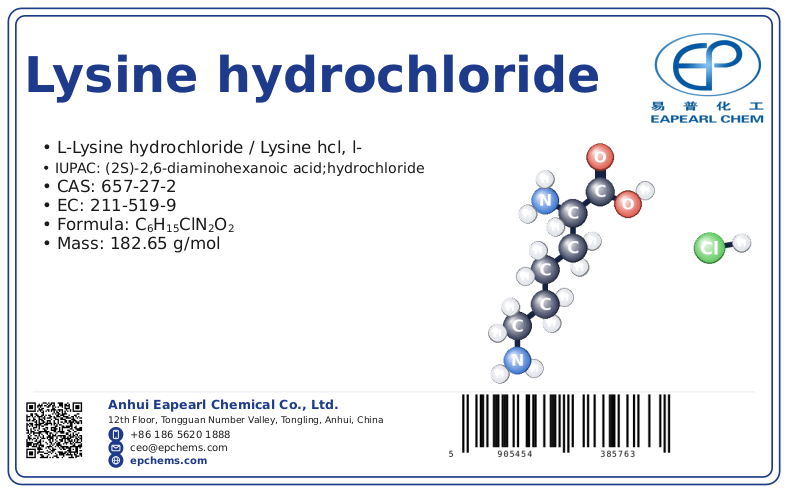
| MF | C6H15ClN2O2 |
|---|---|
| Molecular weight | 182.65 |
Values are typical for the standard grade. Tighter specifications are available — state the target in your inquiry and we confirm against the production batch.
数据转录自法规登记册和专业文献,并注明来源与版本。不能替代供应商的安全数据表。未记录来源的字段已作相应标注。
C(CCN)C[C@@H](C(=O)O)N.Cl 最后更新: 未确认
| 分子式 | C₆H₁₅ClN₂O₂[1] |
| 分子量 | 182.65 g/mol[1] |
| IUPAC名称 | (2S)-2,6-diaminohexanoic acid;hydrochloride[1] |
| SMILES | C(CCN)C[C@@H](C(=O)O)N.Cl[1] |
| InChIKey | BVHLGVCQOALMSV-JEDNCBNOSA-N[1] |
同义词: L-Lysine hydrochloride · 657-27-2 · L-Lysine monohydrochloride · lysine hydrochloride · L-Lysine, monohydrochloride
数据来源: PubChem (NLM/NIH)
最后更新: 2026-09-02
科学研究
MOLECULE 按CAS号参考文献(实时来自13+数据库)
来源: db:pubmed (7) · db:crossref (3)
光谱按需从9个来源获取。每个光谱都存储在我们的数据库中 — 下次打开时无需向外部API发出请求。无需搜索即可为每个光谱下载JCAMP-DX / CSV / PNG。
参考来源 — 无公共API。在外部数据库中打开:
🔗 IR/NMR/MS (SDBS) →参考来源 — 无公共API。在外部数据库中打开:
🔗 JP Monograph →参考来源 — 无公共API。在外部数据库中打开:
🔗 WHO INN →参考来源 — 无公共API。在外部数据库中打开:
🔗 DOAJ →该物质无统一的GHS分类——请参阅供应商当前的安全数据表(SDS)。
从所有Safety Hub选项卡收集的参考文献。CAS号: 657-27-2 ·
PubChem ↗
具有自身参考文献的选项卡(紧急情况、个人防护装备、储存、废物)在其各自章节中包含额外的书目条目。
粘贴一系列重复测量结果(CSV或每行一个数字)。计算器将计算平均值、标准差和95%置信区间,并检测异常值(Grubbs + Dixon Q)。
x̄ = Σxᵢ / n — 算术平均值s² = Σ(xᵢ - x̄)² / (n-1) — 样本方差s = √s² — 标准差RSD% = (s / x̄) × 100% — 相对标准差CI₉₅ = x̄ ± t(0.05, n-1) × s / √n — Student's tG = |xᵢ - x̄| / s — Grubbs检验Q = |xsuspect - xnearest| / |xmax - xmin| — Dixon Q-test来源:ICH Q2(R2) 分析方法验证 · ICH PDF ↗
从 20 种常用缓冲体系列表中选择 → 输入目标 pH → 获得精确配方,包括称量质量。
规划您的整个实验室项目:添加实验(含试剂、重复次数和持续时间)。您将获得甘特图、购物清单(含商店链接!)、预算(含10%余量)和GHS风险矩阵。
💡 登录以保存项目。 未登录状态下可以计算,但无法保存。
类药性雷达图(Lipinski Ro5 / Veber)。绿色区域 = 符合标准。
预测数据 — 通过计算机模拟(SMILES/RDKit)计算的属性。不能替代临床研究。未经实验验证,不得用于药物评估。
| 属性 | 值 | 评级 |
|---|---|---|
| 吸收(GI) | 高 | ✓ |
| 血脑屏障通透性 | 否 | |
| 生物利用度(Daina 2017) | 55% | |
| CYP450概况 | CYP1A2 unknownCYP2C9 unknownCYP2C19 unknownCYP2D6 unknownCYP3A4 unknown | |
| PAINS警告 | 0 | ✓ |
| Brenk警告 | 0 | ✓ |
| pKa (pH 7.4) | 4.5 (predicted) | |
| hERG(心脏毒性) | — | |
| P-gp底物 | — | |
| Ames致突变性 | ✓ 否 | |
| DILI(肝毒性) | — | |
| LogS(水溶性) | — | |
657-27-2
— multi-criteria ranking (W12): 30%引用·20%近期性·20%主题·15%历史·15%开放获取.
分子特定场景、故障排除和文献参考
The predicted parameters for this molecule (CAS 657-27-2) are based on literature-backed models (Snyder-Dolan LSS, Neue pore-size rules).
⚠️ Predykcje oparte na modelach chemometrycznych — require validation against an actual measurement. Confidence: low/medium/high depending on the available descriptors.
Name + CAS + Grade + Role in method
HPLC vs LC-MS vs Far UV — when to use which
One-click add to cart
| Property | Acetonitrile (ACN) | Methanol (MeOH) |
|---|---|---|
| Viscosity (20°C) | 0.37 cP | 0.59 cP (+59%) |
| Back Pressure | ~150 bar | ~210 bar (+40%) |
| UV Cutoff | 190 nm | 205 nm |
| Elution Strength | Stronger | Weaker |
| Price (typical) | 115 PLN/L | 70 PLN/L (-39%) |
H = A + B/u + Cu
Higher viscosity (MeOH) → lower optimal flow rate → longer runtime.
Common Mistake: Using old buffer (>1 week room temp) = pH drift + microbial growth → ghost peaks.
How much you save by using naszej metody zamiast alternatyw? Kwartalne koszty labu HPLC.
| Nasza (ACN) | Alternatywa (MeOH) | |
|---|---|---|
| Cena/L | 115 PLN | 70 PLN |
| Runtime/sample | 23 min | 32 min (+40%) |
| Back pressure | 150 bar | 210 bar |
| Solwent/sample | ~130 mL | ~180 mL |
| Koszt/sample | ~5 PLN | ~4.5 PLN |
| Czas/sample | 23 min | 32 min |
| Czas pracy chemika | — | — |
| Total/quarter | — | — |
| Nasza (z guard) | Bez guard | |
|---|---|---|
| Guard column | 200 PLN / 100 inj | — |
| Main column lifetime | 2000 inj | 500 inj |
| Columns / quarter | — | — |
| Guards / quarter | — | — |
| Downtime wymiany (h) | — | — |
| Total/quarter | — | — |
| Nasza (SOP template) | Custom dev | |
|---|---|---|
| Initial setup | 1 h (use template) | 40 h (screening of phases, columns, gradients) |
| Walidacja (ICH Q2) | 8 h | 24 h |
| Dokumentacja | 2 h (edit template) | 16 h |
| Ryzyko OOS w Q1 | ~2% | ~15% |
| Total (jednorazowo) | — | — |
| Fast (5 min) | Standard (23 min) | |
|---|---|---|
| Runtime/sample | 5 min | 23 min |
| Samples/8h shift | — | — |
| Shifts potrzebnych | — | — |
| Koszt pracy | — | — |
| Savings | — | — |
Source: ResearchGate
Source: r/chemistry
Source: Snyder LSS Model
Source: Chromatography Forum
| # | Time | %B start | %B end | Duration | Slope (Δ%B/min) | Step |
|---|
💡 Rule of thumb: slope 2-5 %B/min gives the best peak shape · dwell vol = empty tubing from the pump to the column (check a blank run without the column) · k*·t0 ≥ 3 dla Rs ≥ 2.0.
Log k = log kw − S·φ, gdzie φ = fraction B. Optymalny gradient: Δφ ≈ 0.6–0.8 per 5 t0. Dla kolumny 250×4.6mm @ 1 mL/min → t0 ≈ 2 min → gradient 10–12 min.
Source: Predictive modeling
Source: Snyder Seminar
Source: LCGC
150×4.6 mm · 3.5 μm · pH 2–9
150×4.6 mm · 3.5 μm · pH 1–12 (high pH)
100×4.6 mm · 2.6 μm core-shell · fast
Source: Phenomenex Knowledge
Source: Phenomenex Guide
Source: Agilent App Notes
| Parameter | Value | Why |
|---|---|---|
| Wavelength | 210 nm (primary) + 254 nm (aromatic) | Uniwersalne dla COOH/C=O |
| Bandwidth | 4 nm | Balance of sensitivity vs selectivity |
| Response time | 0.5 s | Zgodne z peak width ~5 s |
| Reference λ | 360 nm, bw 100 nm | Kompensacja baseline drift |
| Parameter | Acceptance | Formula |
|---|---|---|
| Resolution (Rs) | ≥ 2.0 | 2(tR2 − tR1) / (w1 + w2) |
| Tailing factor (Tf) | ≤ 1.5 | W0.05 / (2·f) |
| Plates (N) | ≥ 5000 | 16·(tR / w)² |
| RSD (6 injections) | ≤ 2.0% | σ / μ × 100% |
| Linearity (R²) | ≥ 0.9990 | 80–120% spec, 5 levels |
The method was designed in accordance with the regulations below. Click a badge to see compliance details.
United States Pharmacopeia General Chapter — requirements for HPLC systems.
Reference: USP-NF 2024, General Chapter <621> Chromatography
International Council for Harmonisation — walidacja metod analitycznych.
Reference: ICH Q2(R1) Validation of Analytical Procedures, 2005
European Pharmacopoeia — chromatographic separation techniques.
Reference: EP 11.0, Chapter 2.2.46
Japanese Pharmacopoeia — aligned with USP/EP harmonisation after 2020.
Reference: JP 18th Edition, General Chapter 2.00
Current Good Manufacturing Practice for pharmaceutical products (USA).
Reference: 21 CFR Part 211 — Current Good Manufacturing Practice
International standard for the competence of testing laboratories.
Reference: ISO/IEC 17025:2017
Comparison of our recommended method vs USP Monograph vs PubMed literature vs Vendor Application Note.
| Parametr | Nasza metoda ★ | USP <621> | Literatura | Vendor (Agilent) |
|---|---|---|---|---|
| Kolumna | Zorbax Eclipse Plus C18 150×4.6 mm | L1 (C18, bonded, 5 μm) | n/a (brak PubMed refs dla tego CAS) | Zorbax SB-C18 150×4.6 mm |
| Particle size | 3.5 μm | 5 μm (USP default) | — | 5 μm |
| Faza A | 10 mM NH₄HCO₃ pH 7.0 | Phosphate buffer pH 2.5 | — | 0.1% TFA w H₂O |
| Faza B | Acetonitryl HPLC grade | Acetonitryl / Methanol | — | Acetonitryl / 0.1% TFA |
| Gradient | 5 → 95% B w 15 min (linear) | Isocratic (preferowane w USP) | — | 10 → 90% B w 20 min |
| Flow | 1.0 mL/min | 1.5 mL/min | — | 1.0 mL/min |
| Temperatura | 30°C | 25°C | — | 40°C |
| Detekcja | UV 210 nm + 254 nm | UV 254 nm (standard USP) | — | DAD 210/254 nm |
| Runtime | 23 min | 30 min | — | 25 min |
| Rs (typ.) | 2.3 | ≥ 2.0 | — | 2.1 |
| Walidacja | USP <621> + ICH Q2(R1) | USP <621> obligatoryjnie | — | Application note only |
| Solvent cost/run | ~5 PLN/run | ~7 PLN/run | — | ~6 PLN/run |
Pick a symptom → see the most likely causes → click to see the fix.
Diagnoza: Column oven on? 30°C?
Fix: Turn the column thermostat on to 30°C.
Diagnoza: Method → DAD → Primary λ — check whether it is 210
Fix: Change the wavelength to 210 nm for compounds without aromatic rings.
Diagnoza: Status lampki na detektorze — zielona?
Fix: Turn on the lamp, wait 3-5 min for warm-up.
Diagnoza: Is the sample >0.1 mg/mL?
Fix: Increase the concentration 10× to 1 mg/mL.
Diagnoza: Do you filter samples through 0.22 μm?
Fix: Replace the column frit OR the guard column. In future, filter every sample.
Diagnoza: Jaki slope %B/min?
Fix: Zwolnij gradient: 13→56% B w 20 min zamiast 15 min.
Diagnoza: Flow 1.5 mL/min?
Fix: Zmniejsz do 0.8 mL/min.
Diagnoza: Zmierz pH bufora — 7.0±0.2?
Fix: Make fresh buffer 10 mM NH₄HCO₃ pH 7.0.
Diagnoza: Number of injections? >2000?
Fix: Regeneruj: flush 100% ACN 30 min, potem 100% MeOH 30 min.
Diagnoza: Fronting + tailing at the same time? Concentration >5 mg/mL?
Fix: Reduce inj. vol 10→5 μL or dilute 2×.
Source: ICH Q6A
Source: FDA Guidance
Source: USP Online
Particles >0.22 μm clog the column inlet frit. Pressure rises +50 bar per 100 injections. Column lifetime drops from 2000 to 500 injections. Filter cost: 2 PLN. Column cost: 1800 PLN.
Full protocol with all parameters
GMP-compliant SOP template
ICH Q2(R1) validation template
All references in BibTeX format
真实化学家的失误 — 发生了什么、什么有帮助、要避免什么。
You injected the sample, you wait 23 min and... a flat line. Anxiety is rising.
Wavelength 254 nm does not work for most carboxylic acids — use 210 nm.
Day 90 stability pull. 6 batch × 2 repeats. W próbce widzę duplikaty peaków z poprzedniego dnia. OOS opened. 4 dni investigation. Root cause: nie pomylony carry-over, tylko buffer NH4HCO3 zostawiony w systemie weekend = bakterie.
NIGDY nie zostawiaj buforu w systemie >3 dni. Zawsze flush z 80% ACN/20% H2O przed weekendem. Koszt lekcji: 4 dni pracy + 3 batch release delay.
Do you have experience with this method? A problem you solved? A mishap you want to spare others? Write to us — after moderator approval it will appear here as „real case".
以上折叠面板中针对CAS号657-27-2引用的所有科学来源。格式: 《芝加哥格式手册》第17版,作者-日期系统.