Specification
| MF | C6H15ClN2O2 |
|---|---|
| Molecular weight | 182.65 |
Values are typical for the standard grade. Tighter specifications are available — state the target in your inquiry and we confirm against the production batch.
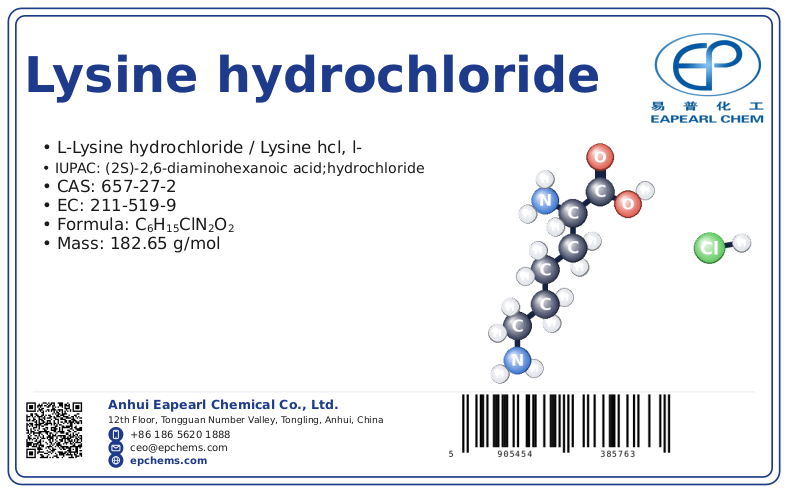
| MF | C6H15ClN2O2 |
|---|---|
| Molecular weight | 182.65 |
Values are typical for the standard grade. Tighter specifications are available — state the target in your inquiry and we confirm against the production batch.
Dati trascritti da registri normativi e letteratura tecnica, con indicazione della fonte e dell'edizione. Non sostituiscono la scheda di dati di sicurezza del fornitore. I campi privi di fonte registrata sono contrassegnati come tali.
C(CCN)C[C@@H](C(=O)O)N.Cl Ultimo aggiornamento: non confermata
| Formula molecolare | C₆H₁₅ClN₂O₂[1] |
| Peso molecolare | 182.65 g/mol[1] |
| Nome IUPAC | (2S)-2,6-diaminohexanoic acid;hydrochloride[1] |
| SMILES | C(CCN)C[C@@H](C(=O)O)N.Cl[1] |
| InChIKey | BVHLGVCQOALMSV-JEDNCBNOSA-N[1] |
Sinonimi: L-Lysine hydrochloride · 657-27-2 · L-Lysine monohydrochloride · lysine hydrochloride · L-Lysine, monohydrochloride
Fonti dei dati: PubChem (NLM/NIH)
Ultimo aggiornamento: 2026-09-02
RICERCA SCIENTIFICA
MOLECULE Bibliografia per-CAS (live da 13+ banche dati)
Fonti: db:pubmed (7) · db:crossref (3)
Gli spettri vengono recuperati su richiesta da 9 fonti. Ogni spettro viene salvato nel nostro database — l'apertura successiva = zero richieste all'API esterna. Scarica JCAMP-DX / CSV / PNG per ogni spettro senza dover cercare.
Fonte di riferimento — nessuna API pubblica. Apri nella banca dati esterna:
🔗 IR/NMR/MS (SDBS) →Fonte di riferimento — nessuna API pubblica. Apri nella banca dati esterna:
🔗 JP Monograph →Fonte di riferimento — nessuna API pubblica. Apri nella banca dati esterna:
🔗 WHO INN →Fonte di riferimento — nessuna API pubblica. Apri nella banca dati esterna:
🔗 DOAJ →Nessuna classificazione GHS armonizzata per questa sostanza — vedere la scheda di dati di sicurezza (SDS) aggiornata del fornitore.
Riferimenti raccolti da tutte le schede del Safety Hub. CAS: 657-27-2 ·
PubChem ↗
Le schede con riferimenti propri (Emergency, PPE, Storage, Waste) contengono ulteriori voci bibliografiche all'interno delle rispettive sezioni.
Incolla una serie di misure replicate (CSV oppure un numero per riga). Il calcolatore calcolerà la media, la deviazione standard e il 95% CI, e rileverà gli outlier (Grubbs + Dixon Q).
x̄ = Σxᵢ / n — media aritmeticas² = Σ(xᵢ - x̄)² / (n-1) — varianza campionarias = √s² — deviazione standardRSD% = (s / x̄) × 100% — deviazione standard relativaCI₉₅ = x̄ ± t(0.05, n-1) × s / √n — Student's tG = |xᵢ - x̄| / s — test di GrubbsQ = |xsuspect - xnearest| / |xmax - xmin| — Dixon Q-testFonte: ICH Q2(R2) Validation of Analytical Procedures · ICH PDF ↗
Scegli un tampone dall'elenco di 20 sistemi popolari → inserisci il pH target → otterrai una ricetta esatta con le masse da pesare.
Pianifica l'intero progetto di laboratorio: aggiungi esperimenti con reagenti, repliche e durata. Otterrai un diagramma di Gantt, una lista degli acquisti (con link al negozio!), un budget con un margine del 10% e una matrice dei rischi GHS.
💡 Accedi per salvare i progetti. Senza effettuare l'accesso puoi calcolare, ma non salvare.
Grafico radar di drug-likeness (Lipinski Ro5 / Veber). Zona verde = conformità ai criteri.
Dati predittivi — proprietà calcolate in silico (SMILES/RDKit). Non sostituiscono gli studi clinici. Non utilizzare per la valutazione di farmaci senza verifica sperimentale.
| Proprietà | Valore | Valutazione |
|---|---|---|
| Absorption (GI) | alto | ✓ |
| Permeabilità BBB | no | |
| Biodisponibilità (Daina 2017) | 55% | |
| CYP450 profile | CYP1A2 unknownCYP2C9 unknownCYP2C19 unknownCYP2D6 unknownCYP3A4 unknown | |
| Allerte PAINS | 0 | ✓ |
| Allerte Brenk | 0 | ✓ |
| pKa (pH 7.4) | 4.5 (predicted) | |
| hERG (cardiotox.) | — | |
| Substrato P-gp | — | |
| Mutagenicità Ames | ✓ no | |
| DILI (epatotox.) | — | |
| LogS (solub. acq.) | — | |
657-27-2
— multi-criteria ranking (W12): 30% citazioni · 20% recency · 20% topic · 15% historical · 15% open access.
Scenari specifici per la molecola, risoluzione dei problemi e riferimenti bibliografici
The predicted parameters for this molecule (CAS 657-27-2) are based on literature-backed models (Snyder-Dolan LSS, Neue pore-size rules).
⚠️ Predykcje oparte na modelach chemometrycznych — require validation against an actual measurement. Confidence: low/medium/high depending on the available descriptors.
Name + CAS + Grade + Role in method
HPLC vs LC-MS vs Far UV — when to use which
One-click add to cart
| Property | Acetonitrile (ACN) | Methanol (MeOH) |
|---|---|---|
| Viscosity (20°C) | 0.37 cP | 0.59 cP (+59%) |
| Back Pressure | ~150 bar | ~210 bar (+40%) |
| UV Cutoff | 190 nm | 205 nm |
| Elution Strength | Stronger | Weaker |
| Price (typical) | 115 PLN/L | 70 PLN/L (-39%) |
H = A + B/u + Cu
Higher viscosity (MeOH) → lower optimal flow rate → longer runtime.
Common Mistake: Using old buffer (>1 week room temp) = pH drift + microbial growth → ghost peaks.
How much you save by using naszej metody zamiast alternatyw? Kwartalne koszty labu HPLC.
| Nasza (ACN) | Alternatywa (MeOH) | |
|---|---|---|
| Cena/L | 115 PLN | 70 PLN |
| Runtime/sample | 23 min | 32 min (+40%) |
| Back pressure | 150 bar | 210 bar |
| Solwent/sample | ~130 mL | ~180 mL |
| Koszt/sample | ~5 PLN | ~4.5 PLN |
| Czas/sample | 23 min | 32 min |
| Czas pracy chemika | — | — |
| Total/quarter | — | — |
| Nasza (z guard) | Bez guard | |
|---|---|---|
| Guard column | 200 PLN / 100 inj | — |
| Main column lifetime | 2000 inj | 500 inj |
| Columns / quarter | — | — |
| Guards / quarter | — | — |
| Downtime wymiany (h) | — | — |
| Total/quarter | — | — |
| Nasza (SOP template) | Custom dev | |
|---|---|---|
| Initial setup | 1 h (use template) | 40 h (screening of phases, columns, gradients) |
| Walidacja (ICH Q2) | 8 h | 24 h |
| Dokumentacja | 2 h (edit template) | 16 h |
| Ryzyko OOS w Q1 | ~2% | ~15% |
| Total (jednorazowo) | — | — |
| Fast (5 min) | Standard (23 min) | |
|---|---|---|
| Runtime/sample | 5 min | 23 min |
| Samples/8h shift | — | — |
| Shifts potrzebnych | — | — |
| Koszt pracy | — | — |
| Savings | — | — |
Source: r/chemistry
Source: ResearchGate
Source: Chromatography Forum
Source: Snyder LSS Model
| # | Time | %B start | %B end | Duration | Slope (Δ%B/min) | Step |
|---|
💡 Rule of thumb: slope 2-5 %B/min gives the best peak shape · dwell vol = empty tubing from the pump to the column (check a blank run without the column) · k*·t0 ≥ 3 dla Rs ≥ 2.0.
Log k = log kw − S·φ, gdzie φ = fraction B. Optymalny gradient: Δφ ≈ 0.6–0.8 per 5 t0. Dla kolumny 250×4.6mm @ 1 mL/min → t0 ≈ 2 min → gradient 10–12 min.
Source: Snyder Seminar
Source: Predictive modeling
Source: LCGC
150×4.6 mm · 3.5 μm · pH 2–9
150×4.6 mm · 3.5 μm · pH 1–12 (high pH)
100×4.6 mm · 2.6 μm core-shell · fast
Source: Phenomenex Guide
Source: Phenomenex Knowledge
Source: Agilent App Notes
| Parameter | Value | Why |
|---|---|---|
| Wavelength | 210 nm (primary) + 254 nm (aromatic) | Uniwersalne dla COOH/C=O |
| Bandwidth | 4 nm | Balance of sensitivity vs selectivity |
| Response time | 0.5 s | Zgodne z peak width ~5 s |
| Reference λ | 360 nm, bw 100 nm | Kompensacja baseline drift |
| Parameter | Acceptance | Formula |
|---|---|---|
| Resolution (Rs) | ≥ 2.0 | 2(tR2 − tR1) / (w1 + w2) |
| Tailing factor (Tf) | ≤ 1.5 | W0.05 / (2·f) |
| Plates (N) | ≥ 5000 | 16·(tR / w)² |
| RSD (6 injections) | ≤ 2.0% | σ / μ × 100% |
| Linearity (R²) | ≥ 0.9990 | 80–120% spec, 5 levels |
The method was designed in accordance with the regulations below. Click a badge to see compliance details.
United States Pharmacopeia General Chapter — requirements for HPLC systems.
Reference: USP-NF 2024, General Chapter <621> Chromatography
International Council for Harmonisation — walidacja metod analitycznych.
Reference: ICH Q2(R1) Validation of Analytical Procedures, 2005
European Pharmacopoeia — chromatographic separation techniques.
Reference: EP 11.0, Chapter 2.2.46
Japanese Pharmacopoeia — aligned with USP/EP harmonisation after 2020.
Reference: JP 18th Edition, General Chapter 2.00
Current Good Manufacturing Practice for pharmaceutical products (USA).
Reference: 21 CFR Part 211 — Current Good Manufacturing Practice
International standard for the competence of testing laboratories.
Reference: ISO/IEC 17025:2017
Comparison of our recommended method vs USP Monograph vs PubMed literature vs Vendor Application Note.
| Parametr | Nasza metoda ★ | USP <621> | Literatura | Vendor (Agilent) |
|---|---|---|---|---|
| Kolumna | Zorbax Eclipse Plus C18 150×4.6 mm | L1 (C18, bonded, 5 μm) | n/a (brak PubMed refs dla tego CAS) | Zorbax SB-C18 150×4.6 mm |
| Particle size | 3.5 μm | 5 μm (USP default) | — | 5 μm |
| Faza A | 10 mM NH₄HCO₃ pH 7.0 | Phosphate buffer pH 2.5 | — | 0.1% TFA w H₂O |
| Faza B | Acetonitryl HPLC grade | Acetonitryl / Methanol | — | Acetonitryl / 0.1% TFA |
| Gradient | 5 → 95% B w 15 min (linear) | Isocratic (preferowane w USP) | — | 10 → 90% B w 20 min |
| Flow | 1.0 mL/min | 1.5 mL/min | — | 1.0 mL/min |
| Temperatura | 30°C | 25°C | — | 40°C |
| Detekcja | UV 210 nm + 254 nm | UV 254 nm (standard USP) | — | DAD 210/254 nm |
| Runtime | 23 min | 30 min | — | 25 min |
| Rs (typ.) | 2.3 | ≥ 2.0 | — | 2.1 |
| Walidacja | USP <621> + ICH Q2(R1) | USP <621> obligatoryjnie | — | Application note only |
| Solvent cost/run | ~5 PLN/run | ~7 PLN/run | — | ~6 PLN/run |
Pick a symptom → see the most likely causes → click to see the fix.
Diagnoza: Column oven on? 30°C?
Fix: Turn the column thermostat on to 30°C.
Diagnoza: Method → DAD → Primary λ — check whether it is 210
Fix: Change the wavelength to 210 nm for compounds without aromatic rings.
Diagnoza: Status lampki na detektorze — zielona?
Fix: Turn on the lamp, wait 3-5 min for warm-up.
Diagnoza: Is the sample >0.1 mg/mL?
Fix: Increase the concentration 10× to 1 mg/mL.
Diagnoza: Do you filter samples through 0.22 μm?
Fix: Replace the column frit OR the guard column. In future, filter every sample.
Diagnoza: Jaki slope %B/min?
Fix: Zwolnij gradient: 13→56% B w 20 min zamiast 15 min.
Diagnoza: Flow 1.5 mL/min?
Fix: Zmniejsz do 0.8 mL/min.
Diagnoza: Zmierz pH bufora — 7.0±0.2?
Fix: Make fresh buffer 10 mM NH₄HCO₃ pH 7.0.
Diagnoza: Number of injections? >2000?
Fix: Regeneruj: flush 100% ACN 30 min, potem 100% MeOH 30 min.
Diagnoza: Fronting + tailing at the same time? Concentration >5 mg/mL?
Fix: Reduce inj. vol 10→5 μL or dilute 2×.
Source: USP Online
Source: FDA Guidance
Source: ICH Q6A
Particles >0.22 μm clog the column inlet frit. Pressure rises +50 bar per 100 injections. Column lifetime drops from 2000 to 500 injections. Filter cost: 2 PLN. Column cost: 1800 PLN.
Full protocol with all parameters
GMP-compliant SOP template
ICH Q2(R1) validation template
All references in BibTeX format
Veri incidenti di chimici — cosa è successo, cosa ha aiutato, cosa evitare.
Q1 audit: column cost +340% vs Q4. QA blamed the lab. Investigation: a new operator was using a 0.45 μm filter instead of 0.22 μm. Microparticles got through the guard and were killing the main columns by the 100th injection.
The filter SOP must be WRITTEN and checked every batch. 0.22 μm is the standard per USP . Cost of the error: 10 columns × 1800 PLN = 18,000 PLN + audit finding.
You injected the sample, you wait 23 min and... a flat line. Anxiety is rising.
Wavelength 254 nm does not work for most carboxylic acids — use 210 nm.
Do you have experience with this method? A problem you solved? A mishap you want to spare others? Write to us — after moderator approval it will appear here as „real case".
Tutte le fonti scientifiche citate negli accordion sopra per il CAS 657-27-2.Formato: Chicago Manual of Style 17ª ed., sistema Author-Date.