Specification
| MF | C6H15ClN2O2 |
|---|---|
| Molecular weight | 182.65 |
Values are typical for the standard grade. Tighter specifications are available — state the target in your inquiry and we confirm against the production batch.
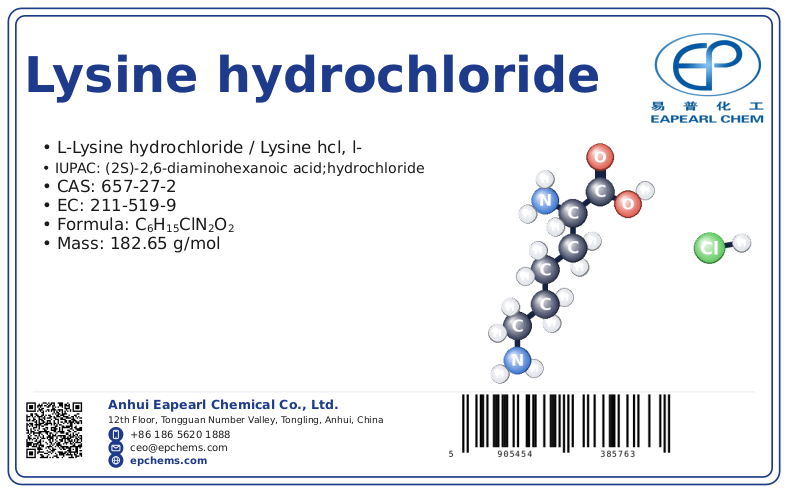
| MF | C6H15ClN2O2 |
|---|---|
| Molecular weight | 182.65 |
Values are typical for the standard grade. Tighter specifications are available — state the target in your inquiry and we confirm against the production batch.
Dane transkrybowane z rejestrów regulacyjnych i literatury fachowej, z podaniem źródła i wydania. Nie zastępują karty charakterystyki dostawcy. Pola bez zapisanego źródła oznaczone jako takie.
C(CCN)C[C@@H](C(=O)O)N.Cl Ostatnia aktualizacja: niepotwierdzona
| Wzór sumaryczny | C₆H₁₅ClN₂O₂[1] |
| Masa cząsteczkowa | 182.65 g/mol[1] |
| Nazwa IUPAC | (2S)-2,6-diaminohexanoic acid;hydrochloride[1] |
| SMILES | C(CCN)C[C@@H](C(=O)O)N.Cl[1] |
| InChIKey | BVHLGVCQOALMSV-JEDNCBNOSA-N[1] |
Synonimy: L-Lysine hydrochloride · 657-27-2 · L-Lysine monohydrochloride · lysine hydrochloride · L-Lysine, monohydrochloride
Data sources: PubChem (NLM/NIH)
Last updated: 2026-09-02
BADANIA NAUKOWE
MOLECULE Bibliografia per-CAS (live z 13+ baz)
Źródła: db:pubmed (7) · db:crossref (3)
Widma pobierane na żądanie z 9 źródeł. Każde widmo jest zapisywane w naszej bazie — kolejne otwarcie = zero zapytania do zewnętrznego API. Pobierz JCAMP-DX / CSV / PNG przy każdym widmie bez szukania.
Źródło referencyjne — brak publicznego API. Otwórz w zewnętrznej bazie:
🔗 IR/NMR/MS (SDBS) →Źródło referencyjne — brak publicznego API. Otwórz w zewnętrznej bazie:
🔗 JP Monograph →Źródło referencyjne — brak publicznego API. Otwórz w zewnętrznej bazie:
🔗 WHO INN →Źródło referencyjne — brak publicznego API. Otwórz w zewnętrznej bazie:
🔗 DOAJ →Brak zharmonizowanej klasyfikacji GHS dla tej substancji — patrz aktualna karta charakterystyki (SDS) dostawcy.
Referencje zebrane ze wszystkich zakładek Safety Hub. CAS: 657-27-2 ·
PubChem ↗
Zakładki z własnymi referencjami (Emergency, PPE, Storage, Waste) zawierają dodatkowe pozycje bibliograficzne wewnątrz swoich sekcji.
Wklej serię powtórzeń pomiarów (CSV lub po jednej liczbie w linii). Kalkulator policzy średnią, odchylenie, 95% CI, wykryje outliery (Grubbs + Dixon Q).
x̄ = Σxᵢ / n — średnia arytmetycznas² = Σ(xᵢ - x̄)² / (n-1) — wariancja próbys = √s² — odchylenie standardoweRSD% = (s / x̄) × 100% — względne odchylenieCI₉₅ = x̄ ± t(0.05, n-1) × s / √n — Student's tG = |xᵢ - x̄| / s — test GrubbsaQ = |xsuspect - xnearest| / |xmax - xmin| — Dixon Q-testŹródło: ICH Q2(R2) Validation of Analytical Procedures · ICH PDF ↗
Wybierz bufor z listy 20 popularnych systemów → wprowadź docelowe pH → otrzymasz dokładny przepis z masami do odważenia.
Zaplanuj cały projekt laboratoryjny: dodaj eksperymenty z reagentami, powtórzeniami i czasem trwania. Otrzymasz wykres Gantta, listę zakupów (linki do sklepu!), budżet z 10% marginesem i macierz ryzyka GHS.
💡 Zaloguj się, aby zapisywać projekty. Bez logowania możesz kalkulować, ale nie zapisać.
Wykres radarowy drug-likeness (Lipinski Ro5 / Veber). Strefa zielona = zgodność z kryteriami.
Dane predykcyjne — właściwości obliczone in silico (SMILES/RDKit). Nie zastępują badań klinicznych. Nie używaj do oceny leków bez weryfikacji eksperymentalnej.
| Właściwość | Wartość | Ocena |
|---|---|---|
| Wchłanianie (GI) | wysokie | ✓ |
| Przepuszczalność BBB | nie | |
| Biodostępność (Daina 2017) | 55% | |
| Profil CYP450 | CYP1A2 unknownCYP2C9 unknownCYP2C19 unknownCYP2D6 unknownCYP3A4 unknown | |
| Alerty PAINS | 0 | ✓ |
| Alerty Brenka | 0 | ✓ |
| pKa (pH 7.4) | 4.5 (predicted) | |
| hERG (kardiotoks.) | — | |
| P-gp substrat | — | |
| Ames mutagenność | ✓ nie | |
| DILI (wątrobok.) | — | |
| LogS (rozp. wod.) | — | |
657-27-2
— multi-criteria ranking (W12): 30% cytowania · 20% recency · 20% topic · 15% historical · 15% open access.
Scenariusze specyficzne dla cząsteczki, rozwiązywanie problemów i odniesienia literaturowe
The predicted parameters for this molecule (CAS 657-27-2) are based on literature-backed models (Snyder-Dolan LSS, Neue pore-size rules).
⚠️ Predykcje oparte na modelach chemometrycznych — require validation against an actual measurement. Confidence: low/medium/high depending on the available descriptors.
Name + CAS + Grade + Role in method
HPLC vs LC-MS vs Far UV — when to use which
One-click add to cart
| Property | Acetonitrile (ACN) | Methanol (MeOH) |
|---|---|---|
| Viscosity (20°C) | 0.37 cP | 0.59 cP (+59%) |
| Back Pressure | ~150 bar | ~210 bar (+40%) |
| UV Cutoff | 190 nm | 205 nm |
| Elution Strength | Stronger | Weaker |
| Price (typical) | 115 PLN/L | 70 PLN/L (-39%) |
H = A + B/u + Cu
Higher viscosity (MeOH) → lower optimal flow rate → longer runtime.
Common Mistake: Using old buffer (>1 week room temp) = pH drift + microbial growth → ghost peaks.
How much you save by using naszej metody zamiast alternatyw? Kwartalne koszty labu HPLC.
| Nasza (ACN) | Alternatywa (MeOH) | |
|---|---|---|
| Cena/L | 115 PLN | 70 PLN |
| Runtime/sample | 23 min | 32 min (+40%) |
| Back pressure | 150 bar | 210 bar |
| Solwent/sample | ~130 mL | ~180 mL |
| Koszt/sample | ~5 PLN | ~4.5 PLN |
| Czas/sample | 23 min | 32 min |
| Czas pracy chemika | — | — |
| Total/quarter | — | — |
| Nasza (z guard) | Bez guard | |
|---|---|---|
| Guard column | 200 PLN / 100 inj | — |
| Main column lifetime | 2000 inj | 500 inj |
| Columns / quarter | — | — |
| Guards / quarter | — | — |
| Downtime wymiany (h) | — | — |
| Total/quarter | — | — |
| Nasza (SOP template) | Custom dev | |
|---|---|---|
| Initial setup | 1 h (use template) | 40 h (screening of phases, columns, gradients) |
| Walidacja (ICH Q2) | 8 h | 24 h |
| Dokumentacja | 2 h (edit template) | 16 h |
| Ryzyko OOS w Q1 | ~2% | ~15% |
| Total (jednorazowo) | — | — |
| Fast (5 min) | Standard (23 min) | |
|---|---|---|
| Runtime/sample | 5 min | 23 min |
| Samples/8h shift | — | — |
| Shifts potrzebnych | — | — |
| Koszt pracy | — | — |
| Savings | — | — |
Source: ResearchGate
Source: Chromatography Forum
Source: Snyder LSS Model
Source: r/chemistry
| # | Time | %B start | %B end | Duration | Slope (Δ%B/min) | Step |
|---|
💡 Rule of thumb: slope 2-5 %B/min gives the best peak shape · dwell vol = empty tubing from the pump to the column (check a blank run without the column) · k*·t0 ≥ 3 dla Rs ≥ 2.0.
Log k = log kw − S·φ, gdzie φ = fraction B. Optymalny gradient: Δφ ≈ 0.6–0.8 per 5 t0. Dla kolumny 250×4.6mm @ 1 mL/min → t0 ≈ 2 min → gradient 10–12 min.
Source: Snyder Seminar
Source: Predictive modeling
Source: LCGC
150×4.6 mm · 3.5 μm · pH 2–9
150×4.6 mm · 3.5 μm · pH 1–12 (high pH)
100×4.6 mm · 2.6 μm core-shell · fast
Source: Agilent App Notes
Source: Phenomenex Guide
Source: Phenomenex Knowledge
| Parameter | Value | Why |
|---|---|---|
| Wavelength | 210 nm (primary) + 254 nm (aromatic) | Uniwersalne dla COOH/C=O |
| Bandwidth | 4 nm | Balance of sensitivity vs selectivity |
| Response time | 0.5 s | Zgodne z peak width ~5 s |
| Reference λ | 360 nm, bw 100 nm | Kompensacja baseline drift |
| Parameter | Acceptance | Formula |
|---|---|---|
| Resolution (Rs) | ≥ 2.0 | 2(tR2 − tR1) / (w1 + w2) |
| Tailing factor (Tf) | ≤ 1.5 | W0.05 / (2·f) |
| Plates (N) | ≥ 5000 | 16·(tR / w)² |
| RSD (6 injections) | ≤ 2.0% | σ / μ × 100% |
| Linearity (R²) | ≥ 0.9990 | 80–120% spec, 5 levels |
The method was designed in accordance with the regulations below. Click a badge to see compliance details.
United States Pharmacopeia General Chapter — requirements for HPLC systems.
Reference: USP-NF 2024, General Chapter <621> Chromatography
International Council for Harmonisation — walidacja metod analitycznych.
Reference: ICH Q2(R1) Validation of Analytical Procedures, 2005
European Pharmacopoeia — chromatographic separation techniques.
Reference: EP 11.0, Chapter 2.2.46
Japanese Pharmacopoeia — aligned with USP/EP harmonisation after 2020.
Reference: JP 18th Edition, General Chapter 2.00
Current Good Manufacturing Practice for pharmaceutical products (USA).
Reference: 21 CFR Part 211 — Current Good Manufacturing Practice
International standard for the competence of testing laboratories.
Reference: ISO/IEC 17025:2017
Comparison of our recommended method vs USP Monograph vs PubMed literature vs Vendor Application Note.
| Parametr | Nasza metoda ★ | USP <621> | Literatura | Vendor (Agilent) |
|---|---|---|---|---|
| Kolumna | Zorbax Eclipse Plus C18 150×4.6 mm | L1 (C18, bonded, 5 μm) | n/a (brak PubMed refs dla tego CAS) | Zorbax SB-C18 150×4.6 mm |
| Particle size | 3.5 μm | 5 μm (USP default) | — | 5 μm |
| Faza A | 10 mM NH₄HCO₃ pH 7.0 | Phosphate buffer pH 2.5 | — | 0.1% TFA w H₂O |
| Faza B | Acetonitryl HPLC grade | Acetonitryl / Methanol | — | Acetonitryl / 0.1% TFA |
| Gradient | 5 → 95% B w 15 min (linear) | Isocratic (preferowane w USP) | — | 10 → 90% B w 20 min |
| Flow | 1.0 mL/min | 1.5 mL/min | — | 1.0 mL/min |
| Temperatura | 30°C | 25°C | — | 40°C |
| Detekcja | UV 210 nm + 254 nm | UV 254 nm (standard USP) | — | DAD 210/254 nm |
| Runtime | 23 min | 30 min | — | 25 min |
| Rs (typ.) | 2.3 | ≥ 2.0 | — | 2.1 |
| Walidacja | USP <621> + ICH Q2(R1) | USP <621> obligatoryjnie | — | Application note only |
| Solvent cost/run | ~5 PLN/run | ~7 PLN/run | — | ~6 PLN/run |
Pick a symptom → see the most likely causes → click to see the fix.
Diagnoza: Column oven on? 30°C?
Fix: Turn the column thermostat on to 30°C.
Diagnoza: Method → DAD → Primary λ — check whether it is 210
Fix: Change the wavelength to 210 nm for compounds without aromatic rings.
Diagnoza: Status lampki na detektorze — zielona?
Fix: Turn on the lamp, wait 3-5 min for warm-up.
Diagnoza: Is the sample >0.1 mg/mL?
Fix: Increase the concentration 10× to 1 mg/mL.
Diagnoza: Do you filter samples through 0.22 μm?
Fix: Replace the column frit OR the guard column. In future, filter every sample.
Diagnoza: Jaki slope %B/min?
Fix: Zwolnij gradient: 13→56% B w 20 min zamiast 15 min.
Diagnoza: Flow 1.5 mL/min?
Fix: Zmniejsz do 0.8 mL/min.
Diagnoza: Zmierz pH bufora — 7.0±0.2?
Fix: Make fresh buffer 10 mM NH₄HCO₃ pH 7.0.
Diagnoza: Number of injections? >2000?
Fix: Regeneruj: flush 100% ACN 30 min, potem 100% MeOH 30 min.
Diagnoza: Fronting + tailing at the same time? Concentration >5 mg/mL?
Fix: Reduce inj. vol 10→5 μL or dilute 2×.
Source: ICH Q6A
Source: USP Online
Source: FDA Guidance
Particles >0.22 μm clog the column inlet frit. Pressure rises +50 bar per 100 injections. Column lifetime drops from 2000 to 500 injections. Filter cost: 2 PLN. Column cost: 1800 PLN.
Full protocol with all parameters
GMP-compliant SOP template
ICH Q2(R1) validation template
All references in BibTeX format
Prawdziwe wpadki chemików — co się stało, co pomogło, czego unikać.
Day 90 stability pull. 6 batch × 2 repeats. W próbce widzę duplikaty peaków z poprzedniego dnia. OOS opened. 4 dni investigation. Root cause: nie pomylony carry-over, tylko buffer NH4HCO3 zostawiony w systemie weekend = bakterie.
NIGDY nie zostawiaj buforu w systemie >3 dni. Zawsze flush z 80% ACN/20% H2O przed weekendem. Koszt lekcji: 4 dni pracy + 3 batch release delay.
I ran the method exactly as written. Main peak Tf = 2.8 (should be <1.5). Integration impossible. I repeated it 6× — always tailing.
Causes: (1) buffer pH 8.2 instead of 7.0, (2) 2-month-old buffer (bacteria!), (3) C8 column instead of C18. Fix: fresh buffer pH 7.0 + switch to C18 → Tf 1.2, Rs 1.9→2.3.
Do you have experience with this method? A problem you solved? A mishap you want to spare others? Write to us — after moderator approval it will appear here as „real case".
Wszystkie źródła naukowe cytowane w akordeonach powyżej dla CAS 657-27-2. Format: Chicago Manual of Style 17th ed., Author-Date system.