Specification
| MF | C6H15ClN2O2 |
|---|---|
| Molecular weight | 182.65 |
Values are typical for the standard grade. Tighter specifications are available — state the target in your inquiry and we confirm against the production batch.
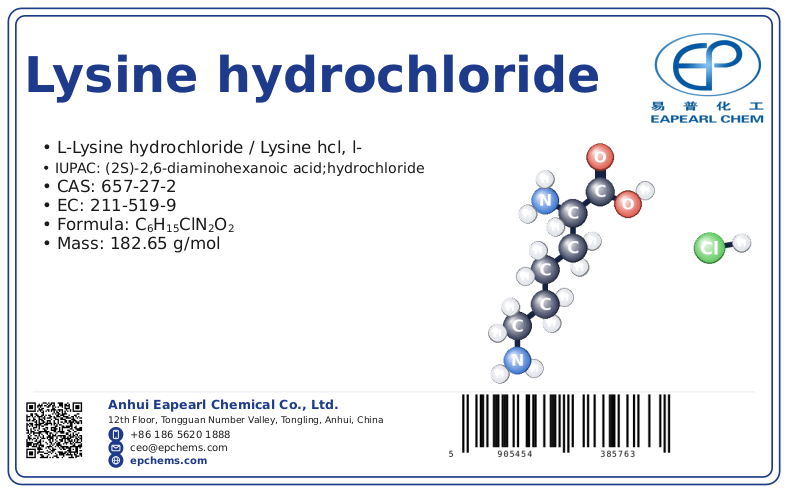
| MF | C6H15ClN2O2 |
|---|---|
| Molecular weight | 182.65 |
Values are typical for the standard grade. Tighter specifications are available — state the target in your inquiry and we confirm against the production batch.
Daten transkribiert aus regulatorischen Registern und Fachliteratur, unter Angabe von Quelle und Ausgabe. Sie ersetzen nicht das Sicherheitsdatenblatt des Lieferanten. Felder ohne hinterlegte Quelle sind als solche gekennzeichnet.
C(CCN)C[C@@H](C(=O)O)N.Cl Zuletzt aktualisiert: unbestätigt
| Summenformel | C₆H₁₅ClN₂O₂[1] |
| Molekulargewicht | 182.65 g/mol[1] |
| IUPAC-Name | (2S)-2,6-diaminohexanoic acid;hydrochloride[1] |
| SMILES | C(CCN)C[C@@H](C(=O)O)N.Cl[1] |
| InChIKey | BVHLGVCQOALMSV-JEDNCBNOSA-N[1] |
Synonyme: L-Lysine hydrochloride · 657-27-2 · L-Lysine monohydrochloride · lysine hydrochloride · L-Lysine, monohydrochloride
Datenquellen: PubChem (NLM/NIH)
Zuletzt aktualisiert: 2026-09-02
WISSENSCHAFTLICHE FORSCHUNG
MOLECULE Bibliografie pro CAS (live aus 13+ Datenbanken)
Quellen: db:pubmed (7) · db:crossref (3)
Spektren werden bei Bedarf aus 9 Quellen abgerufen. Jedes Spektrum wird in unserer Datenbank gespeichert — beim nächsten Öffnen erfolgt keine Anfrage an die externe API. Laden Sie JCAMP-DX / CSV / PNG zu jedem Spektrum herunter, ohne zu suchen.
Referenzquelle — keine öffentliche API. In einer externen Datenbank öffnen:
🔗 IR/NMR/MS (SDBS) →Referenzquelle — keine öffentliche API. In einer externen Datenbank öffnen:
🔗 JP Monograph →Referenzquelle — keine öffentliche API. In einer externen Datenbank öffnen:
🔗 WHO INN →Referenzquelle — keine öffentliche API. In einer externen Datenbank öffnen:
🔗 DOAJ →Keine harmonisierte GHS-Einstufung für diese Substanz — siehe aktuelles Sicherheitsdatenblatt (SDS) des Lieferanten.
Referenzen aus allen Safety-Hub-Registerkarten gesammelt. CAS: 657-27-2 ·
PubChem ↗
Registerkarten mit eigenen Referenzen (Emergency, PPE, Storage, Waste) enthalten zusätzliche bibliografische Einträge in ihren jeweiligen Abschnitten.
Fügen Sie eine Serie von Messwiederholungen ein (CSV oder eine Zahl pro Zeile). Der Rechner berechnet Mittelwert, Standardabweichung und 95% CI und erkennt Ausreißer (Grubbs + Dixon Q).
x̄ = Σxᵢ / n — arithmetisches Mittels² = Σ(xᵢ - x̄)² / (n-1) — Stichprobenvarianzs = √s² — StandardabweichungRSD% = (s / x̄) × 100% — relative StandardabweichungCI₉₅ = x̄ ± t(0.05, n-1) × s / √n — Student's tG = |xᵢ - x̄| / s — Grubbs-TestQ = |xsuspect - xnearest| / |xmax - xmin| — Dixon Q-testQuelle: ICH Q2(R2) Validation of Analytical Procedures · ICH PDF ↗
Wählen Sie einen Puffer aus der Liste von 20 gängigen Systemen → geben Sie den Ziel-pH-Wert ein → Sie erhalten ein exaktes Rezept mit den einzuwiegenden Massen.
Planen Sie Ihr gesamtes Laborprojekt: Fügen Sie Experimente mit Reagenzien, Wiederholungen und Dauer hinzu. Sie erhalten ein Gantt-Diagramm, eine Einkaufsliste (mit Links zum Shop!), ein Budget mit 10% Reserve und eine GHS-Risikomatrix.
💡 Melden Sie sich an, um Projekte zu speichern. Ohne Anmeldung können Sie berechnen, aber nicht speichern.
Drug-Likeness-Radardiagramm (Lipinski Ro5 / Veber). Grüne Zone = Übereinstimmung mit den Kriterien.
Vorhersagedaten — in silico berechnete Eigenschaften (SMILES/RDKit). Sie ersetzen keine klinischen Studien. Nicht zur Arzneimittelbewertung ohne experimentelle Verifizierung verwenden.
| Eigenschaft | Wert | Bewertung |
|---|---|---|
| Resorption (GI) | hoch | ✓ |
| BHS-Permeabilität | nein | |
| Bioverfügbarkeit (Daina 2017) | 55% | |
| CYP450-Profil | CYP1A2 unknownCYP2C9 unknownCYP2C19 unknownCYP2D6 unknownCYP3A4 unknown | |
| PAINS-Warnungen | 0 | ✓ |
| Brenk-Warnungen | 0 | ✓ |
| pKa (pH 7.4) | 4.5 (predicted) | |
| hERG (Kardiotox.) | — | |
| P-gp-Substrat | — | |
| Ames-Mutagenität | ✓ nein | |
| DILI (Hepatotox.) | — | |
| LogS (Wasserlösl.) | — | |
657-27-2
— multi-criteria ranking (W12): 30% Zitierungen · 20% Aktualität · 20% Thema · 15% historisch · 15% Open Access.
Molekülspezifische Szenarien, Fehlerbehebung und Literaturhinweise
The predicted parameters for this molecule (CAS 657-27-2) are based on literature-backed models (Snyder-Dolan LSS, Neue pore-size rules).
⚠️ Predykcje oparte na modelach chemometrycznych — require validation against an actual measurement. Confidence: low/medium/high depending on the available descriptors.
Name + CAS + Grade + Role in method
HPLC vs LC-MS vs Far UV — when to use which
One-click add to cart
| Property | Acetonitrile (ACN) | Methanol (MeOH) |
|---|---|---|
| Viscosity (20°C) | 0.37 cP | 0.59 cP (+59%) |
| Back Pressure | ~150 bar | ~210 bar (+40%) |
| UV Cutoff | 190 nm | 205 nm |
| Elution Strength | Stronger | Weaker |
| Price (typical) | 115 PLN/L | 70 PLN/L (-39%) |
H = A + B/u + Cu
Higher viscosity (MeOH) → lower optimal flow rate → longer runtime.
Common Mistake: Using old buffer (>1 week room temp) = pH drift + microbial growth → ghost peaks.
How much you save by using naszej metody zamiast alternatyw? Kwartalne koszty labu HPLC.
| Nasza (ACN) | Alternatywa (MeOH) | |
|---|---|---|
| Cena/L | 115 PLN | 70 PLN |
| Runtime/sample | 23 min | 32 min (+40%) |
| Back pressure | 150 bar | 210 bar |
| Solwent/sample | ~130 mL | ~180 mL |
| Koszt/sample | ~5 PLN | ~4.5 PLN |
| Czas/sample | 23 min | 32 min |
| Czas pracy chemika | — | — |
| Total/quarter | — | — |
| Nasza (z guard) | Bez guard | |
|---|---|---|
| Guard column | 200 PLN / 100 inj | — |
| Main column lifetime | 2000 inj | 500 inj |
| Columns / quarter | — | — |
| Guards / quarter | — | — |
| Downtime wymiany (h) | — | — |
| Total/quarter | — | — |
| Nasza (SOP template) | Custom dev | |
|---|---|---|
| Initial setup | 1 h (use template) | 40 h (screening of phases, columns, gradients) |
| Walidacja (ICH Q2) | 8 h | 24 h |
| Dokumentacja | 2 h (edit template) | 16 h |
| Ryzyko OOS w Q1 | ~2% | ~15% |
| Total (jednorazowo) | — | — |
| Fast (5 min) | Standard (23 min) | |
|---|---|---|
| Runtime/sample | 5 min | 23 min |
| Samples/8h shift | — | — |
| Shifts potrzebnych | — | — |
| Koszt pracy | — | — |
| Savings | — | — |
Source: r/chemistry
Source: ResearchGate
Source: Snyder LSS Model
Source: Chromatography Forum
| # | Time | %B start | %B end | Duration | Slope (Δ%B/min) | Step |
|---|
💡 Rule of thumb: slope 2-5 %B/min gives the best peak shape · dwell vol = empty tubing from the pump to the column (check a blank run without the column) · k*·t0 ≥ 3 dla Rs ≥ 2.0.
Log k = log kw − S·φ, gdzie φ = fraction B. Optymalny gradient: Δφ ≈ 0.6–0.8 per 5 t0. Dla kolumny 250×4.6mm @ 1 mL/min → t0 ≈ 2 min → gradient 10–12 min.
Source: Snyder Seminar
Source: Predictive modeling
Source: LCGC
150×4.6 mm · 3.5 μm · pH 2–9
150×4.6 mm · 3.5 μm · pH 1–12 (high pH)
100×4.6 mm · 2.6 μm core-shell · fast
Source: Phenomenex Guide
Source: Agilent App Notes
Source: Phenomenex Knowledge
| Parameter | Value | Why |
|---|---|---|
| Wavelength | 210 nm (primary) + 254 nm (aromatic) | Uniwersalne dla COOH/C=O |
| Bandwidth | 4 nm | Balance of sensitivity vs selectivity |
| Response time | 0.5 s | Zgodne z peak width ~5 s |
| Reference λ | 360 nm, bw 100 nm | Kompensacja baseline drift |
| Parameter | Acceptance | Formula |
|---|---|---|
| Resolution (Rs) | ≥ 2.0 | 2(tR2 − tR1) / (w1 + w2) |
| Tailing factor (Tf) | ≤ 1.5 | W0.05 / (2·f) |
| Plates (N) | ≥ 5000 | 16·(tR / w)² |
| RSD (6 injections) | ≤ 2.0% | σ / μ × 100% |
| Linearity (R²) | ≥ 0.9990 | 80–120% spec, 5 levels |
The method was designed in accordance with the regulations below. Click a badge to see compliance details.
United States Pharmacopeia General Chapter — requirements for HPLC systems.
Reference: USP-NF 2024, General Chapter <621> Chromatography
International Council for Harmonisation — walidacja metod analitycznych.
Reference: ICH Q2(R1) Validation of Analytical Procedures, 2005
European Pharmacopoeia — chromatographic separation techniques.
Reference: EP 11.0, Chapter 2.2.46
Japanese Pharmacopoeia — aligned with USP/EP harmonisation after 2020.
Reference: JP 18th Edition, General Chapter 2.00
Current Good Manufacturing Practice for pharmaceutical products (USA).
Reference: 21 CFR Part 211 — Current Good Manufacturing Practice
International standard for the competence of testing laboratories.
Reference: ISO/IEC 17025:2017
Comparison of our recommended method vs USP Monograph vs PubMed literature vs Vendor Application Note.
| Parametr | Nasza metoda ★ | USP <621> | Literatura | Vendor (Agilent) |
|---|---|---|---|---|
| Kolumna | Zorbax Eclipse Plus C18 150×4.6 mm | L1 (C18, bonded, 5 μm) | n/a (brak PubMed refs dla tego CAS) | Zorbax SB-C18 150×4.6 mm |
| Particle size | 3.5 μm | 5 μm (USP default) | — | 5 μm |
| Faza A | 10 mM NH₄HCO₃ pH 7.0 | Phosphate buffer pH 2.5 | — | 0.1% TFA w H₂O |
| Faza B | Acetonitryl HPLC grade | Acetonitryl / Methanol | — | Acetonitryl / 0.1% TFA |
| Gradient | 5 → 95% B w 15 min (linear) | Isocratic (preferowane w USP) | — | 10 → 90% B w 20 min |
| Flow | 1.0 mL/min | 1.5 mL/min | — | 1.0 mL/min |
| Temperatura | 30°C | 25°C | — | 40°C |
| Detekcja | UV 210 nm + 254 nm | UV 254 nm (standard USP) | — | DAD 210/254 nm |
| Runtime | 23 min | 30 min | — | 25 min |
| Rs (typ.) | 2.3 | ≥ 2.0 | — | 2.1 |
| Walidacja | USP <621> + ICH Q2(R1) | USP <621> obligatoryjnie | — | Application note only |
| Solvent cost/run | ~5 PLN/run | ~7 PLN/run | — | ~6 PLN/run |
Pick a symptom → see the most likely causes → click to see the fix.
Diagnoza: Column oven on? 30°C?
Fix: Turn the column thermostat on to 30°C.
Diagnoza: Method → DAD → Primary λ — check whether it is 210
Fix: Change the wavelength to 210 nm for compounds without aromatic rings.
Diagnoza: Status lampki na detektorze — zielona?
Fix: Turn on the lamp, wait 3-5 min for warm-up.
Diagnoza: Is the sample >0.1 mg/mL?
Fix: Increase the concentration 10× to 1 mg/mL.
Diagnoza: Do you filter samples through 0.22 μm?
Fix: Replace the column frit OR the guard column. In future, filter every sample.
Diagnoza: Jaki slope %B/min?
Fix: Zwolnij gradient: 13→56% B w 20 min zamiast 15 min.
Diagnoza: Flow 1.5 mL/min?
Fix: Zmniejsz do 0.8 mL/min.
Diagnoza: Zmierz pH bufora — 7.0±0.2?
Fix: Make fresh buffer 10 mM NH₄HCO₃ pH 7.0.
Diagnoza: Number of injections? >2000?
Fix: Regeneruj: flush 100% ACN 30 min, potem 100% MeOH 30 min.
Diagnoza: Fronting + tailing at the same time? Concentration >5 mg/mL?
Fix: Reduce inj. vol 10→5 μL or dilute 2×.
Source: FDA Guidance
Source: ICH Q6A
Source: USP Online
Particles >0.22 μm clog the column inlet frit. Pressure rises +50 bar per 100 injections. Column lifetime drops from 2000 to 500 injections. Filter cost: 2 PLN. Column cost: 1800 PLN.
Full protocol with all parameters
GMP-compliant SOP template
ICH Q2(R1) validation template
All references in BibTeX format
Echte Pannen von Chemikern — was passiert ist, was geholfen hat und was zu vermeiden ist.
I ran the method exactly as written. Main peak Tf = 2.8 (should be <1.5). Integration impossible. I repeated it 6× — always tailing.
Causes: (1) buffer pH 8.2 instead of 7.0, (2) 2-month-old buffer (bacteria!), (3) C8 column instead of C18. Fix: fresh buffer pH 7.0 + switch to C18 → Tf 1.2, Rs 1.9→2.3.
Submission to JPBA. Reviewer 2: „Peak at 12.4 min shows manual integration, but baseline slope suggests co-elution". I had to revalidate the whole method. 3 months of delay.
Manual integration = a red flag for reviewers. Solve CO-ELUTION in methods dev, not in integration. Optimise the gradient instead of force-fitting the peak.
Do you have experience with this method? A problem you solved? A mishap you want to spare others? Write to us — after moderator approval it will appear here as „real case".
Alle wissenschaftlichen Quellen, die in den Akkordeons oben für CAS 657-27-2 zitiert werden.Format: Chicago Manual of Style, 17. Aufl., Autor-Datum-System.