Manufacturer since 2009 · Tongling, Anhui ISO certified Licensed for hazardous & precursor chemicals
[email protected] · +86 186 5620 1888
Eapearl Chemical

Trichloroethylene

TCF

CAS 79-01-6 EC 201-167-4 C2HCl3 Precursor CLP Danger
IARC Grupa 1 — Substancja kancerogenna dla ludzi
CAS: 79-01-6 | Źródło IARC
US TSCACA DSL_TOXICMolGod Score: Pierwszorzędne
MolGod_SDSCARD_1
REACH 2020/878
v1 · 22.09.2026

Specification

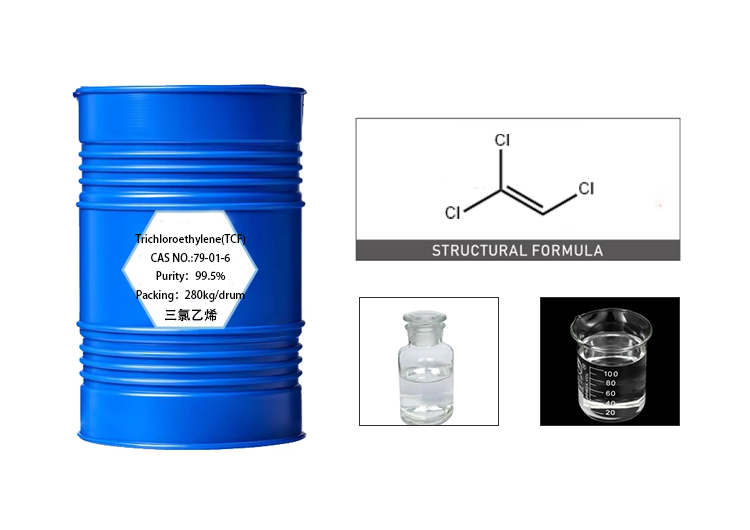
Product NameTrichloroethylene
Other NamesTCF
CAS No.79-01-6
EINECS No.201-167-4
MFC2HCl3
Molecular weight131.39
Purity99.5%
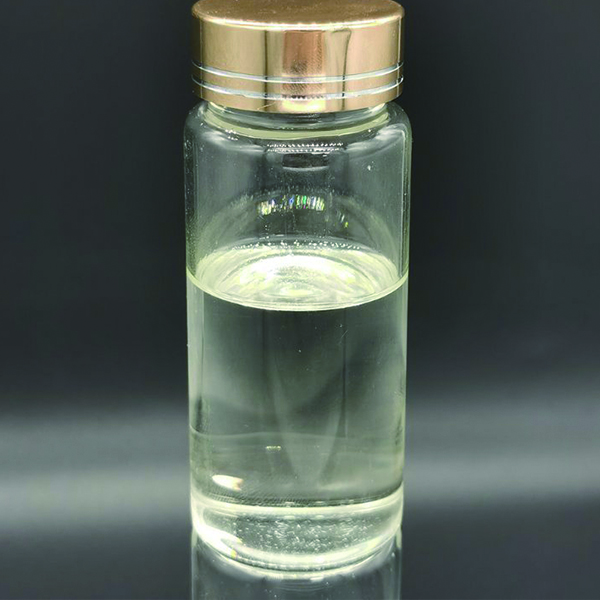
Appearancecolorless clear liquid
Density1.50 g/cm³
Melting point-87.1 °C
Boiling point87.1 °C
Flashing point32.2 °C

Values are typical for the standard grade. Tighter specifications are available — state the target in your inquiry and we confirm against the production batch.

Hazard classification

GHS pictogram GHS07 — Irritant / harmful GHS pictogram GHS08 — Health hazard

Danger

Harmonised classification (EU) — ECHA Annex VI (harmonised, ATP 23; 2026-07-07)

  • H350 May cause cancer
  • H341 Suspected of causing genetic defects
  • H336 May cause drowsiness or dizziness
  • H315 Causes skin irritation
  • H319 Causes serious eye irritation
  • H412 Harmful to aquatic life with long lasting effects
Precautionary statements (27)
  • P203 Obtain, read and follow all safety instructions before use
  • P261 Avoid breathing dust/fume/gas/mist/vapours/spray
  • P264 Wash thoroughly after handling
  • P264+P265
  • P271 Use only outdoors or in a well-ventilated area
  • P273 Avoid release to the environment
  • P280 Wear protective gloves/protective clothing/eye protection/face protection
  • P302+P352
  • P304+P340
  • P305+P351+P338
  • P318
  • P319
  • P321 Specific treatment
  • P332+P317
  • P337+P317
  • P362+P364
  • P403+P233
  • P405 Store locked up
  • P501 Dispose of contents/container to an approved waste collection point
  • P272 Contaminated work clothing should not be allowed out of the workplace
  • P333+P317
  • P260 Do not breathe dust/fume/gas/mist/vapours/spray
  • P270 Do not eat, drink or smoke when using this product
  • P308+P316
  • P317
  • P301+P316
  • P331 Do NOT induce vomiting

European Chemicals Agency. "trichloroethylene; trichloroethene, Index No. 602-027-00-9." In Table 3 of Annex VI to Regulation (EC) No 1272/2008 (CLP Regulation), 23rd Adaptation to Technical Progress (harmonised list as of 2026-07-07). Helsinki: European Chemicals Agency, 2026. https://echa.europa.eu/information-on-chemicals/annex-vi-to-clp.

Packaging and shipping
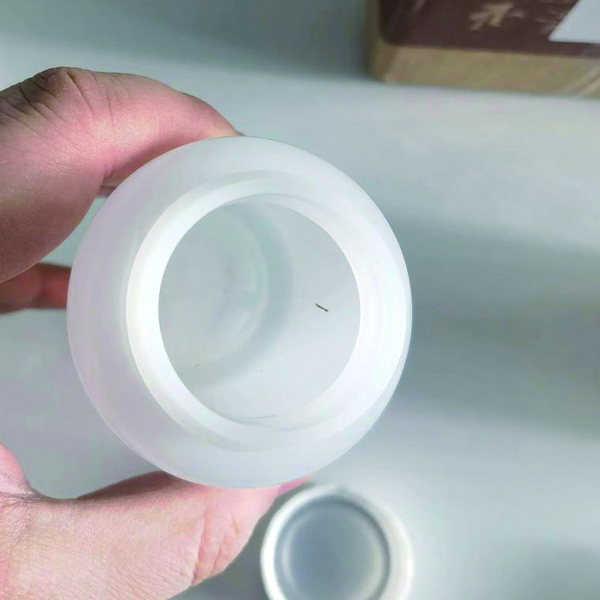
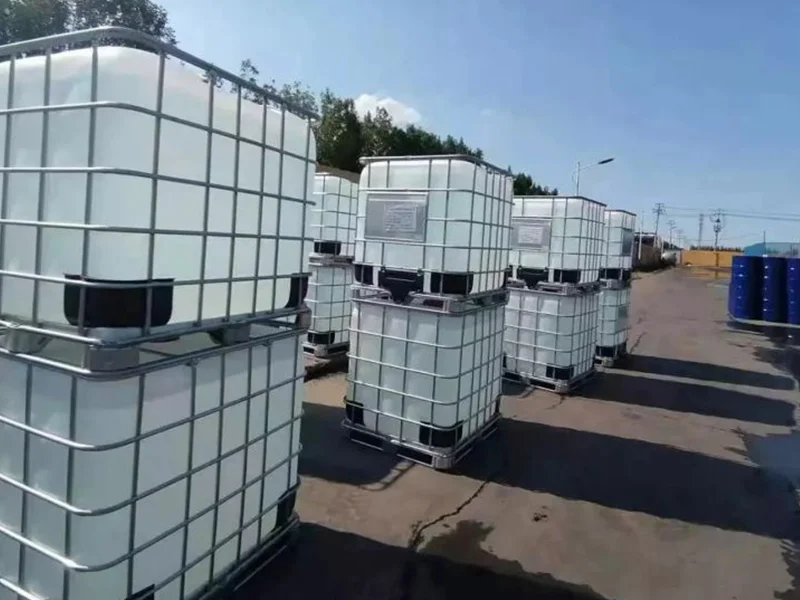
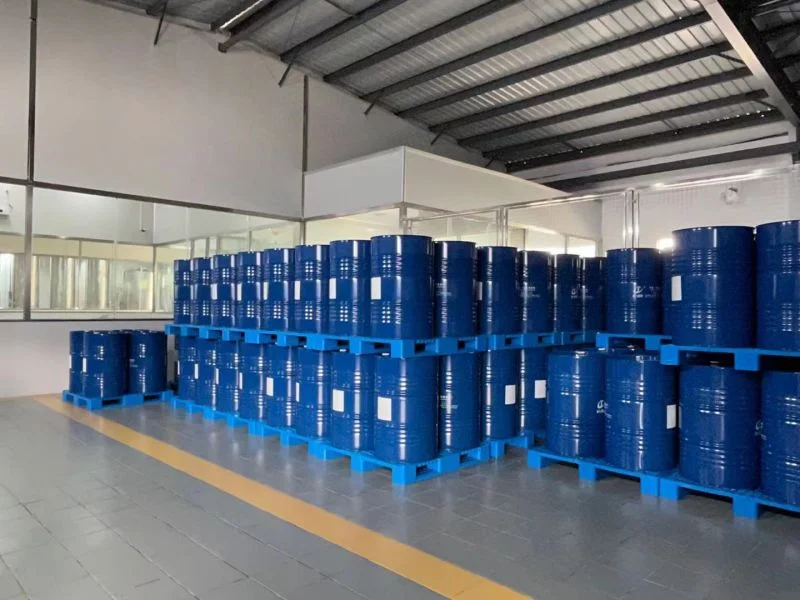
Drum270 kg
IBC Drum1127 kg
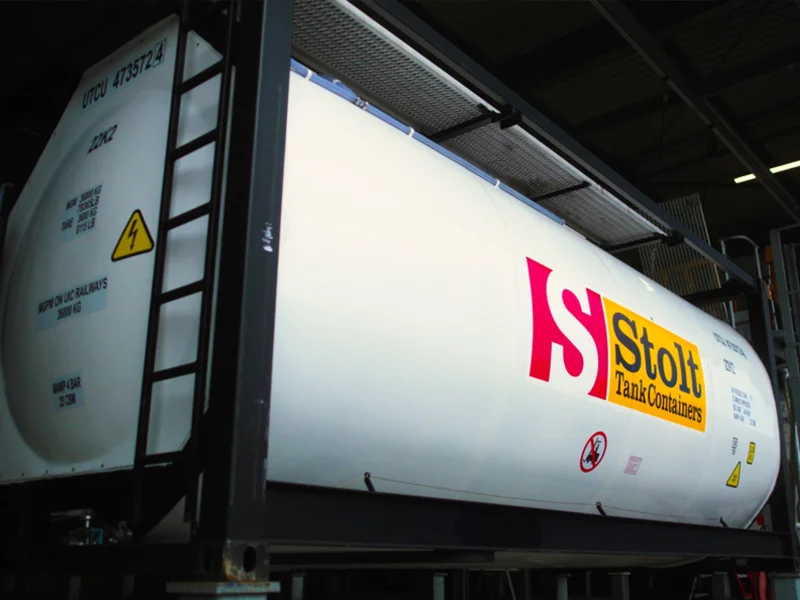
ISO tank (20ft)24–26 m³
ISO tank (40ft)48–50 m³
Trichloroethylene
Trichloroethylene
Trichloroethylene
Trichloroethylene

Trichloroethylene (TCE), with the chemical formula C₂HCl₃, is a colorless, transparent, volatile organic chlorinated hydrocarbon liquid with a sweet taste similar to chloroform. The trichloroethylene products provided by Anhui Yipu Chemical are strictly controlled in terms of purity. Their core characteristic lies in their extremely strong solubility for organic substances such as oils, resins, and waxes, and their moderate boiling point (approximately 87°C), resulting in very low residue after evaporation. Historically, it was widely used in dry cleaning, metal degreasing, and electronic cleaning, but due to its clear carcinogenicity and environmental persistence, its application scope is being strictly restricted and it is accelerating the transition to safer and more environmentally friendly alternatives.
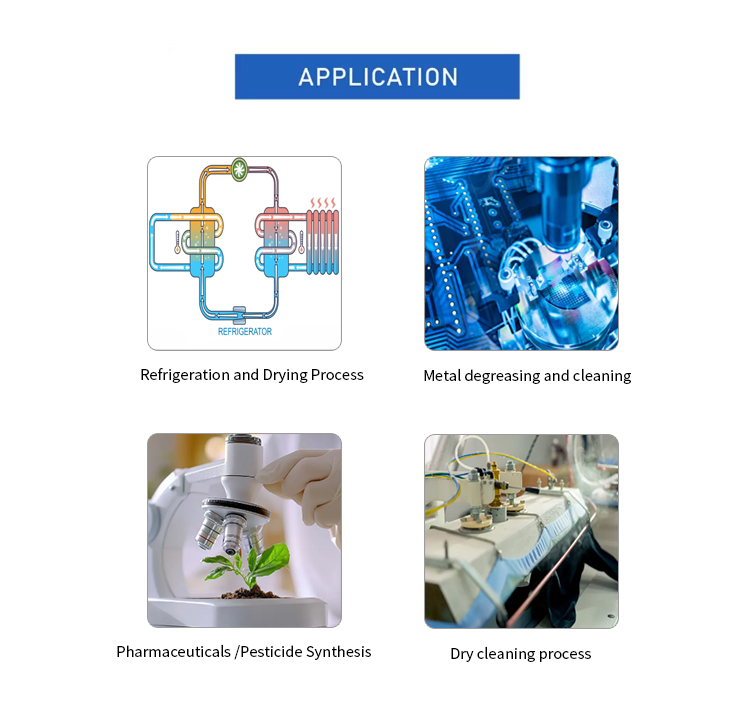
Trichloroethylene (TCE), a high-purity industrial solvent and refrigerant, is used in applications such as metal degreasing, electronic cleaning, chemical synthesis, and professional dry cleaning.Trichloroethylene (TCE), a high-purity industrial solvent and refrigerant, is used in applications such as metal degreasing, electronic cleaning, chemical synthesis, and professional dry cleaning.Trichloroethylene (TCE), a high-purity industrial solvent and refrigerant, is used in applications such as metal degreasing, electronic cleaning, chemical synthesis, and professional dry cleaning.

Trichloroethylene (TCE), a high-purity industrial solvent and refrigerant, is used in applications such as metal degreasing, electronic cleaning, chemical synthesis, and professional dry cleaning.

Product Description

Anhui Eapearl Chemical Co., Ltd., as a professional chemical supplier in China, deeply understands the significant role of trichloroethylene (TCE) as an efficient industrial solvent and a key chemical intermediate in specific industrial fields. At the same time, we are fully aware that trichloroethylene is internationally recognized as a type 1 carcinogen, and its production, sales, use, and disposal are subject to increasingly strict regulations from both domestic and international sources. We solemnly promise to strictly abide by all relevant laws and regulations, only providing high-quality products for compliant and safe industrial uses, and placing safety, health, environmental protection, and full lifecycle compliance management at the forefront of all business activities.

Trichloroethylene (Trichloroethylene, abbreviated as TCE), with the chemical formula C₂HCl₃, is a colorless transparent, volatile, and chloroform-like organic chlorinated hydrocarbon liquid. The trichloroethylene products provided by Anhui Yipu Chemical are strictly controlled in purity. Its core characteristic lies in its extremely strong solubility for organic substances such as oils, resins, and waxes, and its moderate boiling point (approximately 87°C), resulting in very low residual after evaporation. Historically, it was widely used in dry cleaning, metal degreasing, and electronic cleaning, but due to its clear carcinogenicity and environmental persistence, its application scope is being strictly restricted and accelerating its transition to safer and more environmentally friendly alternatives.
The core value of trichloroethylene lies in its powerful degreasing ability and its irreplaceable nature as a specific chemical intermediate. However, its use must be carried out under the condition of a comprehensive risk assessment and the implementation of the highest level of protective measures.

Efficient degreasing and cleaning of metal components (traditional core application): Due to its excellent solubility in cutting oils, anti-rust oils, stamping oils, etc., it was widely used for the pre-treatment of metal components in the automotive, aerospace, and precision machinery industries before electroplating, spraying, or welding. Currently, this field is accelerating the transition to water-based or low-toxic solvent alternatives.

Precise cleaning of electronic components (high-end application, requiring extremely high purity): Used to clean the residual flux on printed circuit boards (PCBs) and the surfaces of semiconductor chips, requiring extremely high product purity (typically ≥ 99.5%). Due to environmental protection and health risks, this application is being strictly restricted and replaced.

Chemical synthesis intermediates: As an important raw material for producing tetrachloroethylene (dry cleaning solvent), chloroacetic acid, HFC-134a (refrigerant), and other chemicals. Other restricted applications: It was once used as a dry cleaning solvent, extraction agent, etc., but has now largely been phased out.
Trichloroethylene (TCE), a high-purity industrial solvent and refrigerant, is used in applications such as metal degreasing, electronic cleaning, chemical synthesis, and professional dry cleaning.

Trichloroethylene (TCE), a high-purity industrial solvent and refrigerant, is used in applications such as metal degreasing, electronic cleaning, chemical synthesis, and professional dry cleaning.

Delivery&Payment method

Trichloroethylene (TCE), a high-purity industrial solvent and refrigerant, is used in applications such as metal degreasing, electronic cleaning, chemical synthesis, and professional dry cleaning.

Frequently asked

In what packaging is Trichloroethylene shipped?

Standard formats are Drum (270 kg), IBC Drum (1127 kg), ISO tank (20ft) (24–26 m³), ISO tank (40ft) (48–50 m³). Other packaging can be arranged for full-container orders.

Is a safety data sheet available for Trichloroethylene?

Yes, on request. Safety data sheets are issued per grade and destination market; state the country of import in your inquiry.

What purity do you supply?

The standard grade is 99.5%. Tighter specifications are confirmed against the production batch before shipment.

Technical reading on Trichloroethylene

Related products

🧬 Wizualizator molekuły 3D
Ładowanie molekuły...
Model 3D Trichloroethylene, CAS 79-01-6, wzór sumaryczny C2HCl3, masa molowa 131.38 g/mol

Dane transkrybowane z rejestrów regulacyjnych i literatury fachowej, z podaniem źródła i wydania. Nie zastępują karty charakterystyki dostawcy. Pola bez zapisanego źródła oznaczone jako takie.

📊 Dane fizykochemiczne — CAS 79-01-6MolGod_PROPHUB_MAIN
📊 Właściwości fizykochemiczne

Szybki przegląd

Wzór: C2HCl3
MW: 131.38 g/mol
CAS: 79-01-6
🔬 Właściwości zaawansowane

Identyfikatory chemiczne

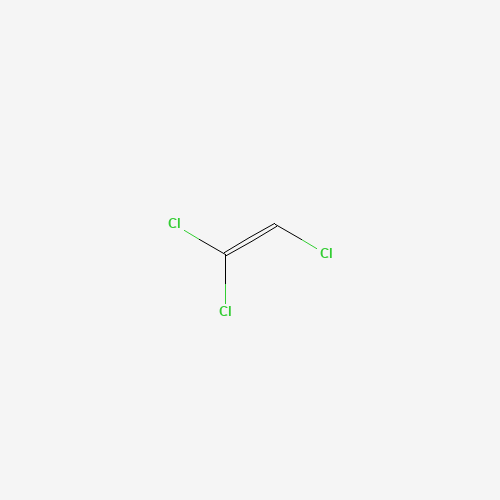
SMILES: C(=C(Cl)Cl)Cl

Ostatnia aktualizacja: niepotwierdzona

Przegląd chemiczny: TrichloroethyleneMolGod_OVERVIEW_1
Wzór sumarycznyC2HCl3[1]
Masa cząsteczkowa131.38 g/mol[1]
Temperatura topnienia-84.7 °C[1][2]
Temperatura wrzenia87.22 °C[1][2][3]
Density1.5 g/cm³[3]
LogP (lipofilowość)2.6[1]
Nazwa IUPAC1,1,2-trichloroethene[1]
SMILESC(=C(Cl)Cl)Cl[1]
InChIKeyXSTXAVWGXDQKEL-UHFFFAOYSA-N[1]

Synonimy: TRICHLOROETHYLENE · Trichloroethene · 79-01-6 · 1,1,2-Trichloroethene · Ethinyl trichloride

Data sources: PubChem (NLM/NIH)
Last updated: 2026-09-21

📚 Naukowe referencje (Chicago Author-Date) (3 źródeł)
  1. PubChem. National Center for Biotechnology Information (NIH/NLM), chemical compound database. dotyczy: Wzór sumaryczny · Masa cząsteczkowa · Temperatura topnienia · Temperatura wrzenia · LogP (lipofilowość) · Nazwa IUPAC · SMILES · InChIKey
  2. NIST. Chemistry WebBook, SRD 69. National Institute of Standards and Technology. dotyczy: Temperatura topnienia · Temperatura wrzenia
  3. DECHEMA, PTB, and BAM. CHEMSAFE - Database of Evaluated Safety Characteristics for the Avoidance of Explosions. Frankfurt am Main: DECHEMA e.V.; Braunschweig/Berlin: Physikalisch-Technische Bundesanstalt and Bundesanstalt fur Materialforschung und -prufung. dotyczy: Temperatura wrzenia · Density

BADANIA NAUKOWE

[1]PubMed2025
Krzyzanowski B, Beyene KM, Turner JR et al.. (2025). "Ambient Trichloroethylene Exposure and Parkinson Disease Risk in Medicare Beneficiaries.". Neurology. https://doi.org/10.1212/WNL.0000000000214174
[2]PubMed2025
Xie H, Zhao J, Chen J et al.. (2025). "MPTP controls the release of mtDNA and induces endothelial cell PANoptosis in trichloroethylene-induced immune kidney injury.". European journal of pharmacology.
[3]PubMed2023
Zhang X, Xie H, Liu Z et al.. (2023). "HMGB 1 acetylation mediates trichloroethylene-induced immune kidney injury by facilitating endothelial cell-podocyte communication.". Ecotoxicology and environme
[4]PubMed2023
Liu Z, Ma J, Zuo X et al.. (2023). "IP3R-dependent mitochondrial dysfunction mediates C5b-9-induced ferroptosis in trichloroethylene-caused immune kidney injury.". Frontiers in immunology. https://doi
[5]PubMed2023
Habib M, Ali M, Ayaz T et al.. (2023). "Degradation of trichloroethylene in aqueous solution by FeS(2) catalyst under innovative oxic environments.". Environmental pollution (Barking, Essex : 1987). h
[6]PubMed2023
Qiu L, Lok KS, Lu Q et al.. (2023). "Zinc and copper supplements enhance trichloroethylene removal by Pseudomonas plecoglossicida in water.". Environmental technology. https://doi.org/10.1080/09593330
[7]PubMed2022
Liu Z, Ma J, Zuo X et al.. (2022). "C5b-9 mediates ferroptosis of tubular epithelial cells in trichloroethylene-sensitization mice.". Ecotoxicology and environmental safety. https://doi.org/10.1016/j.
[8]PubMed2022
Xie H, Zhang X, Peng J et al.. (2022). "Endothelin-1 down-regulated vascular endothelial growth factor A is involved in trichloroethene-induced kidney injury.". Toxicology and industrial health. https
📚 Naukowe referencje (Chicago Author-Date) 20 refs · 3 baz

MOLECULE Bibliografia per-CAS (live z 13+ baz)

Źródła: db:pubmed (10) · db:crossref (8) · db:Europe PMC (2)

  1. db:pubmed Krzyzanowski B, Beyene KM, Turner JR et al.. (2025). "Ambient Trichloroethylene Exposure and Parkinson Disease Risk in Medicare Beneficiaries.". Neurology. https://doi.org/10.1212/WNL.0000000000214174
  2. db:pubmed Xie H, Zhao J, Chen J et al.. (2025). "MPTP controls the release of mtDNA and induces endothelial cell PANoptosis in trichloroethylene-induced immune kidney injury.". European journal of pharmacology. https://doi.org/10.1016/j.ejphar.2025.178118
  3. db:pubmed Zhang X, Xie H, Liu Z et al.. (2023). "HMGB 1 acetylation mediates trichloroethylene-induced immune kidney injury by facilitating endothelial cell-podocyte communication.". Ecotoxicology and environmental safety. https://doi.org/10.1016/j.ecoenv.2023.115042
  4. db:pubmed Liu Z, Ma J, Zuo X et al.. (2023). "IP3R-dependent mitochondrial dysfunction mediates C5b-9-induced ferroptosis in trichloroethylene-caused immune kidney injury.". Frontiers in immunology. https://doi.org/10.3389/fimmu.2023.1106693
  5. db:pubmed Habib M, Ali M, Ayaz T et al.. (2023). "Degradation of trichloroethylene in aqueous solution by FeS(2) catalyst under innovative oxic environments.". Environmental pollution (Barking, Essex : 1987). https://doi.org/10.1016/j.envpol.2023.122062
  6. db:pubmed Qiu L, Lok KS, Lu Q et al.. (2023). "Zinc and copper supplements enhance trichloroethylene removal by Pseudomonas plecoglossicida in water.". Environmental technology. https://doi.org/10.1080/09593330.2022.2069518
  7. db:pubmed Liu Z, Ma J, Zuo X et al.. (2022). "C5b-9 mediates ferroptosis of tubular epithelial cells in trichloroethylene-sensitization mice.". Ecotoxicology and environmental safety. https://doi.org/10.1016/j.ecoenv.2022.114020
  8. db:pubmed Xie H, Zhang X, Peng J et al.. (2022). "Endothelin-1 down-regulated vascular endothelial growth factor A is involved in trichloroethene-induced kidney injury.". Toxicology and industrial health. https://doi.org/10.1177/07482337221092507
  9. db:pubmed Gushgari-Doyle S, Oremland RS, Keren R et al.. (2021). "Acetylene-Fueled Trichloroethene Reductive Dechlorination in a Groundwater Enrichment Culture.". mBio. https://doi.org/10.1128/mBio.02724-20
  10. db:pubmed Horzmann KA , Portales AM , Batcho KG et al.. (2020). "Developmental toxicity of trichloroethylene in zebrafish (Danio rerio).". Environmental science. Processes & impacts. https://doi.org/10.1039/c9em00565j
  11. db:crossref (2011). "Trichloroethene (C2HCl3)". Gaseous Electronics. https://doi.org/10.1201/b11492-91
  12. db:Europe PMC et al.. (1993). "Nephrotoxic and genotoxic N-acetyl-S-dichlorovinyl-L-cysteine is a urinary metabolite after occupational 1,1,2-trichloroethene exposure in humans: implications for the risk of trichloroethene exposure.". https://doi.org/10.1289/ehp.9399281
  13. db:Europe PMC (1988). "NTP Toxicology and Carcinogenesis Studies of Trichloroethylene (CAS No. 79-01-6) in Four Strains of Rats (ACI, August, Marshall, Osborne-Mendel) (Gavage Studies).".
  14. db:crossref M.A Siddiqi, K Lucas. (1986). "The excess enthalpy of (trichloroethene + carbon disulphide), (trichloroethene + trichloromethane), and (trichloroethene + tetrachloromethane) at various temperatures and pressures". The Journal of Chemical Thermodynamics. https://doi.org/10.1016/0021-9614(86)90068-6
  15. db:crossref (0). "Trichloroethene Hydrodechlorination in Water by Highly Disordered Monometallic Nanoiron". https://doi.org/10.1021/cm0511217.s001
  16. db:crossref (0). "Acetylene Tunes Microbial Growth During Aerobic Cometabolism of Trichloroethene". https://doi.org/10.1021/acs.est.3c08068.s001
  17. db:crossref Deza Irving. (0). "Rate-limited Mass Transfer of Trichloroethene". https://doi.org/10.15760/honors.460
  18. db:crossref (0). "Sulfidation of Magnetite for Superior Dechlorination of Trichloroethene". https://doi.org/10.1021/acs.est.4c07127.s001
  19. db:crossref (0). "Designing Pd-on-Au Bimetallic Nanoparticle Catalysts for Trichloroethene Hydrodechlorination". https://doi.org/10.1021/es048560b.s001
  20. db:crossref (0). "Optimal Design of Sulfidated Nanoscale Zerovalent Iron for Enhanced Trichloroethene Degradation". https://doi.org/10.1021/acs.est.8b02399.s001
Status regulacyjny substancji
Ten zwiazek: figuruje ze statusem zakazu w wykazie regulacyjnym. Wykazy: US/TSCA, CA/DSL_TOXIC. Informacja regulacyjna — nie ogranicza zakupu w sklepie.
🧮 Kalkulator stechiometrycznyMolGod_STOICH_1
🧪 Dane chemiczneMolGod_CHEMDATA_1
Numer CAS
79-01-6
Wzór sumaryczny
C2HCl3
Masa molowa
131.38 g/mol
Nazwa IUPAC (EN)
1,1,2-trichloroethene
SMILES
C(=C(Cl)Cl)Cl
InChIKey
XSTXAVWGXDQKEL-UHFFFAOYSA-N
📚 Literatura naukowa (2 artykuł)MolGod_LITSCI_1
📡 Data sourcesMolGod_SOURCES_1

The data in this widget comes from the following verified scientific sources:

  • PubChem — National Center for Biotechnology Information (NCBI/NIH), USA
  • ChEMBL — European Bioinformatics Institute (EMBL-EBI), UK
  • NIST WebBook — National Institute of Standards and Technology, USA

Data is cached locally for speed — the widget also works offline.

⚗️ Physicochemical propertiesMolGod_PHYSTAB_2
Temp. wrzenia
87.1
Temp. topnienia
-84.7
Density
1.46

Source: PubChem, NIST WebBook. Last updated: date not confirmed

🔍 Identyfikatory zewnętrzneMolGod_EXTID_1
1 z 16 systemów ID6%
BazaIdentyfikatorAkcje
CAS Registry Number79-01-6Otwórz →

Źródła: PubChem (NIH), Wikidata SPARQL, KEGG, ChEMBL (EBI), CompTox CTX (EPA).

Dalsza literatura

Publications thematically related to this CAS. They are not the source of any value given on this card.

Bibliografia (rozszerzona) (5)

  1. ★★☆☆☆ CROSSREF 🔓 OPEN ❓ unverified Anonymous. "Trichloroethylene.". https://doi.org/10.31003/fcc_f100635_03_01. link [dostep: 2026-09-23] CC0 (metadata)
  2. ★★☆☆☆ CROSSREF 🔓 OPEN ❓ unverified Anonymous. "Specification for trichloroethylene.". https://doi.org/10.3403/00085175u. link [dostep: 2026-09-23] CC0 (metadata)
  3. ★★☆☆☆ CROSSREF 🔓 OPEN ❓ unverified Anonymous. "Specification for trichloroethylene.". https://doi.org/10.3403/00085175. link [dostep: 2026-09-23] CC0 (metadata)
  4. ★★☆☆☆ CROSSREF 🔓 OPEN ❓ unverified Anonymous. "Specification for Reclaimed Trichloroethylene.". https://doi.org/10.1520/d5616. link [dostep: 2026-09-23] CC0 (metadata)
  5. ★★☆☆☆ CROSSREF 🔓 OPEN ❓ unverified Anonymous. "Specification for Reclaimed Trichloroethylene.". https://doi.org/10.1520/d5616-00. link [dostep: 2026-09-23] CC0 (metadata)
📡 Spektroskopia — CAS 79-01-6MolGod_SPECHUB_MAIN
📊 Bazy widm spektroskopowych — dane inline 9 źródeł MolGod_SPECDB_2

Widma pobierane na żądanie z 9 źródeł. Każde widmo jest zapisywane w naszej bazie — kolejne otwarcie = zero zapytania do zewnętrznego API. Pobierz JCAMP-DX / CSV / PNG przy każdym widmie bez szukania.

IR IR (Infrared) — NIST WebBook
Public domain (US Federal)
▶ Kliknij aby załadować widmo
🔗 Źródło
punktów
📚 NIST Chemistry WebBook, SRD 69
MS (NIST) Mass Spectrum (EI) — NIST WebBook
Public domain (US Federal)
▶ Kliknij aby załadować widmo
🔗 Źródło
punktów
📚 NIST Standard Reference Database 1A
UV-Vis UV/Visible Absorption — NIST WebBook
Public domain (US Federal)
▶ Kliknij aby załadować widmo
🔗 Źródło
punktów
📚 NIST Chemistry WebBook, SRD 69
¹H NMR NMR (¹H, ¹³C) — NMRShiftDB
CC-BY-SA 4.0
▶ Kliknij aby załadować widmo
🔗 Źródło
punktów
📚 Steinbeck C et al. (2003) J. Chem. Inf. Comput. Sci. 43(1):10–16 DOI: 10.1021/ci025588g
MS (MoNA) MoNA — MassBank of North America
CC-BY 4.0
▶ Kliknij aby załadować widmo
🔗 Źródło
punktów
📚 MassBank of North America (UC Davis) DOI: 10.1002/jms.1777
IR/NMR/MS (SDBS) SDBS — Spectral Database for Organic Compounds (Japan AIST)
Free for non-commercial

Źródło referencyjne — brak publicznego API. Otwórz w zewnętrznej bazie:

🔗 IR/NMR/MS (SDBS) →
📚 SDBSWeb: https://sdbs.db.aist.go.jp (AIST, Japan)
JP Monograph Japanese Pharmacopoeia — Monographs
Reference only

Źródło referencyjne — brak publicznego API. Otwórz w zewnętrznej bazie:

🔗 JP Monograph →
📚 Japanese Pharmacopoeia 18th Edition (2021)
WHO INN WHO — International Nonproprietary Names
WHO Model Lists (free)

Źródło referencyjne — brak publicznego API. Otwórz w zewnętrznej bazie:

🔗 WHO INN →
📚 WHO INN Programme
DOAJ DOAJ — Directory of Open Access Journals
OA journal index (mixed)

Źródło referencyjne — brak publicznego API. Otwórz w zewnętrznej bazie:

🔗 DOAJ →
📚 DOAJ — doaj.org
🔬 Interaktywne widma (live — NIST / MoNA / NMRShiftDB / SDBS) (2)

Dane pobierane na żywo z wielu źródeł (priority-chain). JCAMP-DX / CSV / PNG dostępne do pobrania pod każdym widmem. ⓘ Jedno źródło ★★☆☆☆

IR — Fourier-transform infrared

Ładowanie IR — Fourier-transform infrared…

MS — Mass spectrometry (EI 70eV)

Ładowanie MS — Mass spectrometry (EI 70eV)…

Wlasciwosci strukturalneMolGod_STRUCT3D_1

Ladowanie danych strukturalnych...

❓ Najczęstsze pytania (3)MolGod_FAQ_1
What is 79-01-6?
79-01-6 (CAS 79-01-6) is a chemical compound. The chemical data comes from PubChem (National Institutes of Health, USA).
Pomocne?
What is the CAS number of 79-01-6?
The CAS number for 79-01-6 is 79-01-6. A CAS Registry Number is the standard identifier for a chemical substance in scientific literature and in trade.
Pomocne?
How should 79-01-6 be stored?
79-01-6 should be stored as its safety data sheet directs \— typically in a dry, cool, well-ventilated place, away from heat and from materials it is incompatible with.
Pomocne?
➕ Zaproponuj pytanie
Pobierz pliki strukturyMolGod_STRDL_1

Pliki struktury molekularnej z bazy PubChem (NIH). Kompatybilne z programami: Avogadro, PyMOL, Jmol, ChemDraw.

Zrodlo: PubChem, National Library of Medicine (NIH). CID: 6575

🔄 Konwerter jednostek stężeń LIVE MolGod_UNITCONV_1

Wpisz stężenie Trichloroethylene w dowolnej jednostce — reszta obliczy się automatycznie.

MW: 131.38 g/mol · IUPAC Gold Book ↗

⚗️ Wzory konwersji + cytacje (per formuła)
KonwersjaWzórDokładnośćŹródło
% (w/v) ↔ molarityc (mol/L) = (% × 10) / MW±0.5% rel. when density ≈ 1.0 g/mLIUPAC (2019)
millimolar ↔ molarc (mol/L) = mM × 10⁻³ExactCohen ER, Cvitaš T, Frey JG, Holmström B, Kuchitsu K, Marquardt R, Mills I, Pavese F, Quack M, Stohner J, Strauss HL, Takami M, Thor AJ (2007)
molarity (mol/L)c = n/V = (m/MW)/V±0.1% (depends on MW precision)IUPAC (2019)
parts per million (mg/L) ↔ molarityc (mol/L) = ppm / (1000 × MW); equivalently ppm = mg/L for dilute aqueous±1% (density-independent for dilute solutions)IUPAC (2019)
mg/mL ↔ molarityc (mol/L) = (mg/mL × 1000) / MW / 1000 = mg/mL / MW × 1±0.2%Cohen ER, Cvitaš T, Frey JG, Holmström B, Kuchitsu K, Marquardt R, Mills I, Pavese F, Quack M, Stohner J, Strauss HL, Takami M, Thor AJ (2007)
g/L ↔ molarityc (mol/L) = (g/L) / MW±0.1% (depends on MW precision)Cohen ER, Cvitaš T, Frey JG, Holmström B, Kuchitsu K, Marquardt R, Mills I, Pavese F, Quack M, Stohner J, Strauss HL, Takami M, Thor AJ (2007)
mmol/L ↔ molarityc (mol/L) = mmol/L × 10⁻³ExactCohen ER, Cvitaš T, Frey JG, Holmström B, Kuchitsu K, Marquardt R, Mills I, Pavese F, Quack M, Stohner J, Strauss HL, Takami M, Thor AJ (2007)
Celsius ↔ KelvinT(K) = t(°C) + 273.15±0.01 K (ITS-90 scale)BIPM (Bureau International des Poids et Mesures) (2019)
Celsius ↔ FahrenheitT(°F) = T(°C) × 9/5 + 32±0.1 °FThompson A, Taylor BN (2008)
density-corrected % ↔ molarityc (mol/L) = (%w/w × ρ × 10) / MW, ρ in g/mL±0.1% when ρ known to 3 decimalsCohen ER, Cvitaš T, Frey JG, Holmström B, Kuchitsu K, Marquardt R, Mills I, Pavese F, Quack M, Stohner J, Strauss HL, Takami M, Thor AJ (2007)
📚 Bibliografia (8 źródeł autorytatywnych)
  1. Thompson A, Taylor BN (2008). Guide for the Use of the International System of Units (SI). NIST Special Publication 811 · DOI: 10.6028/NIST.SP.811-2008
    → Primary SI standard for US scientific usage
  2. Cohen ER, Cvitaš T, Frey JG, Holmström B, Kuchitsu K, Marquardt R, Mills I, Pavese F, Quack M, Stohner J, Strauss HL, Takami M, Thor AJ (2007). Quantities, Units and Symbols in Physical Chemistry — The IUPAC Green Book. RSC Publishing, 3rd ed. · DOI: 10.1039/9781847557889 · ISBN: 978-0-85404-433-7
    → Canonical IUPAC guide for chemistry quantities/units
  3. BIPM (Bureau International des Poids et Mesures) (2019). The International System of Units (SI), 9th edition. BIPM ·
    → International SI definitions (incl. redefined kilogram 2019)
  4. ISO/IEC (2022). Quantities and units — Part 1: General. International Organization for Standardization — ISO 80000-1:2022 ·
    → General rules for physical quantities and units
  5. ISO/IEC (2019). Quantities and units — Part 9: Physical chemistry and molecular physics. International Organization for Standardization — ISO 80000-9:2019 ·
    → Concentration / molality / amount-of-substance conventions
  6. Tiesinga E, Mohr PJ, Newell DB, Taylor BN (2021). CODATA recommended values of the fundamental physical constants: 2018. Rev. Mod. Phys. 93(2):025010 · DOI: 10.1103/RevModPhys.93.025010
    → Avogadro, gas constant, molar volume (2019 SI revision)
  7. IUPAC (2019). Compendium of Chemical Terminology — the IUPAC Gold Book (online). IUPAC · DOI: 10.1351/goldbook
    → Definitions of mass fraction, molality, normality, ppm, activity
  8. Mills IM, Cvitaš T, Homann K, Kallay N, Kuchitsu K (1988). Quantities, Units and Symbols in Physical Chemistry. Blackwell Scientific Publications, 1st ed. · ISBN: 0-632-01773-5
    → Historical predecessor of IUPAC Green Book
Podobne struktury molekularneMolGod_SIMSTR_1

Ladowanie podobnych struktur...

Wyjasnienia naukoweMolGod_EDU3D_1

Automatycznie wygenerowane wyjasnienia na podstawie wlasciwosci molekularnych i oznaczen GHS. Zrodlo: dane PubChem + klasyfikacja CLP/GHS.

Substancja rakotworcza

Czasteczka lub jej metabolity moga inicjowac lub promowac procesy nowotworzenia. Mechanizmy: uszkodzenie DNA, zaburzenie regulacji cyklu komorkowego, stres oksydacyjny. Klasyfikacja IARC/CLP kat. 1A/1B.

Klasyfikacja GHS/CLP, kod H350
Substancja draznaca skore

Czasteczka wywoluje miejscowa reakcje zapalna w kontakcie ze skora, prawdopodobnie przez interakcje z lipidami naskorkowej bariery ochronnej.

Klasyfikacja GHS/CLP, kod H315
Substancja draznaca oczy

Kontakt z oczami wywoluje podraznienie. Czasteczka interaguje z bialkami rogowki lub blony sluzowej, wywolujac odpowiedz zapalna.

Klasyfikacja GHS/CLP, kod H319
🧪 Kreator przygotowania roztworu WIZARD MolGod_PREP_1
① Wybierz stężenie
② Objętość docelowa
③ Rozpuszczalnik

Obliczenia wg: IUPAC Gold Book ↗, Merck ↗

Chemia obliczeniowaMolGod_COMPCHEM_1

Ladowanie danych obliczeniowych...

🛡️ Bezpieczeństwo — CAS 79-01-6MolGod_SAFEHUB_MAIN
Informacja o ograniczeniach danych. Informacje dotyczące bezpieczeństwa zawarte na tej stronie mają charakter informacyjny i nie zastępują pełnej karty charakterystyki (SDS). Przed użyciem produktu zapoznaj się z aktualną kartą charakterystyki producenta oraz wytycznymi GHS/CLP. Klasyfikacja CLP dotyczy czystej substancji bulk, nie preparatów handlowych.

Klasyfikacja GHS/CLP — Rozporządzenie (WE) nr 1272/2008 + UN GHS Rev. 9 (2021).

⚠️ Niebezpieczeństwo (Danger)
GHS07 — Drażniące / szkodliwe
GHS07 Drażniące / szkodliwe
GHS08 — Zagrożenie dla zdrowia
GHS08 Zagrożenie dla zdrowia

🚨 Zwroty wskazujące rodzaj zagrożenia (H)

  • H350 — Może powodować raka
  • H341 — Podejrzewa się, że powoduje wady genetyczne
  • H336 — Może wywoływać uczucie senności lub zawroty głowy
  • H315 — Działa drażniąco na skórę
  • H319 — Działa drażniąco na oczy
  • H412 — Działa szkodliwie na organizmy wodne, powodując długotrwałe skutki

🛡 Zwroty określające środki ostrożności (P)

  • P203 — Przed użyciem uzyskać, przeczytać i postępować zgodnie ze wszystkimi instrukcjami dotyczącymi bezpieczeństwa

✓ Klasyfikacja zharmonizowana zgodnie z załącznikiem VI do rozporządzenia CLP (WE) 1272/2008 (klasyfikacja urzędowa, wiążąca). Numer indeksowy: 602-027-00-9.

Referencja (Chicago): European Chemicals Agency. "trichloroethylene; trichloroethene, Index No. 602-027-00-9." In Table 3 of Annex VI to Regulation (EC) No 1272/2008 (CLP Regulation), 23rd Adaptation to Technical Progress (harmonised list as of 2026-07-07). Helsinki: European Chemicals Agency, 2026. https://echa.europa.eu/information-on-chemicals/annex-vi-to-clp.

⚠ IARC — Grupa 1: rakotwórczy dla ludzi. (Niezależna ocena dowodów rakotwórczości IARC/WHO — uzupełnia klasyfikację CLP powyżej.)
Referencja (Chicago): IARC. n.d. IARC Monographs on the Identification of Carcinogenic Hazards to Humans: CAS 79-01-6. Lyon, France: International Agency for Research on Cancer, World Health Organization. https://monographs.iarc.who.int/list-of-classifications/.
Klasyfikacja z lokalnego wykazu MOL-GOD (snapshot) — niezweryfikowana względem bieżącej listy IARC. Zweryfikuj

Tłumaczenia: Rozporządzenie CLP (WE) 1272/2008, Załącznik III i IV. Dane: PubChem/NLM.

📚 Skonsolidowane referencje naukowe — Chicago Author-Date 10 źródeł

Referencje zebrane ze wszystkich zakładek Safety Hub. CAS: 79-01-6 · PubChem ↗

  1. Parlament Europejski i Rada UE. 2008. "Rozporządzenie (WE) nr 1272/2008 w sprawie klasyfikacji, oznakowania i pakowania substancji (CLP)." Dz.Urz. UE L 353. [↗] GHS, Regulacje
  2. United Nations Economic Commission for Europe (UNECE). 2021. "Globally Harmonized System of Classification and Labelling of Chemicals (GHS), Ninth Revised Edition." United Nations, Geneva. [↗] GHS
  3. Goldfrank, Lewis R., Robert S. Hoffman, Mary Ann Howland, et al.. 2019. "Goldfrank's Toxicologic Emergencies, 11th ed.." McGraw-Hill Education, New York. ISBN 978-1-25-985961-8. Pierwsza pomoc, Toksykologia
  4. National Institute for Occupational Safety and Health (NIOSH). 2023. "NIOSH Pocket Guide to Chemical Hazards (DHHS Publ. 2005-149)." U.S. Department of Health and Human Services / CDC, Cincinnati, OH. [↗] Pierwsza pomoc, PPE, Toksykologia
  5. European Committee for Standardization (CEN). 2016. "EN 374-1:2016 — Protective gloves against dangerous chemicals and micro-organisms." CEN, Brussels. [↗] PPE
  6. UNECE. 2023. "European Agreement Concerning the International Carriage of Dangerous Goods by Road (ADR 2025)." United Nations, Geneva. [↗] Utylizacja, Regulacje
  7. National Fire Protection Association (NFPA). 2022. "NFPA 400 — Hazardous Materials Code." NFPA, Quincy, MA. [↗] Magazynowanie
  8. Urben, P.G. (ed.). 2017. "Bretherick's Handbook of Reactive Chemical Hazards, 8th ed.." Butterworth-Heinemann / Elsevier, Oxford. [↗] Magazynowanie
  9. Ministerstwo Klimatu i Środowiska RP. 2023. "Baza danych o produktach i opakowaniach oraz o gospodarce odpadami (BDO)." Ministerstwo Klimatu i Środowiska, Warszawa. [↗] Utylizacja
  10. International Agency for Research on Cancer (IARC / WHO). 2024. "IARC Monographs on the Identification of Carcinogenic Hazards to Humans — List of Classifications." WHO, Lyon. [↗] Toksykologia

Zakładki z własnymi referencjami (Emergency, PPE, Storage, Waste) zawierają dodatkowe pozycje bibliograficzne wewnątrz swoich sekcji.

📈 Statystyka analityczna (t-test · RSD · Grubbs · Q-Dixon) ICH Q2

Wklej serię powtórzeń pomiarów (CSV lub po jednej liczbie w linii). Kalkulator policzy średnią, odchylenie, 95% CI, wykryje outliery (Grubbs + Dixon Q).

Separator: przecinek, spacja, tab, nowa linia. Min 3 pomiary.
📐 Formuły statystyczne
  • x̄ = Σxᵢ / n — średnia arytmetyczna
  • s² = Σ(xᵢ - x̄)² / (n-1) — wariancja próby
  • s = √s² — odchylenie standardowe
  • RSD% = (s / x̄) × 100% — względne odchylenie
  • CI₉₅ = x̄ ± t(0.05, n-1) × s / √n — Student's t
  • G = |xᵢ - x̄| / s — test Grubbsa
  • Q = |xsuspect - xnearest| / |xmax - xmin| — Dixon Q-test

Źródło: ICH Q2(R2) Validation of Analytical Procedures · ICH PDF ↗

🧪 Kalkulator receptur buforów UNIKALNE

Wybierz bufor z listy 20 popularnych systemów → wprowadź docelowe pH → otrzymasz dokładny przepis z masami do odważenia.

Krok 1: Wybierz system buforowy

📜 Historia przepisów (ostatnie 10)
Status farmakologiczny

Badania kliniczne Faza 2

Faza I
Faza II
Faza III
Dopuszczony

Faza II — badania skuteczności na grupie pacjentów.

ChEMBL CHEMBL279816 ↗

Bibliografia (rozszerzona) (5)

  1. ★★☆☆☆ CROSSREF 🔓 OPEN ❓ unverified Anonymous. "Trichloroethylene.". https://doi.org/10.31003/fcc_f100635_03_01. link [dostep: 2026-09-23] CC0 (metadata)
  2. ★★☆☆☆ CROSSREF 🔓 OPEN ❓ unverified Anonymous. "Specification for trichloroethylene.". https://doi.org/10.3403/00085175u. link [dostep: 2026-09-23] CC0 (metadata)
  3. ★★☆☆☆ CROSSREF 🔓 OPEN ❓ unverified Anonymous. "Specification for trichloroethylene.". https://doi.org/10.3403/00085175. link [dostep: 2026-09-23] CC0 (metadata)
  4. ★★☆☆☆ CROSSREF 🔓 OPEN ❓ unverified Anonymous. "Specification for Reclaimed Trichloroethylene.". https://doi.org/10.1520/d5616. link [dostep: 2026-09-23] CC0 (metadata)
  5. ★★☆☆☆ CROSSREF 🔓 OPEN ❓ unverified Anonymous. "Specification for Reclaimed Trichloroethylene.". https://doi.org/10.1520/d5616-00. link [dostep: 2026-09-23] CC0 (metadata)
🚚 Klasyfikacja transportowa (ADR / IATA / IMDG) UN 1710
UN Number
UN 1710
Numer UN wg wskazanego źródła. Klasę transportową i grupę pakowania zweryfikować w ADR Tabela A / Przepisach modelowych ONZ przed wysyłką.
Źródło: Karta SDS sek.14 (kanon zmaterializowany)

🛣️ ADR Transport drogowy

Klasa:
Grupa pakowania:
Nazwa wysyłkowa:
📅 Project Planner — Lab experiment manager NOWOŚĆ

Zaplanuj cały projekt laboratoryjny: dodaj eksperymenty z reagentami, powtórzeniami i czasem trwania. Otrzymasz wykres Gantta, listę zakupów (linki do sklepu!), budżet z 10% marginesem i macierz ryzyka GHS.

🧪 Rozpuszczalność i kompatybilność z solwentami MolGod_SOLUB_1
Molekuła
Trichloroethylene
Wzór
C2HCl3
logP (XLogP3)
2.60
Masa (g/mol)
131.38
Polarność
Hydrofobowa (niepolarna)

⚠️ Kompatybilność wg Parametrów Hansena (δD/δP/δH) — wartości literaturowe. Dane orientacyjne, weryfikuj eksperymentalnie.

Ra < R₀ = good miscibility · Ra < 1,5×R₀ = borderline · above = poor (R₀ — radius of the Hansen sphere of this molecule) For this molecule R₀ = 7.5.

Solwent Kompat. Ra Wizual GC-MS HPLC Zastosowania Referencje
Water (H₂O)1 g/L (pomiar)39.5
✗ NieA (aqueous) (RP)
buffercell cultureanalyticalextraction (hydrophilic)
Ethanol (EtOH)− Słaba15.8
✗ NieA/B modifier (RP/NP)
extractionspectroscopy (UV-Vis)synthesisHPLC modifier
Methanol (MeOH)− Słaba20.2
✗ NieA/B (RP) (RP)
HPLC (eluent)LC-MSKarl FischerUV-transparent to 205 nm
Acetone~ Śr.9.0
✗ NieB modifier (NP)
GC headspacecrystallisationdegreasingsynthesis
Acetonitrile (ACN)− Słaba15.9
✗ NieB (RP) (RP)
HPLC eluent (gold standard)LC-MS (low UV cut-off, 190 nm)peptide analysis
DMSO− Słaba14.2
✗ NieN/A (N/A)
NMR (d6-DMSO)cell biology (cryopreservation)drug deliverysynthesis
THF+ Dobra4.5
✗ NieB (NP) (NP)
GPC/SEC (polymer analysis)Grignard synthesisorganometallics
DCM (CH₂Cl₂)+ Dobra3.3
✓ TakB (NP) (NP)
extractionNP-HPLCGC-MScrystallisation (anti-solvent)
Chloroform (CHCl₃)+ Dobra0.6
✓ TakN/A (toxic) (N/A)
NMR (CDCl3)lipid extraction (Folch method)NP-TLC
Hexane~ Śr.8.7
✓ TakA (NP) (NP)
NP-HPLCoil extraction (lipids)GC-MSTLC (NP)
Toluene+ Dobra3.7
✓ TakB (NP) (NP)
NMR (d8-toluene)synthesisazeotropic drying (Dean-Stark)
📚 Naukowe referencje dla solwentów (Chicago Author-Date) — kliknij aby rozwinąć

11 solvents · 54 full citations (NIST/CRC/IARC/Hansen/Reichardt/Smallwood/Wypych/Armarego/Snyder/GESTIS) — below.

Water (H₂O)
  1. NIST — NIST Chemistry WebBook — Water (CAS 7732-18-5)
  2. CRC — CRC Handbook of Chemistry and Physics, 104th ed., Sec. 8 (Properties of Water)
  3. IAPWS — IAPWS Release on Static Dielectric Constant of Water
  4. Reichardt 2011 — Solvents and Solvent Effects in Organic Chemistry
  5. GESTIS — GESTIS Substance Database — Water
Ethanol (EtOH)
  1. NIST — NIST Chemistry WebBook — Ethanol (CAS 64-17-5)
  2. CRC — CRC Handbook — Ethanol physical constants
  3. Snyder & Kirkland — Modern Liquid Chromatography — Ethanol eluotropic
  4. Smallwood — Handbook of Organic Solvent Properties — Ethanol
  5. GESTIS — GESTIS Substance Database — Ethanol
Methanol (MeOH)
  1. NIST — NIST Chemistry WebBook — Methanol (CAS 67-56-1)
  2. CRC — CRC Handbook — Methanol physical constants
  3. Snyder & Kirkland — Modern Liquid Chromatography — MeOH eluotropic, eo=0.95
  4. GESTIS — GESTIS Substance Database — Methanol
Acetone
  1. NIST — NIST Chemistry WebBook — Acetone (CAS 67-64-1)
  2. CRC — CRC Handbook — Acetone physical & thermodynamic constants
  3. Hansen 2007 — Hansen Solubility Parameters — Acetone (dD=15.5, dP=10.4, dH=7.0)
  4. Smallwood — Handbook of Organic Solvent Properties — Acetone
  5. GESTIS — GESTIS Substance Database — Acetone
Acetonitrile (ACN)
  1. NIST — NIST Chemistry WebBook — Acetonitrile (CAS 75-05-8)
  2. CRC — CRC Handbook — Acetonitrile constants
  3. Snyder & Kirkland — Modern Liquid Chromatography — ACN gold-standard HPLC eluent
  4. Reichardt 2011 — Solvents and Solvent Effects — ACN dipolar aprotic
  5. GESTIS — GESTIS Substance Database — Acetonitrile
DMSO
  1. NIST — NIST Chemistry WebBook — DMSO (CAS 67-68-5)
  2. Wypych 2019 — Handbook of Solvents Vol. 1 — DMSO comprehensive properties
  3. Hansen 2007 — HSP — DMSO (dD=18.4, dP=16.4, dH=10.2)
  4. Reichardt 2011 — Solvents and Solvent Effects — DMSO E_T(30)=45.1, dipolar aprotic
  5. GESTIS — GESTIS Substance Database — DMSO
THF
  1. NIST — NIST Chemistry WebBook — THF (CAS 109-99-9)
  2. Armarego 2009 — Purification of Laboratory Chemicals — THF drying & peroxide test
  3. Hansen 2007 — Hansen Solubility Parameters — THF (dD=16.8, dP=5.7, dH=8.0)
  4. Smallwood — Handbook of Organic Solvent Properties — THF
  5. GESTIS — GESTIS Substance Database — Tetrahydrofuran
DCM (CH₂Cl₂)
  1. NIST — NIST Chemistry WebBook — Dichloromethane (CAS 75-09-2)
  2. IARC 71 — IARC Monograph 71 — DCM (Group 2A carcinogen)
  3. Hansen 2007 — Hansen Solubility Parameters — DCM (dD=18.2, dP=6.3, dH=6.1)
  4. Reichardt 2011 — Solvents and Solvent Effects — DCM polarity index
  5. GESTIS — GESTIS Substance Database — Dichloromethane
Chloroform (CHCl₃)
  1. NIST — NIST Chemistry WebBook — Chloroform (CAS 67-66-3)
  2. IARC 73 — IARC Monograph 73 — Chloroform (Group 2B carcinogen)
  3. Hansen 2007 — Hansen Solubility Parameters — CHCl3 (dD=17.8, dP=3.1, dH=5.7)
  4. Reichardt 2011 — Solvents and Solvent Effects — CHCl3 H-bond donor strength
  5. GESTIS — GESTIS Substance Database — Chloroform
n-Hexane
  1. NIST — NIST Chemistry WebBook — n-Hexane (CAS 110-54-3)
  2. ATSDR n-Hexane — ATSDR Toxicological Profile for n-Hexane — neuropatia obwodowa (n-Heksan NIE jest kancerogenem IARC)
  3. Hansen 2007 — Hansen Solubility Parameters — n-Hexane (dD=14.9, dP=0, dH=0)
  4. Snyder & Kirkland — Modern Liquid Chromatography — n-Hexane NP standard, eo=0.00
  5. GESTIS — GESTIS Substance Database — n-Hexane
Toluene
  1. NIST — NIST Chemistry WebBook — Toluene (CAS 108-88-3)
  2. IARC 71 — IARC Monograph 71 — Toluene
  3. Hansen 2007 — Hansen Solubility Parameters — Toluene (dD=18.0, dP=1.4, dH=2.0)
  4. Smallwood — Handbook of Organic Solvent Properties — Toluene
  5. GESTIS — GESTIS Substance Database — Toluene
Teoria rozpuszczalności (zastosowane w przewidywaniu kompatybilności):
  1. Yalkowsky, Samuel H., and Shri C. Valvani. 1980. "Solubility and Partitioning I: Solubility of Nonelectrolytes in Water." Journal of Pharmaceutical Sciences 69 (8): 912–922. https://doi.org/10.1002/jps.2600690814 — General Solubility Equation (GSE): logS = 0.5 − logP − 0.01(MP−25).
  2. Hansen, Charles M. 2007. Hansen Solubility Parameters: A User's Handbook. 2nd ed. CRC Press. https://doi.org/10.1201/9781420006834 — HSP triplet (dD, dP, dH) + wzór Ra.
  3. Stefanis, E., and C. Panayiotou. 2008. "Prediction of Hansen Solubility Parameters with a New Group-Contribution Method." Int J Thermophys 29: 568–585. https://doi.org/10.1007/s10765-008-0415-z
  4. Reichardt, Christian, and Thomas Welton. 2011. Solvents and Solvent Effects in Organic Chemistry. 4th ed. Wiley-VCH. https://doi.org/10.1002/9783527632220 — E_T(30) polarity scale, solwatochromia.
  5. Snyder, Lloyd R., Joseph J. Kirkland, and John W. Dolan. 2010. Introduction to Modern Liquid Chromatography. 3rd ed. Wiley. https://doi.org/10.1002/9780470508183 — Eluotropic series, polarity index.
  6. Van Krevelen, D. W., and K. Te Nijenhuis. 2009. Properties of Polymers. 4th ed. Elsevier. https://doi.org/10.1016/B978-0-08-054819-7.X0001-5 — Hoftyzer–Van Krevelen group contribution dla dD/dP/dH z SMILES.
  7. Marcus, Yizhak. 1998. The Properties of Solvents. Wiley Series in Solution Chemistry, Vol. 4. ISBN 9780471983699 — Kompletny tabularny zestaw 250+ rozpuszczalników (ε, μ, donicity, acceptor numbers).
  8. PubChem Compound Database — CAS 79-01-6 lookup ↗ — logP (XLogP3), water solubility experimental + predicted.

Kompletna bibliografia w akordeonie REFERENCJE (na dole strony) — Chicago Manual of Style 17th ed., Author-Date.

⚗️ Sprawdź kompatybilność reakcji MolGod_RXNCOMP_1
1 0 0
Zdrowie: 1/4
Palność: 0/4
Reaktywność: 0/4
Wg NFPA 704 / obliczone z H-codes

Sprawdź czy Trichloroethylene jest kompatybilny z innym odczynnikiem

📦 Matryca kompatybilności przechowywania
Kwasy Zasady Utleniacze Łatwopalne Toksyczne Gazy
Kwasy
Zasady
Utleniacze
Łatwopalne
Toksyczne
Gazy
✓ Można razem · ⚠ Ostrożnie · ✗ NIE przechowywać razem · OSHA Chemical Segregation ↗

Dane kompatybilności z: Bretherick's Handbook (7th ed.) ↗, GESTIS ↗, ECHA REACH ↗, NFPA 704 ↗

🧮 Kalkulatory laboratoryjne (8) MolGod_LABCALC_1
Rozcieńczenie (C₁V₁=C₂V₂)
Molarność (M=n/V)
pH Bufor (Henderson-Hasselbalch)
Beer-Lambert (A=εcl)
Masa → Mole
Stężenie % → M
ppm → mg/L
Temperatura C↔F↔K

Formuły zweryfikowane: IUPAC Gold Book ↗, DOI ↗

📊 Bazy widm spektroskopowych MolGod_SPECDB_3
📋 Generator protokołu laboratoryjnego MolGod_PROTOCOL_1

Protokół wygenerowany na podstawie: GHS SDS, Aldrich Lab Guide ↗

🏷️ Generator etykiety (QR) MolGod_LABEL_1
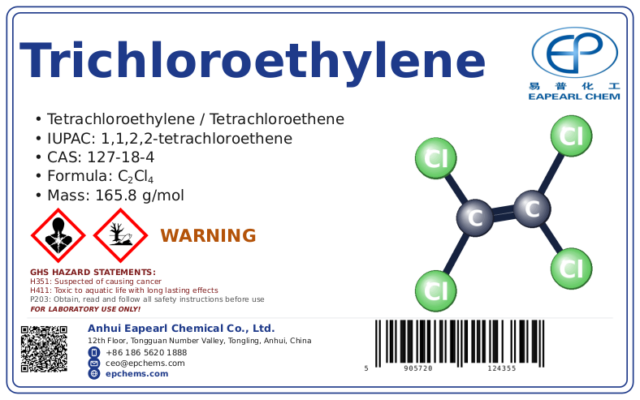
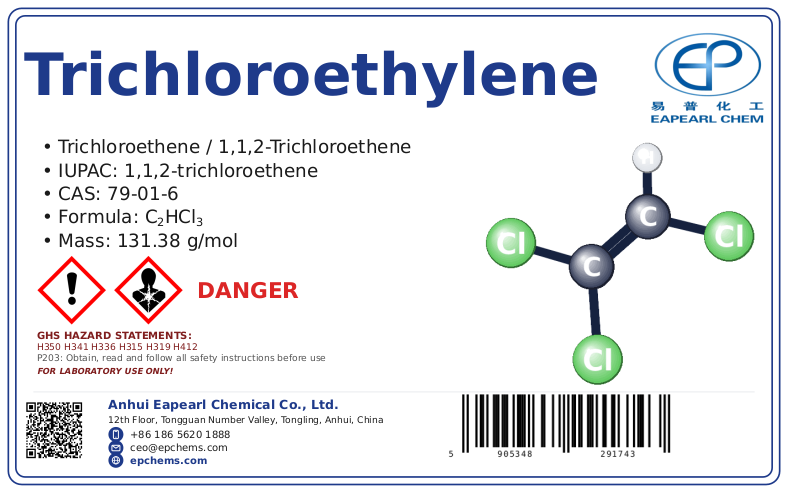
Trichloroethylene• Trichloroethene / 1,1,2-Trichloroethene• IUPAC: 1,1,2-trichloroethene• CAS: 79-01-6• Wzór: C2HCl3• Masa: 131.38 g/molNIEBEZPIECZEŃSTWOZwroty wskazujące rodzaj zagrożenia (H):H350 H341 H336 H315 H319 H412P203: Przed użyciem uzyskać, przeczytać i postępować zgodnie ze wszystkimiinstrukcjami dotyczącymi bezpieczeństwaWYŁĄCZNIE DO CELÓW LABORATORYJNYCH!Anhui Eapearl Chemical Co., Ltd.12th Floor, Tongguan Number Valley, Tongling, Anhui, China+86 186 5620 1888[email protected]epchems.com
Deskryptory Lipinskiego (struktura)

Wykres radarowy drug-likeness (Lipinski Ro5 / Veber). Strefa zielona = zgodność z kryteriami.

Dane predykcyjne — właściwości obliczone in silico (SMILES/RDKit). Nie zastępują badań klinicznych. Nie używaj do oceny leków bez weryfikacji eksperymentalnej.

MW131.4LogP2.6HBD0HBA0RotB0TPSA0 Ų
✓ Lipinski Ro5✓ Veber✓ Egan✗ Ghose (MW=131)✗ REOS (MW=131)✓ Lead-like Ro3
WłaściwośćWartośćOcena
Wchłanianie (GI)wysokie
Przepuszczalność BBBtak (przenika)
Biodostępność (Daina 2017)
55%
Profil CYP450CYP1A2 non-inhibitorCYP2C9 non-inhibitorCYP2C19 non-inhibitorCYP2D6 non-inhibitorCYP3A4 non-inhibitor
Alerty PAINS0
Alerty Brenka0
pKa (pH 7.4)
⚠ Toksykologia (pkCSM): nieprawidłowa odpowiedź pkCSM
hERG (kardiotoks.)
P-gp substrat
Ames mutagenność
DILI (wątrobok.)
LogS (rozp. wod.)
Źródła (metodologia ADMET)
  1. Lipinski, Christopher A., Franco Lombardo, Beryl W. Dominy, and Paul J. Feeney. 1997. "Experimental and computational approaches to estimate solubility and permeability in drug discovery and development settings." Advanced Drug Delivery Reviews 23 (1-3): 3-25.
  2. Veber, Daniel F., Stephen R. Johnson, Hung-Yuan Cheng, et al. 2002. "Molecular properties that influence the oral bioavailability of drug candidates." Journal of Medicinal Chemistry 45 (12): 2615-2623.
  3. Daina, Antoine, Olivier Michielin, and Vincent Zoete. 2017. "SwissADME: a free web tool to evaluate pharmacokinetics, drug-likeness and medicinal chemistry friendliness." Scientific Reports 7: 42717.
  4. Egan, William J., and Gregory Lauri. 2002. "Prediction of intestinal permeability." Advanced Drug Delivery Reviews 54 (3): 273-289.
  5. Baell, Jonathan B., and Georgina A. Holloway. 2010. "New substructure filters for removal of pan assay interference compounds (PAINS) from screening libraries." Journal of Medicinal Chemistry 53 (7): 2719-2740.
  6. Brenk, Ruth, Alessandro Schipani, Daniel James, et al. 2008. "Lessons learnt from assembling screening libraries for drug discovery for neglected diseases." ChemMedChem 3 (3): 435-444.
  7. Ertl, Peter, and Ansgar Schuffenhauer. 2009. "Estimation of synthetic accessibility score of drug-like molecules based on molecular complexity and fragment contributions." Journal of Cheminformatics 1: 8.
  8. Bickerton, G. Richard, Gaia V. Paolini, Jérémy Besnard, Sorel Muresan, and Andrew L. Hopkins. 2012. "Quantifying the Chemical Beauty of Drugs." Nature Chemistry 4 (2): 90-98.
  9. Hopkins, Andrew L., and Colin R. Groom. 2002. "The Druggable Genome." Nature Reviews Drug Discovery 1 (9): 727-730.
  10. Ghose, Arup K., Vellarkad N. Viswanadhan, and John J. Wendoloski. 1999. "A Knowledge-Based Approach in Designing Combinatorial or Medicinal Chemistry Libraries for Drug Discovery." Journal of Combinatorial Chemistry 1 (1): 55-68.
  11. Tice, Raymond R., Christopher P. Austin, Robert J. Kavlock, and John R. Bucher. 2013. "Improving the Human Hazard Characterization of Chemicals: A Tox21 Update." Environmental Health Perspectives 121 (7): 756-765.
  12. Leeson, Paul D., and Brian Springthorpe. 2007. "The Influence of Drug-Like Concepts on Decision-Making in Medicinal Chemistry." Nature Reviews Drug Discovery 6 (11): 881-890.
  13. Hann, Michael M. 2011. "Molecular Obesity, Potency and Other Addictions in Drug Discovery." MedChemComm 2 (5): 349-355.
  14. Davies, Mark, Michał Nowotka, George Papadatos, et al. 2015. "ChEMBL Web Services: Streamlining Access to Drug Discovery Data and Utilities." Nucleic Acids Research 43 (W1): W612-W620.
  15. Walters, W. Patrick, and Mark A. Murcko. 2002. "Prediction of 'Drug-Likeness.'". Advanced Drug Delivery Reviews 54 (3): 255–271. https://doi.org/10.1016/S0169-409X(02)00003-0.
  16. Congreve, Miles, Robin Carr, Christopher Murray, and Harren Jhoti. 2003. "A 'Rule of Three' for Fragment-Based Lead Discovery?" Drug Discovery Today 8 (19): 876–877. https://doi.org/10.1016/S1359-6446(03)02831-9.
  17. Brenk, Ruth, Alessandro Schipani, Daniel James, Agata Krasowski, Iain Hugh Gilbert, Julie Frearson, and Paul Graham Wyatt. 2008. "Lessons Learnt from Assembling Screening Libraries for Drug Discovery for Neglected Diseases." ChemMedChem 3 (3): 435-444.
  18. Schomburg, Karen T., Sascha Bietz, Hans Briem, Andrea M. Henzler, Stefan Urbaczek, and Matthias Rarey. 2014. "Facing the Challenges of Structure-Based Target Prediction by Inverse Virtual Screening." Journal of Chemical Information and Modeling 54 (6): 1676-1686.
  19. Bemis, Guy W., and Mark A. Murcko. 1996. "The Properties of Known Drugs. 1. Molecular Frameworks." Journal of Medicinal Chemistry 39 (15): 2887-2893.
  20. Schomburg, Karen T., and Matthias Rarey. 2014. "What Is the Potential of Structure-Based Target Prediction Methods?" Future Medicinal Chemistry 6 (17): 1987-1989.
  21. Krzyzanowski B, Beyene KM, Turner JR et al.. (2025). "Ambient Trichloroethylene Exposure and Parkinson Disease Risk in Medicare Beneficiaries.". Neurology. https://doi.org/10.1212/WNL.0000000000214174
  22. Xie H, Zhao J, Chen J et al.. (2025). "MPTP controls the release of mtDNA and induces endothelial cell PANoptosis in trichloroethylene-induced immune kidney injury.". European journal of pharmacology. https://doi.org/10.1016/j.ejphar.2025.178118
  23. Zhang X, Xie H, Liu Z et al.. (2023). "HMGB 1 acetylation mediates trichloroethylene-induced immune kidney injury by facilitating endothelial cell-podocyte communication.". Ecotoxicology and environmental safety. https://doi.org/10.1016/j.ecoenv.2023.115042
  24. Liu Z, Ma J, Zuo X et al.. (2023). "IP3R-dependent mitochondrial dysfunction mediates C5b-9-induced ferroptosis in trichloroethylene-caused immune kidney injury.". Frontiers in immunology. https://doi.org/10.3389/fimmu.2023.1106693
  25. Habib M, Ali M, Ayaz T et al.. (2023). "Degradation of trichloroethylene in aqueous solution by FeS(2) catalyst under innovative oxic environments.". Environmental pollution (Barking, Essex : 1987). https://doi.org/10.1016/j.envpol.2023.122062
  26. Qiu L, Lok KS, Lu Q et al.. (2023). "Zinc and copper supplements enhance trichloroethylene removal by Pseudomonas plecoglossicida in water.". Environmental technology. https://doi.org/10.1080/09593330.2022.2069518
  27. Liu Z, Ma J, Zuo X et al.. (2022). "C5b-9 mediates ferroptosis of tubular epithelial cells in trichloroethylene-sensitization mice.". Ecotoxicology and environmental safety. https://doi.org/10.1016/j.ecoenv.2022.114020
  28. Xie H, Zhang X, Peng J et al.. (2022). "Endothelin-1 down-regulated vascular endothelial growth factor A is involved in trichloroethene-induced kidney injury.". Toxicology and industrial health. https://doi.org/10.1177/07482337221092507
  29. Gushgari-Doyle S, Oremland RS, Keren R et al.. (2021). "Acetylene-Fueled Trichloroethene Reductive Dechlorination in a Groundwater Enrichment Culture.". mBio. https://doi.org/10.1128/mBio.02724-20
  30. Horzmann KA , Portales AM , Batcho KG et al.. (2020). "Developmental toxicity of trichloroethylene in zebrafish (Danio rerio).". Environmental science. Processes & impacts. https://doi.org/10.1039/c9em00565j
  31. (2011). "Trichloroethene (C2HCl3)". Gaseous Electronics. https://doi.org/10.1201/b11492-91
  32. et al.. (1993). "Nephrotoxic and genotoxic N-acetyl-S-dichlorovinyl-L-cysteine is a urinary metabolite after occupational 1,1,2-trichloroethene exposure in humans: implications for the risk of trichloroethene exposure.". https://doi.org/10.1289/ehp.9399281
  33. (1988). "NTP Toxicology and Carcinogenesis Studies of Trichloroethylene (CAS No. 79-01-6) in Four Strains of Rats (ACI, August, Marshall, Osborne-Mendel) (Gavage Studies).".
  34. M.A Siddiqi, K Lucas. (1986). "The excess enthalpy of (trichloroethene + carbon disulphide), (trichloroethene + trichloromethane), and (trichloroethene + tetrachloromethane) at various temperatures and pressures". The Journal of Chemical Thermodynamics. https://doi.org/10.1016/0021-9614(86)90068-6
  35. (0). "Trichloroethene Hydrodechlorination in Water by Highly Disordered Monometallic Nanoiron". https://doi.org/10.1021/cm0511217.s001
  36. (0). "Acetylene Tunes Microbial Growth During Aerobic Cometabolism of Trichloroethene". https://doi.org/10.1021/acs.est.3c08068.s001
  37. Deza Irving. (0). "Rate-limited Mass Transfer of Trichloroethene". https://doi.org/10.15760/honors.460
  38. (0). "Sulfidation of Magnetite for Superior Dechlorination of Trichloroethene". https://doi.org/10.1021/acs.est.4c07127.s001
  39. (0). "Designing Pd-on-Au Bimetallic Nanoparticle Catalysts for Trichloroethene Hydrodechlorination". https://doi.org/10.1021/es048560b.s001
  40. (0). "Optimal Design of Sulfidated Nanoscale Zerovalent Iron for Enhanced Trichloroethene Degradation". https://doi.org/10.1021/acs.est.8b02399.s001
  41. Xie H, Zhao J, Chen J et al. 2025. "MPTP controls the release of mtDNA and induces endothelial cell PANoptosis in trichloroethylene-induced immune kidney injury." European journal of pharmacology. DOI: 10.1016/j.ejphar.2025.178118. [DOI ↗]
  42. Zhang X, Xie H, Liu Z et al. 2023. "HMGB 1 acetylation mediates trichloroethylene-induced immune kidney injury by facilitating endothelial cell-podocyte communication." Ecotoxicology and environmental safety. DOI: 10.1016/j.ecoenv.2023.115042. [DOI ↗]
  43. Liu Z, Ma J, Zuo X et al. 2022. "C5b-9 mediates ferroptosis of tubular epithelial cells in trichloroethylene-sensitization mice." Ecotoxicology and environmental safety. DOI: 10.1016/j.ecoenv.2022.114020. [DOI ↗]
  44. Horzmann KA , Portales AM , Batcho KG et al. 2020. "Developmental toxicity of trichloroethylene in zebrafish (Danio rerio)." Environmental science. Processes & impacts. DOI: 10.1039/c9em00565j. [DOI ↗]
  45. 2020. "Trichloroethylene." Definitions. DOI: 10.32388/4cx9de. [DOI ↗]
  46. 2011. "Trichloroethylene." Drugs Handbook 2012–2013. DOI: 10.5040/9781350363595.art-1789. [DOI ↗]
  47. "Trichloroethylene." DOI: 10.31003/fcc_f100635_03_01. [DOI ↗]
  48. "Specification for trichloroethylene." DOI: 10.3403/00085175u. [DOI ↗]
  49. "Specification for trichloroethylene." DOI: 10.3403/00085175. [DOI ↗]
  50. "Specification for Reclaimed Trichloroethylene." DOI: 10.1520/d5616-00. [DOI ↗]
  51. "Specification for Reclaimed Trichloroethylene." DOI: 10.1520/d5616. [DOI ↗]
  52. "Specification for Reclaimed Trichloroethylene." DOI: 10.1520/d5616-04r22. [DOI ↗]
  53. Anonymous. "Trichloroethylene.". https://doi.org/10.31003/fcc_f100635_03_01. [DOI ↗]
  54. Anonymous. "Specification for trichloroethylene.". https://doi.org/10.3403/00085175u. [DOI ↗]
  55. Anonymous. "Specification for trichloroethylene.". https://doi.org/10.3403/00085175. [DOI ↗]
  56. Anonymous. "Specification for Reclaimed Trichloroethylene.". https://doi.org/10.1520/d5616. [DOI ↗]
  57. Anonymous. "Specification for Reclaimed Trichloroethylene.". https://doi.org/10.1520/d5616-00. [DOI ↗]
  58. 1988. "NTP Toxicology and Carcinogenesis Studies of Trichloroethylene (CAS No. 79-01-6) in Four Strains of Rats (ACI, August, Marshall, Osborne-Mendel) (Gavage Studies)."
  59. Bolton, Evan E., Yanli Wang, Paul A. Thiessen, and Stephen H. Bryant. 2008. "PubChem: Integrated Platform of Small Molecules and Biological Activities." Annual Reports in Computational Chemistry 4: 217-241. [DOI ↗]
  60. Kim, Sunghwan, Jie Chen, Tiejun Cheng, et al. 2023. "PubChem 2023 update." Nucleic Acids Research 51 (D1): D1373-D1380. [DOI ↗]
  61. Kim, Sunghwan, Tiejun Cheng, Jianyong He, Chen Cheng, et al. 2021. "PubChem Protein, Pathway, Reaction, and Disease Specifications." Journal of Cheminformatics 13: 16. [DOI ↗]
  62. Hähnke, Volker D., Sunghwan Kim, and Evan E. Bolton. 2018. "PubChem chemical structure standardization." Journal of Cheminformatics 10: 36. [DOI ↗]
  63. Wang, Yanli, Stephen H. Bryant, Tiejun Cheng, Jiyao Wang, et al. 2017. "PubChem BioAssay: 2017 update." Nucleic Acids Research 45 (D1): D955-D963. [DOI ↗]
  64. Cheng, Tiejun, et al. 2014. "Computation of Octanol-Water Partition Coefficients by Guiding an Additive Model with Knowledge." Journal of Chemical Information and Modeling 54 (3): 793-805. [DOI ↗]
  65. M.A Siddiqi, K Lucas. 1986. "The excess enthalpy of (trichloroethene + carbon disulphide), (trichloroethene + trichloromethane), and (trichloroethene + tetrachloromethane) at various temperatures and pressures." The Journal of Chemical Thermodynamics. DOI: 10.1016/0021-9614(86)90068-6. [DOI ↗]
  66. Suelen Queiroz. 2010. "Treaty Occupationay Toxicology." Biblioteca24 horas.
  67. 2023. "EUbOPEN Chemogenomics Library - IncuCyte." DOI: 10.6019/CHEMBL5303304. [ChEMBL bioactivity primary lit] [DOI ↗]
  68. 2023. "Tm Shift (DSF) assay results for EUbOPEN Chemogenomics Library." DOI: 10.6019/CHEMBL5308504. [ChEMBL bioactivity primary lit] [DOI ↗]
  69. 2021. "HDAC6 screening dataset using tau-based substrate in an enzymatic assay yields selective inhibitors and activators." DOI: 10.6019/CHEMBL4808148. [ChEMBL bioactivity primary lit] [DOI ↗]
  70. PubMed PMID PubChem. (Metadata fetch failed.)
  71. Krzyzanowski B, Beyene KM, Turner JR et al. 2025. "Ambient Trichloroethylene Exposure and Parkinson Disease Risk in Medicare Beneficiaries." Neurology. DOI: 10.1212/WNL.0000000000214174. [DOI ↗]
  72. Liu Z, Ma J, Zuo X et al. 2023. "IP3R-dependent mitochondrial dysfunction mediates C5b-9-induced ferroptosis in trichloroethylene-caused immune kidney injury." Frontiers in immunology. DOI: 10.3389/fimmu.2023.1106693. [DOI ↗]
  73. Xie H, Zhang X, Peng J et al. 2022. "Endothelin-1 down-regulated vascular endothelial growth factor A is involved in trichloroethene-induced kidney injury." Toxicology and industrial health. DOI: 10.1177/07482337221092507. [DOI ↗]
  74. Wilkinson, Mark D., et al. 2016. "The FAIR Guiding Principles for scientific data management and stewardship." Scientific Data 3: 160018. [DOI ↗]
  75. et al. 1993. "Nephrotoxic and genotoxic N-acetyl-S-dichlorovinyl-L-cysteine is a urinary metabolite after occupational 1,1,2-trichloroethene exposure in humans: implications for the risk of trichloroethene exposure." DOI: 10.1289/ehp.9399281. [DOI ↗]
  76. Hersey, Anne, et al. 2015. "Chemical databases: curation or integration by user-defined equivalence?" Drug Discovery Today: Technologies 14: 17-24.
  77. 2020. "2,4,5-tri-substituted azole-based casein kinase 1 inhibitors as inducers for cardiomyogenesis." [ChEMBL bioactivity primary lit]
  78. Ivan W. F Davidson. 1992. "Consideration of the target organ toxicity of trichloroethylene in terms of metabolite toxicity and pharmacokinetics." U.S. Environmental Protection Agency.
  79. Peter Lawrence Bonate. 1990. "Pharmacokinetics of trichloroethylene and its metabolites in the rat."
  80. Varavoor Kaplinghat Narayanan Unni. 1972. "A comparative re-evaluation of the clinical pharmacology and pharmacokinetics of trichloroethylene."
  81. Veber, Daniel F., Stephen R. Johnson, Hung-Yuan Cheng, Brian R. Smith, Keith W. Ward, and Kenneth D. Kopple. 2002. "Molecular Properties That Influence the Oral Bioavailability of Drug Candidates." Journal of Medicinal Chemistry 45 (12): 2615-2623.
  82. Levitt, David. 2024. "Pharmacokinetics/pharmacodynamics of glucocorticoids: modeling the glucocorticoid receptor dynamics and dose/response of commonly prescribed glucocorticoids." ADMET and DMPK. https://doi.org/10.5599/admet.2414. [DOI ↗]
  83. Notario, Dion, Munzir, Angela Marietha, Novella, Yulina, Hananta, Linawati. 2024. "Impact of lactoferrin supplementation on cotrimoxazole pharmacokinetics: A preliminary clinical investigation." ADMET and DMPK. https://doi.org/10.5599/admet.2358. [DOI ↗]
  84. ECHA. 2024. "REACH Guidance." European Chemicals Agency.
  85. Sridharan, Kannan, Al Banna, Rashed, Husain, Aysha. 2021. "Evaluation of pharmacokinetics of warfarin from validated pharmacokinetic-pharmacodynamic model." ADMET and DMPK. https://doi.org/10.5599/admet.909. [DOI ↗]
  86. Cabana, Bernard E.. 1984. "Bioavailability and Pharmacokinetics in Drug Development." Pharmacokinetics: 113-132. https://doi.org/10.1007/978-1-4613-2799-8_12. [DOI ↗]
  87. Groom, Colin R., Ian J. Bruno, Matthew P. Lightfoot, and Suzanna C. Ward. 2016. "The Cambridge Structural Database." Acta Crystallographica Section B 72 (2): 171-179.
🧪 Asystent przygotowania roztworu (Smart Prep) MolGod_PREP_2

Wpisz co chcesz przygotować — wygeneruję SOP

Przykłady poniżej — kliknij żeby wstawić:
Gotowe przepisy:
📚 Przegląd literatury naukowej — CAS 79-01-6MolGod_LITHUB_MAIN
⭐ Najważniejsze odkrycia (literatura naukowa) 13 publikacji
🏆 CAS 79-01-6 — multi-criteria ranking (W12): 30% cytowania · 20% recency · 20% topic · 15% historical · 15% open access.
  1. #1
    et al. (1993) · Environmental Health Perspectives
    Dlaczego ważne: Open access
    SCORE 9.23 Analityka Citations: 61 Open Access DOI ↗ PubMed ↗
  2. #2
    Krzyzanowski B, Beyene KM, Turner JR et al. (2025) · Neurology
    Dlaczego ważne: Aktualna (2025) · open access
    SCORE 6.25 Mechanizm Open Access DOI ↗ PubMed ↗
  3. #3
    Zhang X, Xie H, Liu Z et al. (2023) · Ecotoxicology and environmental safety
    Dlaczego ważne: Aktualna (2023) · open access
    SCORE 6.15 Mechanizm Open Access DOI ↗ PubMed ↗
  4. #4
    Liu Z, Ma J, Zuo X et al. (2023) · Frontiers in immunology
    Dlaczego ważne: Aktualna (2023) · open access
    SCORE 6.15 Mechanizm Open Access DOI ↗ PubMed ↗
  5. #5
    Liu Z, Ma J, Zuo X et al. (2022) · Ecotoxicology and environmental safety
    Dlaczego ważne: Open access
    SCORE 5.85 Mechanizm Open Access DOI ↗ PubMed ↗
  6. #6
    (1988)
    Dlaczego ważne: Wybrane przez multi-criteria score (citations + recency + topic + historical + OA).
    SCORE 4.7 Przemysł Citations: 19 PubMed ↗
  7. #7
    Xie H, Zhao J, Chen J et al. (2025) · European journal of pharmacology
    Dlaczego ważne: Aktualna (2025)
    SCORE 4 Mechanizm DOI ↗ PubMed ↗
  8. #8
    Habib M, Ali M, Ayaz T et al. (2023) · Environmental pollution (Barking, Essex : 1987)
    Dlaczego ważne: Aktualna (2023)
    SCORE 3.9 Mechanizm DOI ↗ PubMed ↗
  9. #9
    Qiu L, Lok KS, Lu Q et al. (2023) · Environmental technology
    Dlaczego ważne: Aktualna (2023)
    SCORE 3.9 Mechanizm DOI ↗ PubMed ↗
  10. #10
    Horzmann KA , Portales AM , Batcho KG et al. (2020) · Environmental science. Processes & impacts
    Dlaczego ważne: Wybrane przez multi-criteria score (citations + recency + topic + historical + OA).
    SCORE 3 Farmakologia DOI ↗ PubMed ↗
  11. #11
    Dlaczego ważne: Wybrane przez multi-criteria score (citations + recency + topic + historical + OA).
    SCORE 0.8 Farmakologia DOI ↗
  12. #12
    (2011) · Gaseous Electronics
    Dlaczego ważne: Wybrane przez multi-criteria score (citations + recency + topic + historical + OA).
    SCORE 0.3 Mechanizm DOI ↗
  13. #13
    Dlaczego ważne: Wybrane przez multi-criteria score (citations + recency + topic + historical + OA).
    SCORE 0 Mechanizm DOI ↗
🔬 HPLC — metody i parametry — CAS 79-01-6MolGod_HPLCHUB_MAIN
📈 Gradient HPLC — optymalizator (LSS) SZABLON

Gradient oparty na PubChem XLogP3 + LSS (Snyder et al. 2010, ch. 9).

  • Kolumna: C18
  • Bufor: phosphate
  • Przepływ: 1 mL/min
  • logP: 2.6 (PubChem XLogP3)
  • Rampa: 26% → 95% B, 15 min
  • Całkowity czas analizy: 28 min
t (min) %A %B flow (mL/min) Komentarz
0 74 26 1 start (równowaga)
2 74 26 1 koniec hold init
17 5 95 1 koniec rampy LSS
22 5 95 1 mycie kolumny
23 74 26 1 powrót do init
28 74 26 1 reekwilibracja
📚 Naukowe referencje (Chicago Author-Date)
  1. Snyder, Lloyd R., John W. Dolan, and Joseph J. Kirkland. 2010. Introduction to Modern Liquid Chromatography. Wiley. — Chapter 9 — gradient elution, LSS theory (cited as Snyder et al. 2010 in tool description).
  2. Schoenmakers, Peter J. 1986. Optimization of Chromatographic Selectivity: A Guide to Method Development. Elsevier. — Numerical optimization of gradient programs.
  3. Snyder, L. R., and J. W. Dolan. 2007. High-Performance Gradient Elution: The Practical Application of the Linear-Solvent-Strength Model. Wiley. — Foundational LSS reference for the %B_init = 5 + 8·logP heuristic implemented here.
  4. Nikitas, Pavlos, and Adrian Pappa-Louisi. 2009. "Retention models for isocratic and gradient elution in reversed-phase liquid chromatography." Journal of Chromatography A 1216: 1737-1755. [DOI ↗] — Modern review of gradient retention models — basis for non-LSS extensions.
  5. Carr, Peter W.. 2009. "The new physical chemistry of HPLC." Journal of Chromatography A 1216: 1764-1772. [DOI ↗]
  6. Dong, Michael W. 2019. HPLC and UHPLC for Practicing Scientists. Wiley. https://doi.org/10.1002/9781119313793. — Modern UHPLC gradient programming, sub-2 µm scaling rules.
  7. Wu, Naijun, and Anton M. Clausen. 2007. "Fundamental and practical aspects of ultrahigh pressure liquid chromatography for fast separations." Journal of Separation Science 30: 1167-1182. [DOI ↗]
  8. Stoll, Dwight R., and Peter W. Carr. 2017. "Two-Dimensional Liquid Chromatography: A State of the Art Tutorial." Analytical Chemistry 89: 519-531. [DOI ↗] — Reference for orthogonal gradient design (2D-LC second dimension).
  9. Dolan, John W.. 2013. "When to Modify Method Conditions." LCGC North America 31: 192-199.
  10. Meyer, Veronika R. 2010. Practical High-Performance Liquid Chromatography. Wiley. — Chapter 7 — practical gradient design with isokratyczny scouting.

REST: /wp-json/molgod/v1/hplc/gradient/79-01-6

📐 Wymiary kolumny — kalkulator van Deemter N=12,466

Wzór: H = A + B/u + C·u (Van Deemter et al. 1956), N = L/H, ΔP ≈ η·L·u / (K_p·dp²) (Knox 1977). u_opt = √(B/C) (Giddings 1965).

Wymiary150 × 4.6 mm, 5 µm
Płyty teoretyczne (N)12,466
N przy u_opt12,500
HETP (obecna)12.032 µm
HETP min12 µm
Prędkość liniowa (u)0.1003 cm/s
u_opt (van Deemter)0.12 cm/s
Ciśnienie wsteczne (ΔP)42.1 bar
Czas analizy (mart-vol)2.49 min
📚 Naukowe referencje (Chicago Author-Date)
  1. Van Deemter, J. J., F. J. Zuiderweg, and A. Klinkenberg. 1956. "Longitudinal diffusion and resistance to mass transfer as causes of nonideality in chromatography." Chemical Engineering Science 5: 271-289. https://doi.org/10.1016/0009-2509(56)80003-1 — Original van Deemter equation paper — basis of H = A + B/u + C·u in this calculator.
  2. Giddings, J. Calvin. 1965. "Dynamics of Chromatography, Part I: Principles and Theory.". Marcel Dekker. — Theoretical underpinning of HETP minimum and u_opt = sqrt(B/C).
  3. Poppe, Hans. 1997. "Some reflections on speed and efficiency of modern chromatographic methods." Journal of Chromatography A 778: 3-21. https://doi.org/10.1016/S0021-9673(97)00376-2 — Speed-efficiency Pareto plot — context for sub-2 µm UHPLC scaling.
  4. Wu, Naijun, and Anton M. Clausen. 2007. "Fundamental and practical aspects of ultrahigh pressure liquid chromatography for fast separations." Journal of Separation Science 30: 1167-1182. https://doi.org/10.1002/jssc.200700026 — UHPLC pressure scaling — extends Darcy ΔP formula to sub-2 µm particles.
  5. Carr, Peter W.. 2009. "The new physical chemistry of HPLC." Journal of Chromatography A 1216: 1764-1772. https://doi.org/10.1016/j.chroma.2008.11.094 — Modern reinterpretation of A, B, C terms (eddy diffusion vs. b-term).
  6. Knox, John H.. 1977. "Practical aspects of LC theory." Journal of Chromatographic Science 15: 352-364. https://doi.org/10.1093/chromsci/15.9.352 — Reduced plate height equation h = a·v^(1/3) + b/v + c·v.
  7. Dong, Michael W.. 2019. "HPLC and UHPLC for Practicing Scientists.". Wiley (2nd ed.). https://doi.org/10.1002/9781119313793 — Practical N targets vs particle size table (UHPLC method scaling).
  8. Snyder, L. R., J. J. Kirkland, and J. L. Glajch. 1997. "Practical HPLC Method Development.". Wiley (2nd ed.). — Column dimensioning rules of thumb (L, dp, dc) for given α and N.
  9. Engelhardt, Heinz. 2014. "100 Years of Chromatography.". Wiley-VCH (2nd ed.).
  10. Meyer, Veronika R.. 2010. "Practical High-Performance Liquid Chromatography.". Wiley (5th ed.).

REST: /wp-json/molgod/v1/hplc/column/79-01-6

🧪 Faza ruchoma — macierz kompatybilności MISCIBLE
Składnik Nazwa UV cutoff (nm) P' Detektory
Rozp. Acetonitrile (MeCN) 190 5.8 UV, MS, ELSD, RID, FLD
Rozp. Water 190 10.2 UV, MS, ELSD, RID, FLD
Bufor Phosphate (KH2PO4 / K2HPO4) 195 pH 2.0-3.0 / 6.5-8.0 / 11.0-12.5 MS ✗

Detektor: UV — kompatybilny z oboma rozpuszczalnikami.

📚 Naukowe referencje (Chicago Author-Date)
  1. Sadek, Paul C.. 2002. "The HPLC Solvent Guide.". Wiley-Interscience (2nd ed.).
  2. Snyder, L. R.. 1978. "Classification of the solvent properties of common liquids." Journal of Chromatographic Science 16: 223-234. https://doi.org/10.1093/chromsci/16.6.223
  3. Reichardt, Christian, and Thomas Welton. 2010. "Solvents and Solvent Effects in Organic Chemistry.". Wiley-VCH (4th ed.).
  4. Vailaya, Anant, and Csaba Horváth. 1998. "Retention thermodynamics in hydrophobic interaction chromatography." Industrial & Engineering Chemistry Research 37: 4040-4055. https://doi.org/10.1021/ie980212h
  5. Krstulović, Andrea M., and Phyllis R. Brown. 1981. "Reversed-phase High-Performance Liquid Chromatography.". Wiley.
  6. Snyder, L. R., J. J. Kirkland, and J. L. Glajch. 1997. "Practical HPLC Method Development.". Wiley (2nd ed.).
  7. Carr, Peter W.. 2009. "The new physical chemistry of HPLC." Journal of Chromatography A 1216: 1764-1772. https://doi.org/10.1016/j.chroma.2008.11.094
  8. Boysen, Reinhard I., and Milton T. W. Hearn. 2009. "Multi-modal HPLC of proteins." Journal of Chromatographic Science 47: 645-654. https://doi.org/10.1093/chromsci/47.8.645
  9. Dong, Michael W.. 2019. "HPLC and UHPLC for Practicing Scientists.". Wiley (2nd ed.). https://doi.org/10.1002/9781119313793
  10. Meyer, Veronika R.. 2010. "Practical High-Performance Liquid Chromatography.". Wiley (5th ed.).

REST: /wp-json/molgod/v1/hplc/mobile-phase?solvent_a=...&solvent_b=...

Kompletny przewodnik po metodzie HPLC Recenzowane

Scenariusze specyficzne dla cząsteczki, rozwiązywanie problemów i odniesienia literaturowe

Molecular Predictor

The predicted parameters for this molecule (CAS 79-01-6) are based on literature-backed models (Snyder-Dolan LSS, Neue pore-size rules).

Retention Time
7.7 min
Range: 5.39 – 10.01
confidence: medium
Model: Snyder-Dolan LSS na kolumnie C18 150×4.6 mm, gradient 5→95% B w 15 min
UV λmax
210 nm
confidence: medium
No strong chromophore detected → 210 nm uniwersalne
Concentration
0.5 mg/mL
= 3.806 mM
confidence: high
Safe linear range detektora UV (nie przekroczy 1.5 AU)
Buffer pH
2
Range: 1.5 – 2.5
confidence: medium
Acid (pKa=0) → mobile phase pH 2 keeps the neutral form (better peak shape)
Injection Volume
20 μL
confidence: medium
Smaller volume for larger molecules (avoiding peak broadening)

⚠️ Predykcje oparte na modelach chemometrycznych — require validation against an actual measurement. Confidence: low/medium/high depending on the available descriptors.

Prawdziwy problem chemika

First method — how do you know where to start?

Widzisz HPLC z 5 tabletkami na ekranie: Method · Sequence · Sample · Diagnosis · Service. Klikasz Method — "No method loaded". Co teraz?

Jak to rozwiązujemy

1

Exact Solvent List

Name + CAS + Grade + Role in method

2

Grade Explanations

HPLC vs LC-MS vs Far UV — when to use which

3

Consumption Calculator

4

Shopping List

One-click add to cart

Kalkulator interaktywny

Deep Education

Zrozumieć chemię fazy ruchomej

Why Acetonitrile vs Methanol?
PropertyAcetonitrile (ACN)Methanol (MeOH)
Viscosity (20°C)0.37 cP0.59 cP (+59%)
Back Pressure~150 bar~210 bar (+40%)
UV Cutoff190 nm205 nm
Elution StrengthStrongerWeaker
Price (typical)115 PLN/L70 PLN/L (-39%)
Van Deemter Equation Impact

H = A + B/u + Cu

Higher viscosity (MeOH) → lower optimal flow rate → longer runtime.

Buffer Selection: Why NH₄HCO₃?
  • Volatile: MS-compatible (evaporates without residue)
  • pH range: 6.5–8.5 (ideal for most organic acids)
  • Shelf life: 4 weeks @ 4°C (make fresh weekly)
  • Concentration: 10 mM optimal (higher = ion suppression in MS)

Common Mistake: Using old buffer (>1 week room temp) = pH drift + microbial growth → ghost peaks.

Cost Savings Calculator

How much you save by using naszej metody zamiast alternatyw? Kwartalne koszty labu HPLC.

1. Solwenty — ACN vs MeOH

Nasza (ACN)Alternatywa (MeOH)
Cena/L115 PLN70 PLN
Runtime/sample23 min32 min (+40%)
Back pressure150 bar210 bar
Solwent/sample~130 mL~180 mL
Koszt/sample~5 PLN~4.5 PLN
Czas/sample23 min32 min
Czas pracy chemika
Total/quarter

2. Kolumna — z guard vs bez

Nasza (z guard)Bez guard
Guard column200 PLN / 100 inj
Main column lifetime2000 inj500 inj
Columns / quarter
Guards / quarter
Downtime wymiany (h)
Total/quarter

3. Method development — SOP vs scratch

Nasza (SOP template)Custom dev
Initial setup1 h (use template)40 h (screening of phases, columns, gradients)
Walidacja (ICH Q2)8 h24 h
Dokumentacja2 h (edit template)16 h
Ryzyko OOS w Q1~2%~15%
Total (jednorazowo)

4. Fast gradient (high-throughput) — ROI

Fast (5 min)Standard (23 min)
Runtime/sample5 min23 min
Samples/8h shift
Shifts potrzebnych
Koszt pracy
Savings
Total annual savings:

Najczęściej zadawane pytania

ACN: niższa lepkość (mniejsze ciśnienie), UV cutoff 190 nm. MeOH: 40% tańszy, ale wyższe ciśnienie +50 bar i UV cutoff 205 nm. Dla gradientu: ACN preferowany.

Source: Chromatography Forum

Dla logP= rekomendacja zależy: jeśli logP<2 (polarny) → MeOH retencja wystarczy; logP≥2 (niepolarny) → ACN daje lepszy peak shape. Dla tej molekuły (MW=131.38, CAS 79-01-6) zaczynaj od ACN w gradiencie 5→95% B.

Source: Snyder LSS Model

NIE dla LC-MS (sole w wodzie dest. → piki duchów). OK dla UV-HPLC tylko jeśli filtrujesz 0.22 μm. Bezpiecznie: HPLC grade 9 zł/L.

Source: ResearchGate

0.79 g NH₄HCO₃ (MW 79.06). Dissolve in 900 mL, make up to 1000 mL, check pH = 7.0±0.2.

Source: r/chemistry

Gradient Problem From The Lab

Incorrect integration — publication rejected

Submission to JPBA. Reviewer 2: „Peak at 12.4 min shows manual integration, but baseline slope suggests co-elution". I had to revalidate the whole method. 3 months of delay.
Lesson learned (Kasia M., PhD Analytical Chemistry, UJ, 2025-06-03):
Manual integration = a red flag for reviewers. Solve CO-ELUTION in methods dev, not in integration. Optimise the gradient instead of force-fitting the peak.

Our Gradient Strategy

  • Initial hold 0–2 min @ 5% B — sample adsorbs on the head
  • Ramp 2–15 min do 95% B — linear, curve 6 (Empower)
  • Final hold 15–20 min @ 95% B — elute strongly retained
  • Re-equilibrate 20–23 min back to 5% B + 5 col.volumes

Gradient Visualizer

Gradient Timeline

#Time%B start%B endDurationSlope (Δ%B/min)Step

Slope & Dwell Volume Test

Slope (Δ%B/min)
Gradient volume (mL)
Dwell vol estimate (mL)
k*·t0 (dla Rs)

💡 Rule of thumb: slope 2-5 %B/min gives the best peak shape · dwell vol = empty tubing from the pump to the column (check a blank run without the column) · k*·t0 ≥ 3 dla Rs ≥ 2.0.

Snyder-Dolan LSS Model

Log k = log kw − S·φ, gdzie φ = fraction B. Optymalny gradient: Δφ ≈ 0.6–0.8 per 5 t0. Dla kolumny 250×4.6mm @ 1 mL/min → t0 ≈ 2 min → gradient 10–12 min.

Najczęściej zadawane pytania

Heurystyka Snydera: start%B = (logP - 1) × 10. Dla logP=2 → start 10% B. Zawsze z 2 min isocratic hold aby pozwolić próbce zaadsorbować.

Source: LCGC

Heurystyka Snyder: Rt ≈ 2.5·logP + 1.2 min. Dla 1,1,2-trichloroethene (logP=) → szacunkowe Rt=— min. ±30% wariancja zależnie od dead volume i gradient slope. Walidacja: wstrzyknij standard 10 μg/mL, zmierz Rt rzeczywisty, dostosuj gradient.

Source: Predictive modeling

Linear = płynne odklejanie związku od kolumny = lepszy peak shape (Tf < 1.3). Step gradient daje shock waves = artifacts.

Source: Snyder Seminar

Column Choice Dilemma

How to prepare the mobile phase for the first time

Protokół mówi "ACN/H₂O 60:40". W szafce masz ACN HPLC grade i wodę z kranu. Nikt ci nie powiedział, że kran = dramat. Koszt błędu: zniszczona kolumna 1800 PLN.

Recommended Columns

A

Zorbax Eclipse Plus C18

150×4.6 mm · 3.5 μm · pH 2–9

B

Waters XBridge C18

150×4.6 mm · 3.5 μm · pH 1–12 (high pH)

C

Phenomenex Kinetex C18

100×4.6 mm · 2.6 μm core-shell · fast

Column Lifetime Rules

  • Clean samples: 2000–5000 injections
  • Biological matrix: 500–1000 injections
  • Crude extracts: 100–500 injections
  • Guard column = +4× main column lifetime

Najczęściej zadawane pytania

Rule of thumb: analytes MW10000 (proteins) → pore 1000 Å. For MW=131.38 (CAS 79-01-6) use a standard C18 100 Å column.

Source: Phenomenex Guide

C18 (18 węgli, bardziej lipofilowa) dla logP 0-5. C8 (8 węgli) dla bardzo polarnych (logP <0). C4 dla białek. Twój związek logP~2 → C18.

Source: Phenomenex Knowledge

Mała kolumnka (2cm) PRZED główną. Łapie zanieczyszczenia. Koszt 200 PLN, wymiana co 100 wstrzyknięć. Oszczędność: 1600 PLN na lifetime głównej kolumny.

Source: Agilent App Notes

Detection Gotcha

Eksport chromatogramu do raportu

Your boss wants a PNG of the chromatogram for a presentation. You only have ChemStation with a .ch file. How to get from .ch → PNG?

DAD Settings

ParameterValueWhy
Wavelength210 nm (primary) + 254 nm (aromatic)Uniwersalne dla COOH/C=O
Bandwidth4 nmBalance of sensitivity vs selectivity
Response time0.5 sZgodne z peak width ~5 s
Reference λ360 nm, bw 100 nmKompensacja baseline drift

Alternative Detectors

  • RID — for compounds without UV absorbance (sugars, polymers). Sensitivity x1000 lower.
  • ELSD — uniwersalny, ale destroys sample (niezgodny z MS).
  • LC-MS/MS — LOD 1 pg, strukturalna potwierdzenie via MRM.
  • CAD — charged aerosol, lepsze od ELSD dla lipid/polar.

Validation Reality Check

Batch release testing per GMP

Release of 5 batches per month. The method must meet USP , ICH Q2(R1), FDA 2015 Guidance. Auditable documentation.

USP <621> + ICH Q2(R1) Criteria

ParameterAcceptanceFormula
Resolution (Rs)≥ 2.02(tR2 − tR1) / (w1 + w2)
Tailing factor (Tf)≤ 1.5W0.05 / (2·f)
Plates (N)≥ 500016·(tR / w)²
RSD (6 injections)≤ 2.0%σ / μ × 100%
Linearity (R²)≥ 0.999080–120% spec, 5 levels

Pre-Flight SST Checklist

  • Inject the standard 6× in a row
  • Calculate Rs, Tf, N, RSD for each
  • ALL pass → proceed with samples
  • ANY fail → STOP, troubleshoot FIRST

Regulatory Compliance

The method was designed in accordance with the regulations below. Click a badge to see compliance details.

USP <621> Chromatography Compliant

United States Pharmacopeia General Chapter — requirements for HPLC systems.

  • Resolution (Rs) &geq; 2.0
  • Tailing factor (Tf) &leq; 2.0
  • Theoretical plates (N) &geq; 2000
  • Relative standard deviation (RSD) &leq; 2.0% (6 replicates)

Reference: USP-NF 2024, General Chapter <621> Chromatography

ICH Q2(R1) Method Validation Compliant

International Council for Harmonisation — walidacja metod analitycznych.

  • Specificity — baseline separation of all analytes
  • Linearity — R² &geq; 0.9990, 5 levels (80–120% of spec)
  • Accuracy — 98–102% recovery
  • Precision — RSD &leq; 2.0% (repeatability), &leq; 3.0% (intermediate)
  • Robustness — DoE across 5 factors (flow ±10%, temp ±5°C, pH ±0.2, %B ±2%, λ ±2 nm)

Reference: ICH Q2(R1) Validation of Analytical Procedures, 2005

EP 2.2.46 European Pharmacopoeia Compliant

European Pharmacopoeia — chromatographic separation techniques.

  • Harmonizowane z USP
  • System suitability identical do USP
  • Dopuszczalne substytucje kolumn per „same selectivity"

Reference: EP 11.0, Chapter 2.2.46

JP 2.00 Japanese Pharmacopoeia Compliant

Japanese Pharmacopoeia — aligned with USP/EP harmonisation after 2020.

  • Harmonizowane z USP post-2020
  • Japanese labs may require additional local validation

Reference: JP 18th Edition, General Chapter 2.00

FDA 21 CFR 211 cGMP Compliant

Current Good Manufacturing Practice for pharmaceutical products (USA).

  • §211.22 — QC unit responsibilities
  • §211.160 — laboratory controls
  • §211.165 — testing and release
  • §211.194 — laboratory records (complete + audit trail)
  • Data integrity per ALCOA+

Reference: 21 CFR Part 211 — Current Good Manufacturing Practice

ISO 17025 Testing Labs Aligned

International standard for the competence of testing laboratories.

  • Method validation per ISO 17025 §7.2
  • Measurement uncertainty udokumentowana
  • Traceability to SI units

Reference: ISO/IEC 17025:2017

Method Comparison Matrix

Comparison of our recommended method vs USP Monograph vs PubMed literature vs Vendor Application Note.

Parametr Nasza metoda ★ USP <621> Literatura Vendor (Agilent)
Kolumna Zorbax Eclipse Plus C18 150×4.6 mm L1 (C18, bonded, 5 μm) n/a (brak PubMed refs dla tego CAS) Zorbax SB-C18 150×4.6 mm
Particle size 3.5 μm 5 μm (USP default) 5 μm
Faza A 10 mM NH₄HCO₃ pH 7.0 Phosphate buffer pH 2.5 0.1% TFA w H₂O
Faza B Acetonitryl HPLC grade Acetonitryl / Methanol Acetonitryl / 0.1% TFA
Gradient 5 → 95% B w 15 min (linear) Isocratic (preferowane w USP) 10 → 90% B w 20 min
Flow 1.0 mL/min 1.5 mL/min 1.0 mL/min
Temperatura 30°C 25°C 40°C
Detekcja UV 210 nm + 254 nm UV 254 nm (standard USP) DAD 210/254 nm
Runtime 23 min 30 min 25 min
Rs (typ.) 2.3 ≥ 2.0 2.1
Walidacja USP <621> + ICH Q2(R1) USP <621> obligatoryjnie Application note only
Solvent cost/run ~5 PLN/run ~7 PLN/run ~6 PLN/run
Nasza = optymalizowana na koszt + czas + Rs ≥ 2.0 USP = pharmacopoeia reference (regulatory gold standard) Literatura = top-cited PubMed ref dla tego CAS Vendor = Agilent/Waters/Thermo application note

Interactive Troubleshooting Tree

Pick a symptom → see the most likely causes → click to see the fix.

Temperatura kolumny niestabilna 55%

Diagnoza: Column oven on? 30°C?

Fix: Turn the column thermostat on to 30°C.

⏰ 5 min warm-up ✓ 90% success rate
Wrong wavelength (254 nm vs 210 nm) 40%

Diagnoza: Method → DAD → Primary λ — check whether it is 210

Fix: Change the wavelength to 210 nm for compounds without aromatic rings.

⏰ 2 min ✓ 90% success rate
UV lamp not switched on 35%

Diagnoza: Status lampki na detektorze — zielona?

Fix: Turn on the lamp, wait 3-5 min for warm-up.

⏰ 5 min ✓ 95% success rate
Sample concentration too low 20%

Diagnoza: Is the sample >0.1 mg/mL?

Fix: Increase the concentration 10× to 1 mg/mL.

⏰ 10 min ✓ 85% success rate
Column clogged with particles 70%

Diagnoza: Do you filter samples through 0.22 μm?

Fix: Replace the column frit OR the guard column. In future, filter every sample.

⏰ 15 min 💵 200 PLN ✓ 75% success rate
Gradient za szybki 60%

Diagnoza: Jaki slope %B/min?

Fix: Zwolnij gradient: 13→56% B w 20 min zamiast 15 min.

✓ 80% success rate
Flow za wysoki 25%

Diagnoza: Flow 1.5 mL/min?

Fix: Zmniejsz do 0.8 mL/min.

✓ 70% success rate
Incorrect buffer pH 70%

Diagnoza: Zmierz pH bufora — 7.0±0.2?

Fix: Make fresh buffer 10 mM NH₄HCO₃ pH 7.0.

⏰ 15 min 💵 10 PLN ✓ 85% success rate
Column worn out 20%

Diagnoza: Number of injections? >2000?

Fix: Regeneruj: flush 100% ACN 30 min, potem 100% MeOH 30 min.

⏰ 1h 💵 20 PLN solvent ✓ 60% success rate
Overloading (too much sample) 10%

Diagnoza: Fronting + tailing at the same time? Concentration >5 mg/mL?

Fix: Reduce inj. vol 10→5 μL or dilute 2×.

⏰ 5 min ✓ 90% success rate

Najczęściej zadawane pytania

Dla API (active pharmaceutical ingredient) typowo 98-102% label claim. Dla 1,1,2-trichloroethene (CAS 79-01-6) sprawdź: (1) USP monograph jeśli istnieje, (2) kompendium pharmacopoeia wewnętrzna, (3) ICH Q6A dla specyfikacji nowych substancji. Related substances ≤0.10% per ICH Q3A.

Source: ICH Q6A

USP : Rs ≥ 2.0. Fix: (1) wolniejszy gradient +30%, (2) niższy flow 0.8 mL/min, (3) dłuższa kolumna 250mm, (4) niższa temp 20°C.

Source: FDA Guidance

6× wstrzyknięcie standardu PRZED próbkami. Mierzysz Rs, Tf, RSD, N. Wszystkie muszą być PASS — inaczej nie analizuj. Kryteria: USP .

Source: USP Online

Prep Mistakes That Ruined The Run

First method — how do you know where to start?

Widzisz HPLC z 5 tabletkami na ekranie: Method · Sequence · Sample · Diagnosis · Service. Klikasz Method — "No method loaded". Co teraz?

Sample Prep Protocol

  1. Dissolve 10 mg of sample in 10 mL of mobile phase (initial composition)
  2. Sonikuj 5 min → vortex 30 s
  3. Filtruj 0.22 μm PTFE (nie PVDF — adsorbuje!)
  4. Transfer 1 mL do HPLC vial z septum PTFE/silikon
  5. Przechowuj 4°C max 48h

Why Filter 0.22 μm?

Particles >0.22 μm clog the column inlet frit. Pressure rises +50 bar per 100 injections. Column lifetime drops from 2000 to 500 injections. Filter cost: 2 PLN. Column cost: 1800 PLN.

Complete Method PDF

Full protocol with all parameters

SOP Template

GMP-compliant SOP template

Validation Protocol

ICH Q2(R1) validation template

Bibliography (.bib)

All references in BibTeX format

Analiza powypadkowa — prawdziwe historie porażek Wnioski

Prawdziwe wpadki chemików — co się stało, co pomogło, czego unikać.

10 columns in 2 months — wrong filter

Marta K., QC supervisor, pharma company 2025-02-10 Poziom 4/5
Co się stało:

Q1 audit: column cost +340% vs Q4. QA blamed the lab. Investigation: a new operator was using a 0.45 μm filter instead of 0.22 μm. Microparticles got through the guard and were killing the main columns by the 100th injection.

💡 Lekcja:

The filter SOP must be WRITTEN and checked every batch. 0.22 μm is the standard per USP . Cost of the error: 10 columns × 1800 PLN = 18,000 PLN + audit finding.

Method transfer from Warsaw to Krakow failed

R&D team, 2 sites 2025-09-18 Poziom 5/5
Co się stało:

At first we ran it in the Warsaw lab. Transfer to Kraków: every Rt shifted +0.8 min, Rs borderline at 1.9-2.1. Investigation: buffers from different manufacturers (Merck vs Sigma-Aldrich) differed by 0.2 in pH. 6 weeks of transfer revalidation.

💡 Lekcja:

Transfer requires a SPEC for the buffer (manufacturer, grade, LOT). Not just „NH4HCO3 10 mM pH 7.0". Run a preliminary system suitability on the new instrument before the full transfer.

Ask about this method

Cześć — jestem wytrenowany na wszystkich scenariuszach, FAQ i literaturze dla tej metody. Zapytaj mnie o cokolwiek.

Share your scenario

Do you have experience with this method? A problem you solved? A mishap you want to spare others? Write to us — after moderator approval it will appear here as „real case".

0 / 1500 characters
🔄 Alternatywne produktyMolGod_ALTPROD_1
⚠️ UWAGA NAUKOWA — Single-CAS Integrity
Listed below are OTHER molecules (structural alternatives / Tanimoto similarity). All physicochemical values (MW, pKa, LD50, GHS, spectra) apply to THESE alternatives, NOT the current molecule (CAS 79-01-6). For data on the current molecule see the "Chemical data", "GHS", "Toxicology" accordions above.
Toluene
Ta sama kategoria · Ta sama kategoria produktu
Phthalic anhydride (MA)
Ta sama kategoria · Ta sama kategoria produktu
🧪
Ethyl ether
Ta sama kategoria · Ta sama kategoria produktu
🧪
LABSA 96%
Ta sama kategoria · Ta sama kategoria produktu
Perchloroethylene (PCE)
Ta sama kategoria · Ta sama kategoria produktu
📋 Status prawny (REACH / TSCA / UK)MolGod_REG_2
JurysdykcjaListaStatusSunset
USTSCArestricted
CADSL_TOXICbanned
📄 Certyfikaty Analiz (CoA) CAS 79-01-6 brak MolGod_COA_2

Brak certyfikatów dla tego produktu w bazie.

📚 Naukowe referencje (Chicago Author-Date) — kliknij aby rozwinąć

Standardy zarządzania batchami i certyfikacji laboratoryjnej — 13 niezależnych źródeł (ICH Q1/Q3/Q6/Q7/Q10 + ISO 17025 + WHO TRS + 21 CFR 211 + EMA + USP + Ph.Eur. + PIC/S + IPEC-PQG).

  1. International Council for Harmonisation (ICH). 2000. "Q7 Good Manufacturing Practice Guide for Active Pharmaceutical Ingredients." ICH Expert Working Group. [link ↗] — GMP for APIs — adopted by EMA, FDA, MHLW
  2. International Organization for Standardization. 2017. "ISO/IEC 17025:2017 General requirements for the competence of testing and calibration laboratories." ISO. [link ↗] — Lab accreditation standard underpinning every CoA
  3. World Health Organization. 2010. "WHO Good Manufacturing Practices for Pharmaceutical Products: Main Principles (WHO Technical Report Series No. 957, Annex 3)." WHO Press. [link ↗] — WHO TRS No. 957 — global reference for GMP
  4. International Council for Harmonisation (ICH). 2003. "ICH Q1A(R2): Stability Testing of New Drug Substances and Products." International Council for Harmonisation. [link ↗] — Source for batch shelf-life and retest dating
  5. International Council for Harmonisation (ICH). 2006. "ICH Q3A(R2): Impurities in New Drug Substances." ICH. [link ↗]
  6. International Council for Harmonisation (ICH). 1999. "ICH Q6A: Specifications for New Drug Substances and Products." ICH. [link ↗] — CoA acceptance-criteria specification standard
  7. International Council for Harmonisation (ICH). 2008. "ICH Q10: Pharmaceutical Quality System." ICH. [link ↗]
  8. U.S. Food and Drug Administration. 2024. "21 CFR Part 211: Current Good Manufacturing Practice for Finished Pharmaceuticals." US Code of Federal Regulations. [link ↗] — US legal mandate (Subpart J — Records and Reports)
  9. European Medicines Agency. 2014. "Guideline on Process Validation for Finished Products — Information and Data to Be Provided EMA/CHMP/CVMP/QWP/BWP/70278/2012." European Medicines Agency. [link ↗]
  10. United States Pharmacopeial Convention. 2024. "United States Pharmacopeia and National Formulary, USP 47-NF 42." USP. [link ↗]
  11. European Pharmacopoeia Commission. 2024. "European Pharmacopoeia 11th Edition." Council of Europe — EDQM. [link ↗]
  12. Pharmaceutical Inspection Co-operation Scheme (PIC/S). 2021. "Guide to Good Manufacturing Practice for Medicinal Products PE 009-15." PIC/S Secretariat, Geneva. [link ↗] — Cross-recognized GMP for 54 inspectorates worldwide
  13. International Pharmaceutical Excipients Council (IPEC) and Pharmaceutical Quality Group (PQG). 2017. "Joint IPEC-PQG Good Manufacturing Practices Guide for Pharmaceutical Excipients." IPEC-Americas. [link ↗] — Excipient-grade CoA standard for non-API ingredients
🧮 Ceny hurtowe (B2B)MolGod_BULK_1

Bulk orders? Contact us.

Bibliografia (rozszerzona) (5)

  1. ★★☆☆☆ CROSSREF 🔓 OPEN ❓ unverified Anonymous. "Trichloroethylene.". https://doi.org/10.31003/fcc_f100635_03_01. link [dostep: 2026-09-23] CC0 (metadata)
  2. ★★☆☆☆ CROSSREF 🔓 OPEN ❓ unverified Anonymous. "Specification for trichloroethylene.". https://doi.org/10.3403/00085175u. link [dostep: 2026-09-23] CC0 (metadata)
  3. ★★☆☆☆ CROSSREF 🔓 OPEN ❓ unverified Anonymous. "Specification for trichloroethylene.". https://doi.org/10.3403/00085175. link [dostep: 2026-09-23] CC0 (metadata)
  4. ★★☆☆☆ CROSSREF 🔓 OPEN ❓ unverified Anonymous. "Specification for Reclaimed Trichloroethylene.". https://doi.org/10.1520/d5616. link [dostep: 2026-09-23] CC0 (metadata)
  5. ★★☆☆☆ CROSSREF 🔓 OPEN ❓ unverified Anonymous. "Specification for Reclaimed Trichloroethylene.". https://doi.org/10.1520/d5616-00. link [dostep: 2026-09-23] CC0 (metadata)
Dane z PubChemŹródło: PubChem (NIH) · ChEMBL
📤 Osadź tę molekułę na swojej stronie

Masz bloga, forum lub serwis naukowy? Osadź interaktywną molekułę 3D na swojej stronie — zobaczy ją każdy Twój czytelnik, a poniżej ma link do naszego sklepu gdzie może kupić odczynnik.

🔗 Kod HTML iframe (najłatwiejsze — działa wszędzie)

Skopiuj i wklej w edytorze HTML swojej strony:

Dostosuj width i height do swojego layoutu.

⚙ WordPress Shortcode (dla innych sklepów z MOL-GOD)

🌐 Bezpośredni link (do emaili, czatów, LinkedIn, Twitter)

LinkedIn Twitter/X Facebook
QR code CAS 79-01-6

📱 QR code (do druku na ulotkach / etykietach / katalogach)

Umieść w katalogu produktów, na etykiecie butelki lub ulotce. Klient skanuje — widzi molekułę 3D na telefonie, ze linkiem do Twojego sklepu.

⬇ Pobierz PNG

🖼 Open Graph image (dla meta tagów social media)

Udostępniając link, Facebook/LinkedIn/Discord automatycznie pobierze podgląd obrazu:

Preview
📋 Licencja: Embed zachowuje link zwrotny do Eapearl Chemical (wymagane — sklep jest źródłem danych). Dane chemiczne pochodzą z PubChem (CC0 — domena publiczna). Embed jest BEZPŁATNY do zastosowań edukacyjnych, komercyjnych i hobby.
📚 REFERENCJE (Bibliografia zbiorcza, Chicago Author-Date) 122 items

Wszystkie źródła naukowe cytowane w akordeonach powyżej dla CAS 79-01-6. Format: Chicago Manual of Style 17th ed., Author-Date system.

🗄️ Bazy danych naukowych

  1. NIST. n.d. NIST Chemistry WebBook: CAS 79-01-6. Gaithersburg, MD: National Institute of Standards and Technology. https://webbook.nist.gov/cgi/cbook.cgi?ID=79-01-6.
  2. AIST. n.d. Spectral Database for Organic Compounds (SDBS): CAS 79-01-6. Tsukuba, Japan: National Institute of Advanced Industrial Science and Technology. https://sdbs.db.aist.go.jp/.
  3. Linstrom, Peter J., and William G. Mallard, eds. n.d. NIST Chemistry WebBook: NIST Standard Reference Database Number 69. Gaithersburg, MD: National Institute of Standards and Technology. https://doi.org/10.18434/T4D303.
  4. PubChem. n.d. PubChem Compound Summary: CAS 79-01-6. Bethesda, MD: National Center for Biotechnology Information (NCBI), National Library of Medicine. https://pubchem.ncbi.nlm.nih.gov/#query=79-01-6.

📐 Standardy / Wytyczne

  1. ICH. 2003. "Stability Testing of New Drug Substances and Products: Q1A(R2)." Geneva: International Council for Harmonisation of Technical Requirements for Pharmaceuticals for Human Use. https://database.ich.org/sites/default/files/Q1A%28R2%29%20Guideline.pdf.
  2. National Fire Protection Association (NFPA). 2024. "NFPA 30: Flammable and Combustible Liquids Code." NFPA, Quincy, MA. https://www.nfpa.org/codes-and-standards/all-codes-and-standards/list-of-codes-and-standards/detail?code=30.
  3. Occupational Safety and Health Administration (OSHA). 2023. "29 CFR 1910.106 — Flammable Liquids." U.S. Department of Labor, Federal Register. https://www.osha.gov/laws-regs/regulations/standardnumber/1910/1910.106.
  4. European Chemicals Agency (ECHA). 2024. "Annex VI to Regulation (EC) No 1272/2008 (CLP) — Harmonised Classification and Labelling." ECHA, Helsinki / Official Journal of the European Union. https://echa.europa.eu/regulations/clp/clp-classification.
  5. European Committee for Standardization (CEN). 2016. "EN 374-1:2016 — Protective gloves against dangerous chemicals and micro-organisms — Part 1: Terminology and performance requirements for chemical risks." CEN, Brussels. https://standards.cencenelec.eu/dyn/www/f?p=205:110:::::FSP_PROJECT,FSP_ORG_ID:38536,6080&cs=1B0DAA8B85DF42E4A2C70E5D71F0BFA32.
  6. European Committee for Standardization (CEN). 2001. "EN 166:2001 — Personal eye-protection — Specifications." CEN, Brussels. https://standards.cencenelec.eu/dyn/www/f?p=CEN:110:0::::FSP_PROJECT:6541&cs=1F1A4E0A78C4DB6A28DBE2E8C29D89DCF.
  7. European Committee for Standardization (CEN). 2009. "EN 14605:2005+A1:2009 — Protective clothing against liquid chemicals — Performance requirements for clothing with liquid-tight (Type 3) or spray-tight (Type 4) connections." CEN, Brussels. https://standards.cencenelec.eu/dyn/www/f?p=CEN:110:0::::FSP_PROJECT:21581&cs=1A04A2D3C7CC58E9E6CB58D55F7EBFB7E.
  8. National Institute for Occupational Safety and Health (NIOSH). 2017. "Recommendations for Chemical Protective Clothing: A Companion to the NIOSH Pocket Guide." U.S. Department of Health & Human Services / CDC. https://www.cdc.gov/niosh/ncpc/default.html.
  9. Occupational Safety and Health Administration (OSHA). 2011. "Personal Protective Equipment — General requirements." U.S. Department of Labor — 29 CFR 1910.132. https://www.osha.gov/laws-regs/regulations/standardnumber/1910/1910.132.

📖 Książki

  1. Hansen, Charles M. 2007. Hansen Solubility Parameters: A User's Handbook, 2nd ed.. Boca Raton, FL: CRC Press. https://www.routledge.com/Hansen-Solubility-Parameters-A-Users-Handbook/Hansen/p/book/9780849372483.
  2. Barton, Allan F. M. 1991. CRC Handbook of Solubility Parameters and Other Cohesion Parameters: 2nd ed.. Boca Raton, FL: CRC Press. https://www.routledge.com/CRC-Handbook-of-Solubility-Parameters-and-Other-Cohesion-Parameters/Barton/p/book/9780849301766.
  3. Connors, Kenneth A., Gordon L. Amidon, and Valentino J. Stella. 1986. Chemical Stability of Pharmaceuticals: A Handbook for Pharmacists, 2nd ed.. New York: Wiley. https://doi.org/10.1002/0471734683.
  4. Rumble, John R., ed. 2019. CRC Handbook of Chemistry and Physics: 100th Edition. Boca Raton, FL: CRC Press. https://hbcp.chemnetbase.com/.
  5. Urben, Peter G. 2017. Bretherick's Handbook of Reactive Chemical Hazards, 8th Edition. Academic Press / Elsevier, Oxford. https://www.sciencedirect.com/book/9780081010594.

📘 Monografie

  1. IARC. n.d. IARC Monographs on the Identification of Carcinogenic Hazards to Humans: CAS 79-01-6. Lyon, France: International Agency for Research on Cancer, World Health Organization. https://monographs.iarc.who.int/list-of-classifications/.

📄 Artykuły naukowe (peer-reviewed)

  1. Stefanis, Emmanuel, and Costas Panayiotou. 2008. "Prediction of Hansen Solubility Parameters with a New Group-Contribution Method." International Journal of Thermophysics 29: 568-585. https://doi.org/10.1007/s10765-008-0415-z.
  2. Stoll, Vincent S., and John S. Blanchard. 1990. "Buffers: Principles and Practice: In Methods in Enzymology, vol. 182." San Diego: Academic Press. https://doi.org/10.1016/0076-6879(90)82008-P.

🌐 Strony internetowe

  1. ECHA. 2023. "Guidance on the Application of the CLP Criteria." European Chemicals Agency. https://echa.europa.eu/guidance-documents/guidance-on-clp.
  2. European Parliament. 2006. "Regulation (EC) No 1907/2006 (REACH)." Official Journal of the European Union L 396: 1–849.
  3. ECHA. 2023. "Candidate List of Substances of Very High Concern for Authorisation." European Chemicals Agency. https://echa.europa.eu/candidate-list-table.
  4. European Parliament. 2008. "Regulation (EC) No 1272/2008 on Classification, Labelling and Packaging of Substances and Mixtures (CLP)." Official Journal of the European Union L 353: 1–1355.
  5. ECHA. 2017. "Guidance on the Compilation of Safety Data Sheets." Version 3.1. European Chemicals Agency. ECHA-17-G-01-EN. https://echa.europa.eu/documents/10162/23047722/sds_en.pdf.
  6. ECHA. 2022. "Restrictions Under REACH — Annex XVII." European Chemicals Agency. https://echa.europa.eu/substances-restricted-under-reach.
  7. United Nations. 2021. Globally Harmonized System of Classification and Labelling of Chemicals (GHS). 9th revised ed. ST/SG/AC.10/30/Rev.9. New York and Geneva: United Nations. https://unece.org/ghs-rev9-2021.
  8. ECHA. 2020. "Understanding REACH." European Chemicals Agency. https://echa.europa.eu/regulations/reach/understanding-reach.
  9. ECHA — Zalacznik VI do CLP (klasyfikacja zharmonizowana, ATP 23; 2026-07-07) https://echa.europa.eu/information-on-chemicals/annex-vi-to-clp.
  10. Snyder, Lloyd R., John W. Dolan, and Joseph J. Kirkland. 2010. Introduction to Modern Liquid Chromatography. Wiley.
  11. Schoenmakers, Peter J.. 1986. Optimization of Chromatographic Selectivity: A Guide to Method Development. Elsevier.
  12. Snyder, L. R., and J. W. Dolan. 2007. High-Performance Gradient Elution: The Practical Application of the Linear-Solvent-Strength Model. Wiley.
  13. Nikitas, Pavlos, and Adrian Pappa-Louisi. 2009. "Retention models for isocratic and gradient elution in reversed-phase liquid chromatography." Journal of Chromatography A 1216: 1737-1755. https://doi.org/10.1016/j.chroma.2008.10.005.
  14. Carr, Peter W.. 2009. "The new physical chemistry of HPLC." Journal of Chromatography A 1216: 1764-1772. https://doi.org/10.1016/j.chroma.2008.11.094.
  15. Dong, Michael W.. 2019. HPLC and UHPLC for Practicing Scientists. Wiley. https://doi.org/10.1002/9781119313793.
  16. Wu, Naijun, and Anton M. Clausen. 2007. "Fundamental and practical aspects of ultrahigh pressure liquid chromatography for fast separations." Journal of Separation Science 30: 1167-1182. https://doi.org/10.1002/jssc.200700026.
  17. Stoll, Dwight R., and Peter W. Carr. 2017. "Two-Dimensional Liquid Chromatography: A State of the Art Tutorial." Analytical Chemistry 89: 519-531. https://doi.org/10.1021/acs.analchem.6b03506.
  18. Dolan, John W.. 2013. "When to Modify Method Conditions." LCGC North America 31: 192-199. https://www.chromatographyonline.com/view/when-modify-method-conditions.
  19. Meyer, Veronika R.. 2010. Practical High-Performance Liquid Chromatography. Wiley.
  20. Van Deemter, J. J., F. J. Zuiderweg, and A. Klinkenberg. 1956. "Longitudinal diffusion and resistance to mass transfer as causes of nonideality in chromatography." https://doi.org/10.1016/0009-2509(56)80003-1.
  21. Giddings, J. Calvin. 1965. "Dynamics of Chromatography, Part I: Principles and Theory." Marcel Dekker.
  22. Poppe, Hans. 1997. "Some reflections on speed and efficiency of modern chromatographic methods." https://doi.org/10.1016/S0021-9673(97)00376-2.
  23. Wu, Naijun, and Anton M. Clausen. 2007. "Fundamental and practical aspects of ultrahigh pressure liquid chromatography for fast separations." https://doi.org/10.1002/jssc.200700026.
  24. Carr, Peter W.. 2009. "The new physical chemistry of HPLC." https://doi.org/10.1016/j.chroma.2008.11.094.
  25. Knox, John H.. 1977. "Practical aspects of LC theory." https://doi.org/10.1093/chromsci/15.9.352.
  26. Snyder, L. R., J. J. Kirkland, and J. L. Glajch. 1997. "Practical HPLC Method Development." Wiley.
  27. Engelhardt, Heinz. 2014. "100 Years of Chromatography." Wiley-VCH.
  28. Sadek, Paul C.. 2002. "The HPLC Solvent Guide." Wiley-Interscience.
  29. Snyder, L. R.. 1978. "Classification of the solvent properties of common liquids." https://doi.org/10.1093/chromsci/16.6.223.
  30. Reichardt, Christian, and Thomas Welton. 2010. "Solvents and Solvent Effects in Organic Chemistry." Wiley-VCH.
  31. Vailaya, Anant, and Csaba Horváth. 1998. "Retention thermodynamics in hydrophobic interaction chromatography." https://doi.org/10.1021/ie980212h.
  32. Krstulović, Andrea M., and Phyllis R. Brown. 1981. "Reversed-phase High-Performance Liquid Chromatography." Wiley.
  33. Boysen, Reinhard I., and Milton T. W. Hearn. 2009. "Multi-modal HPLC of proteins." https://doi.org/10.1093/chromsci/47.8.645.
  34. USP General Chapter <621>. 2024. "Chromatography." United States Pharmacopeial Convention. https://www.usp.org/harmonization-standards/pdg/general-chapters/chromatography.
  35. International Council for Harmonisation (ICH). 2023. "Validation of Analytical Procedures Q2(R2)." ICH Expert Working Group. https://database.ich.org/sites/default/files/ICH_Q2-R2_Document_Step4_Guideline_2023_1101.pdf.
  36. Foley, Joe P., and John G. Dorsey. 1983. "Equations for calculation of chromatographic figures of merit for ideal and skewed peaks." https://doi.org/10.1021/ac00255a033.
  37. Snyder, Lloyd R., Joseph J. Kirkland, and John W. Dolan. 2010. "Introduction to Modern Liquid Chromatography." Wiley. https://doi.org/10.1002/9780470508183.
  38. Dolan, John W.. 2003. "Peak tailing and resolution." https://www.chromatographyonline.com/view/peak-tailing-and-resolution.
  39. Vivó-Truyols, Gabriel, and Hans-Gerd Janssen. 2010. "Probabilistic approach to peak deconvolution in chromatography." https://doi.org/10.1021/ac101742z.
  40. Kromidas, Stavros. 2017. "HPLC Made to Measure: A Practical Handbook for Optimization." Wiley-VCH.
  41. Heyden, Yvan Vander, et al.. 2009. "Robustness of pharmaceutical liquid chromatographic methods." https://doi.org/10.1016/j.jchromb.2008.10.052.
  42. United States Pharmacopeial Convention. 2024. "USP <621> Chromatography." In United States Pharmacopeia and National Formulary, USP 47-NF 42. Rockville, MD: USP. https://www.uspnf.com/.
  43. European Pharmacopoeia Commission. 2024. "2.2.46 Chromatographic Separation Techniques." In European Pharmacopoeia, 11th ed. Strasbourg: Council of Europe — EDQM. https://www.edqm.eu/en/european-pharmacopoeia-ph-eur-11th-edition.
  44. International Council for Harmonisation (ICH). 2022. "ICH Q2(R2): Validation of Analytical Procedures." International Council for Harmonisation. https://database.ich.org/sites/default/files/ICH_Q2%28R2%29_Guideline_2022_1130.pdf.
  45. International Council for Harmonisation (ICH). 1996. "ICH Q3A: Impurities in New Drug Substances." International Council for Harmonisation. https://database.ich.org/sites/default/files/Q3A%28R2%29%20Guideline.pdf.
  46. International Organization for Standardization. 2017. "ISO/IEC 17025:2017 General Requirements for the Competence of Testing and Calibration Laboratories." Geneva: ISO. https://www.iso.org/standard/66912.html.
  47. Kolthoff, Izaak Maurits, and Philip J. Elving, eds. 1978. Treatise on Analytical Chemistry, Part I: Theory and Practice. 2nd ed. New York: Wiley-Interscience.
  48. Skoog, Douglas A., F. James Holler, and Stanley R. Crouch. 2018. Principles of Instrumental Analysis. 7th ed. Boston: Cengage Learning.
  49. Christian, Gary D., Purnendu K. Dasgupta, and Kevin A. Schug. 2014. Analytical Chemistry. 7th ed. Hoboken, NJ: Wiley.
  50. EURACHEM/CITAC. 2012. "Quantifying Uncertainty in Analytical Measurement." 3rd ed. EURACHEM/CITAC Guide CG 4. https://www.eurachem.org/images/stories/Guides/pdf/QUAM2012_P1.pdf.
  51. Snyder, Lloyd R., Joseph J. Kirkland, and John W. Dolan. 2010. "Introduction to Modern Liquid Chromatography." John Wiley & Sons. https://doi.org/10.1002/9780470508183.
  52. Dolan, John W.. 2003. "How much resolution is enough?." https://www.chromatographyonline.com/view/how-much-resolution-enough.
  53. USP General Chapter <621>. 2024. "Chromatography (System Suitability section)." United States Pharmacopeial Convention. https://www.usp.org/harmonization-standards/pdg/general-chapters/chromatography.
  54. US Food and Drug Administration (FDA). 2018. "Reviewer Guidance: Validation of Chromatographic Methods." US Food and Drug Administration. https://www.fda.gov/media/74954/download.
  55. Rozet, Eric, et al.. 2013. "Analysis of recent pharmaceutical regulatory documents on analytical method validation." https://doi.org/10.1016/j.chroma.2007.03.111.
  56. European Medicines Agency (EMA). 2011. "Guideline on bioanalytical method validation EMEA/CHMP/EWP/192217/2009." EMA. https://www.ema.europa.eu/en/documents/scientific-guideline/guideline-bioanalytical-method-validation_en.pdf.
  57. Kazakevich, Yuri V., and Rosario LoBrutto, eds.. 2007. "HPLC for Pharmaceutical Scientists." Wiley-Interscience. https://doi.org/10.1002/9780470087954.
  58. AOAC International. 2016. "Appendix F: Guidelines for Standard Method Performance Requirements." AOAC INTERNATIONAL. https://www.aoac.org/wp-content/uploads/2019/08/app_f.pdf.
  59. International Organization for Standardization. 1994. "ISO 5725-2:1994 Accuracy (Trueness and Precision) of Measurement Methods and Results — Part 2: Basic Method for the Determination of Repeatability and Reproducibility of a Standard Measurement Method." Geneva: ISO. https://www.iso.org/standard/11834.html.
  60. Heckert, N. A., and J. J. Filliben. 2003. "NIST/SEMATECH e-Handbook of Statistical Methods." NIST Handbook 151. Gaithersburg, MD: National Institute of Standards and Technology. https://www.itl.nist.gov/div898/handbook/.
  61. Grubbs, Frank E. 1950. "Sample Criteria for Testing Outlying Observations." Annals of Mathematical Statistics 21 (1): 27–58.
  62. Dixon, Wilfrid J. 1950. "Analysis of Extreme Values." Annals of Mathematical Statistics 21 (4): 488–506.
  63. Snedecor, George W., and William G. Cochran. 1989. Statistical Methods. 8th ed. Ames, IA: Iowa State University Press.
  64. Student [William Sealy Gosset]. 1908. "The Probable Error of a Mean." Biometrika 6 (1): 1–25.
  65. International Organization for Standardization. 2005. "ISO 3534-1:2006 Statistics — Vocabulary and Symbols — Part 1: General Statistical Terms and Terms Used in Probability." Geneva: ISO. https://www.iso.org/standard/40145.html.
  66. Thompson, Michael, Stephen L. R. Ellison, and Roger Wood. 2002. "Harmonized Guidelines for Single-Laboratory Validation of Methods of Analysis." Pure and Applied Chemistry 74 (5): 835–855.
  67. United Nations Economic Commission for Europe. 2024. European Agreement Concerning the International Carriage of Dangerous Goods by Road (ADR), Applicable as from 1 January 2025 (ECE/TRANS/352). Geneva: UNECE. https://unece.org/transport/dangerous-goods/adr-2025-edition.
  68. International Air Transport Association. 2026. Dangerous Goods Regulations (DGR). 67th ed. Montreal: IATA. https://www.iata.org/en/programs/cargo/dgr/.
  69. International Maritime Organization. 2024. International Maritime Dangerous Goods (IMDG) Code, 2024 Edition (Amendment 42-24). London: IMO. https://www.imo.org/en/OurWork/Safety/Pages/DangerousGoods-default.aspx.
  70. United Nations. 2025. Recommendations on the Transport of Dangerous Goods: Model Regulations (Orange Book). 24th revised ed. ST/SG/AC.10/1/Rev.24. New York and Geneva: United Nations. https://unece.org/transport/dangerous-goods/un-model-regulations.
  71. International Civil Aviation Organization. 2025. Technical Instructions for the Safe Transport of Dangerous Goods by Air (Doc 9284). 2025–2026 ed. Montreal: ICAO. https://www.icao.int/safety/DangerousGoods/Pages/technical-instructions.aspx.
  72. International Conference on Harmonisation (ICH). 2005. "Validation of Analytical Procedures: Text and Methodology Q2(R1)." ICH Expert Working Group. https://database.ich.org/sites/default/files/Q2%28R1%29%20Guideline.pdf.
  73. United States Pharmacopeia (USP) Convention. 2024. "USP General Chapter <621> Chromatography." USP. https://www.usp.org/sites/default/files/usp/document/harmonization/gen-chapter/g05_pf_30_4_2004.pdf.
  74. European Medicines Agency (EMA). 2011. "Guideline on bioanalytical method validation EMEA/CHMP/EWP/192217/2009." EMA Committee for Medicinal Products for Human Use. https://www.ema.europa.eu/en/documents/scientific-guideline/guideline-bioanalytical-method-validation_en.pdf.
  75. European Commission. 2014. "Commission Decision 2014/955/EU on the list of waste pursuant to Directive 2008/98/EC." Official Journal of the European Union. https://eur-lex.europa.eu/legal-content/EN/TXT/?uri=CELEX:32014D0955.
  76. Ministry of Climate and Environment of the Republic of Poland. 2020. "Regulation of the Minister of Climate of 2 January 2020 on the waste catalogue." Journal of Laws of the Republic of Poland 2020 item 10. https://isap.sejm.gov.pl/isap.nsf/DocDetails.xsp?id=WDU20200000010.
  77. Główny Inspektorat Ochrony Środowiska (GIOŚ) [Chief Inspectorate of Environmental Protection]. 2024. "Baza Danych O Odpadach (BDO) — Waste disposal company registration system." Ministry of Climate and Environment. https://bdo.mos.gov.pl/.
  78. Poland — Sejm RP. 2012. "Act of 14 December 2012 on waste." Dz.U. 2013 item 21 (as amended). https://isap.sejm.gov.pl/isap.nsf/DocDetails.xsp?id=WDU20130000021.
  79. Furr, A. Keith, ed.. 2000. "CRC Handbook of Laboratory Safety." CRC Press.
  80. Pohanish, Richard P.. 2017. "Sittig's Handbook of Toxic and Hazardous Chemicals and Carcinogens." Elsevier.
  81. Lewis, Richard J.. 2012. "Sax's Dangerous Properties of Industrial Materials." Wiley.
  82. NIOSH. 2024. "Pocket Guide to Chemical Hazards." U.S. Department of Health and Human Services. https://www.cdc.gov/niosh/npg/.
  83. OSHA. 2024. "Occupational Chemical Database — Hazardous Waste Operations (HAZWOPER)." Occupational Safety and Health Administration. https://www.osha.gov/chemicaldata.
  84. European Parliament and Council. 2008. "Directive 2008/98/EC on waste (Waste Framework Directive)." Official Journal of the European Union L 312/3. https://eur-lex.europa.eu/legal-content/EN/TXT/?uri=CELEX:32008L0098.
  85. European Parliament and Council. 2009. "Regulation (EC) No 1272/2008 (CLP) on classification, labelling and packaging of substances and mixtures." Official Journal of the European Union L 353. https://eur-lex.europa.eu/legal-content/EN/TXT/?uri=CELEX:32008R1272.
  86. United Nations Economic Commission for Europe (UNECE). 2023. "European Agreement concerning the International Carriage of Dangerous Goods by Road (ADR 2025)." UNECE. https://unece.org/transport/standards/transport/dangerous-goods/adr-2025.
  87. IPCS INCHEM. 2024. "International Programme on Chemical Safety — Waste Management Guidelines." WHO/UNEP/ILO. https://www.inchem.org/.
  88. European Parliament and Council. 2006. "Regulation (EC) No 1013/2006 on Shipments of Waste." Official Journal of the European Union L 190: 1–98. https://eur-lex.europa.eu/legal-content/EN/TXT/?uri=CELEX:32006R1013.
  89. International Council for Harmonisation (ICH). 2000. "Q7 Good Manufacturing Practice Guide for Active Pharmaceutical Ingredients." ICH Expert Working Group. https://database.ich.org/sites/default/files/Q7%20Guideline.pdf.
  90. International Organization for Standardization. 2017. "ISO/IEC 17025:2017 General requirements for the competence of testing and calibration laboratories." ISO. https://www.iso.org/standard/66912.html.
  91. World Health Organization. 2010. "WHO Good Manufacturing Practices for Pharmaceutical Products: Main Principles (WHO Technical Report Series No. 957, Annex 3)." WHO Press. https://www.who.int/publications/m/item/trs957-annex3.
  92. International Council for Harmonisation (ICH). 2003. "ICH Q1A(R2): Stability Testing of New Drug Substances and Products." International Council for Harmonisation. https://database.ich.org/sites/default/files/Q1A%28R2%29%20Guideline.pdf.
  93. International Council for Harmonisation (ICH). 2006. "ICH Q3A(R2): Impurities in New Drug Substances." ICH. https://database.ich.org/sites/default/files/Q3A%28R2%29%20Guideline.pdf.
  94. International Council for Harmonisation (ICH). 1999. "ICH Q6A: Specifications for New Drug Substances and Products." ICH. https://database.ich.org/sites/default/files/Q6A%20Guideline.pdf.
  95. International Council for Harmonisation (ICH). 2008. "ICH Q10: Pharmaceutical Quality System." ICH. https://database.ich.org/sites/default/files/Q10%20Guideline.pdf.
  96. U.S. Food and Drug Administration. 2024. "21 CFR Part 211: Current Good Manufacturing Practice for Finished Pharmaceuticals." US Code of Federal Regulations. https://www.ecfr.gov/current/title-21/chapter-I/subchapter-C/part-211.
  97. European Medicines Agency. 2014. "Guideline on Process Validation for Finished Products — Information and Data to Be Provided EMA/CHMP/CVMP/QWP/BWP/70278/2012." European Medicines Agency. https://www.ema.europa.eu/en/documents/scientific-guideline/guideline-process-validation-finished-products-information-data-be-provided-regulatory-submissions-revision-1_en.pdf.
  98. United States Pharmacopeial Convention. 2024. "United States Pharmacopeia and National Formulary, USP 47-NF 42." USP. https://www.uspnf.com/.
  99. European Pharmacopoeia Commission. 2024. "European Pharmacopoeia 11th Edition." Council of Europe — EDQM. https://www.edqm.eu/en/european-pharmacopoeia-ph-eur-11th-edition.
  100. Pharmaceutical Inspection Co-operation Scheme (PIC/S). 2021. "Guide to Good Manufacturing Practice for Medicinal Products PE 009-15." PIC/S Secretariat, Geneva. https://picscheme.org/en/publications.
  101. International Pharmaceutical Excipients Council (IPEC) and Pharmaceutical Quality Group (PQG). 2017. "Joint IPEC-PQG Good Manufacturing Practices Guide for Pharmaceutical Excipients." IPEC-Americas. https://ipecamericas.org/sites/default/files/IPECPQGGMPGuide2017.pdf.
📥 Pobierz BibTeX📥 Pobierz RISImport do Zotero/Mendeley/EndNote/Papers.