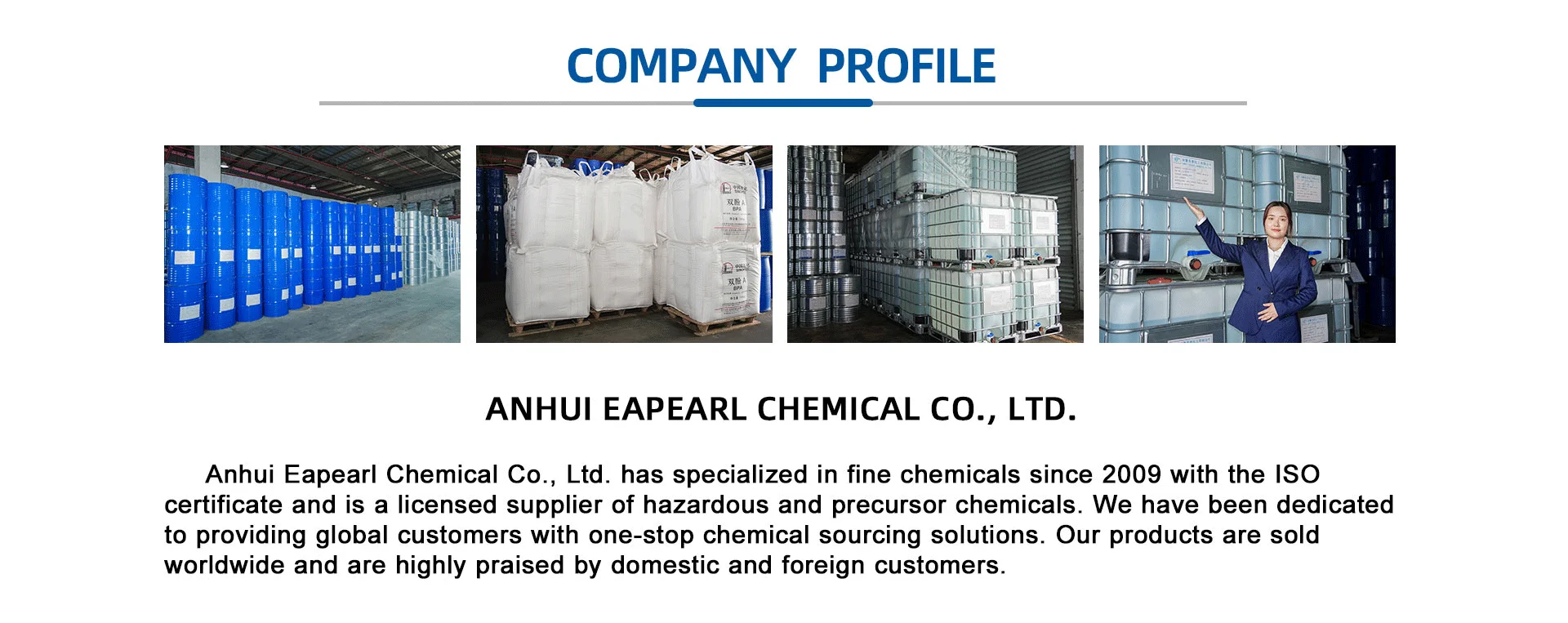
Manufacturer since 2009 · Tongling, Anhui ISO certified Licensed for hazardous & precursor chemicals
[email protected] · +86 186 5620 1888
Eapearl Chemical

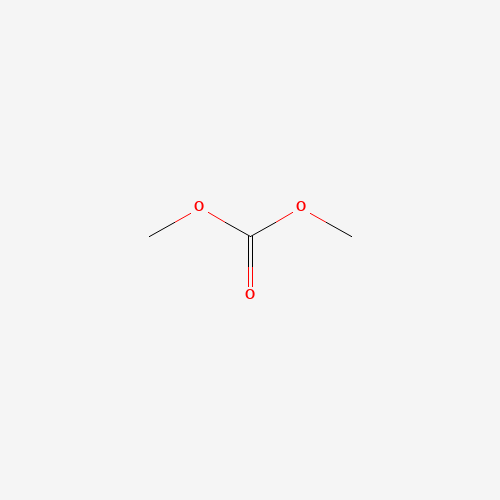
Dimethyl carbonate

DMC

CAS 616-38-6 EC 210-478-4 C3H6O3 Ester CLP Danger
MolGod_SDSCARD_1
REACH 2020/878
v1 · 22.09.2026

Specification

Product NameDimethyl carbonate
Other NamesDMC
CAS No.616-38-6
EINECS No.210-478-4
MFC3H6O3
Molecular weight90.08
Purity99.90%
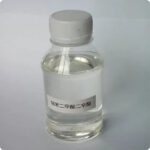
AppearanceColorless transparent liquid
Density1.069 g/mL at 20 °C
Melting point0.5 °C (lit.)
Boiling point90-91 °C
Flashing point17 °C (closed cup)

Values are typical for the standard grade. Tighter specifications are available — state the target in your inquiry and we confirm against the production batch.

Hazard classification
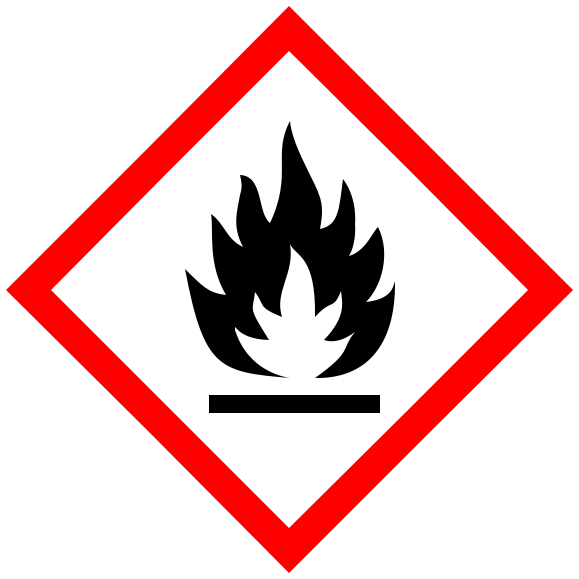
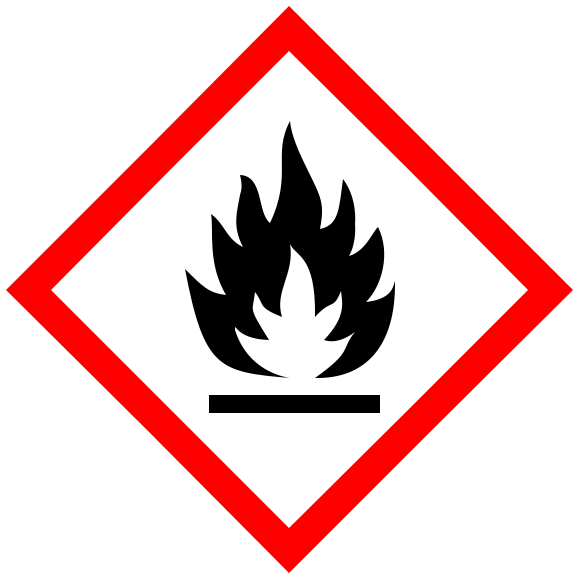
GHS pictogram GHS02 — Flammable

Danger

Harmonised classification (EU) — ECHA Annex VI (harmonised, ATP 23; 2026-07-07)

  • H225 Highly flammable liquid and vapour

European Chemicals Agency. "dimethyl carbonate, Index No. 607-013-00-6." In Table 3 of Annex VI to Regulation (EC) No 1272/2008 (CLP Regulation), 23rd Adaptation to Technical Progress (harmonised list as of 2026-07-07). Helsinki: European Chemicals Agency, 2026. https://echa.europa.eu/information-on-chemicals/annex-vi-to-clp.

Packaging and shipping
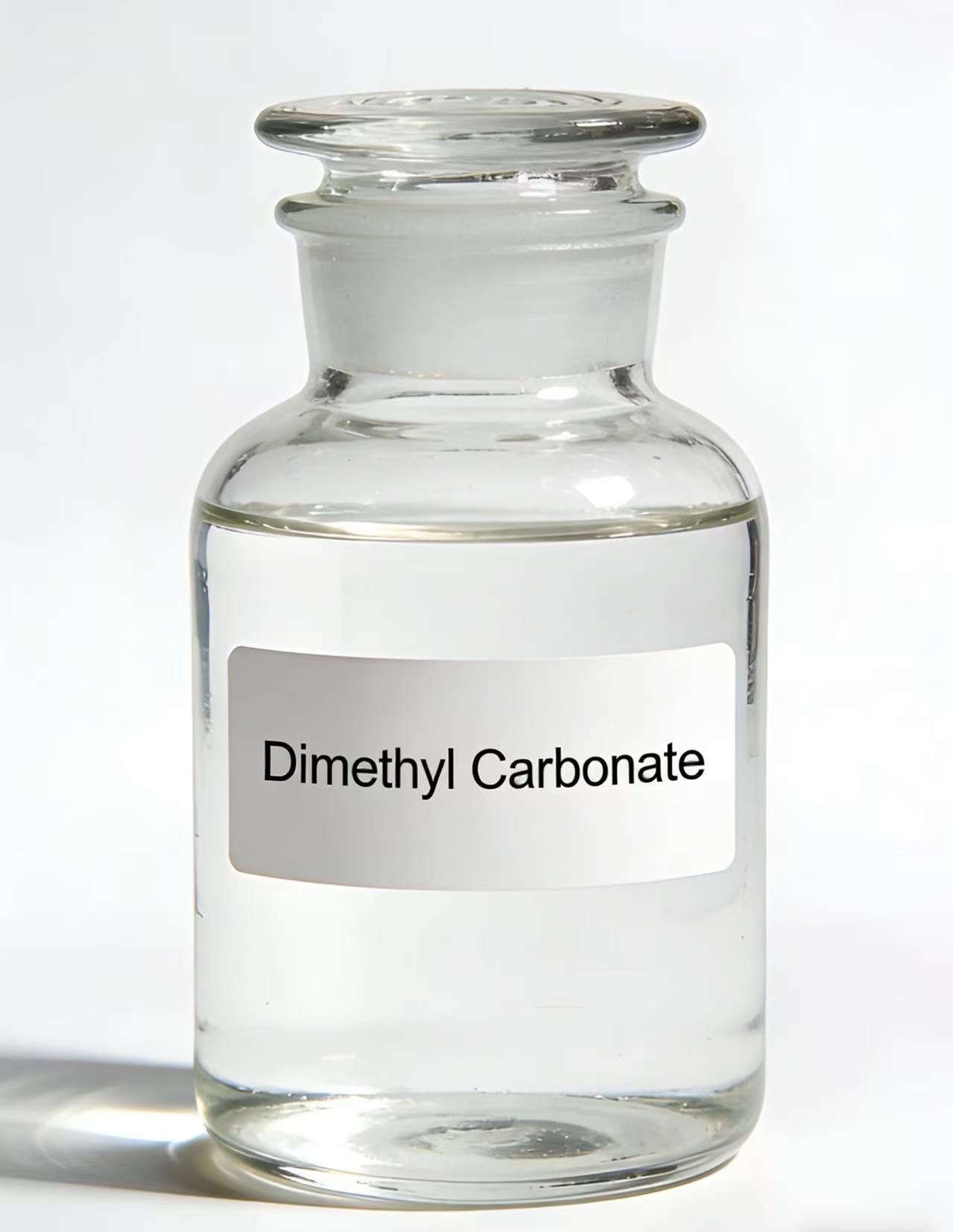
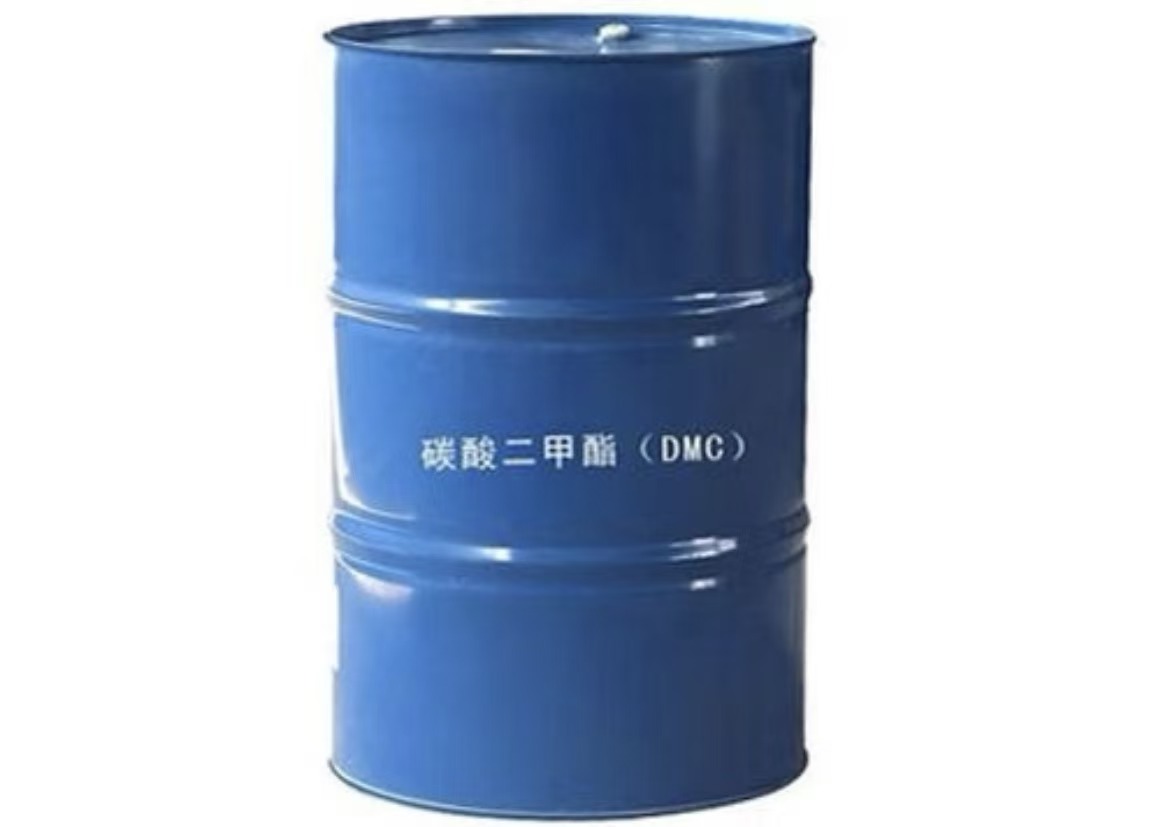
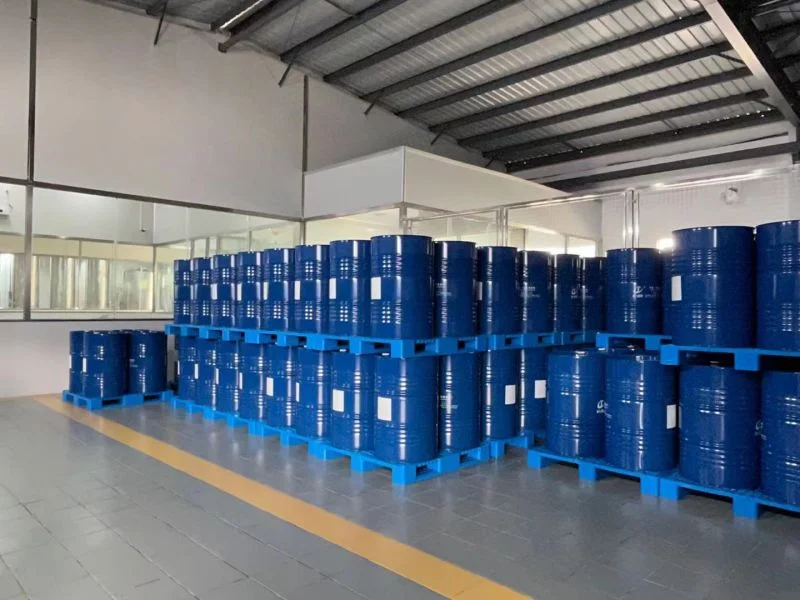
Drum220kg/225 kg
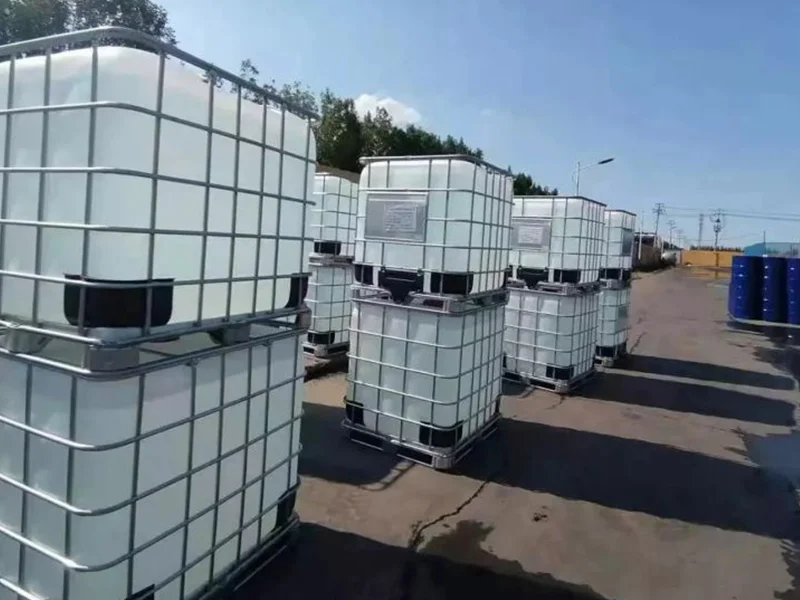
IBC Drum1000kg/1127 kg
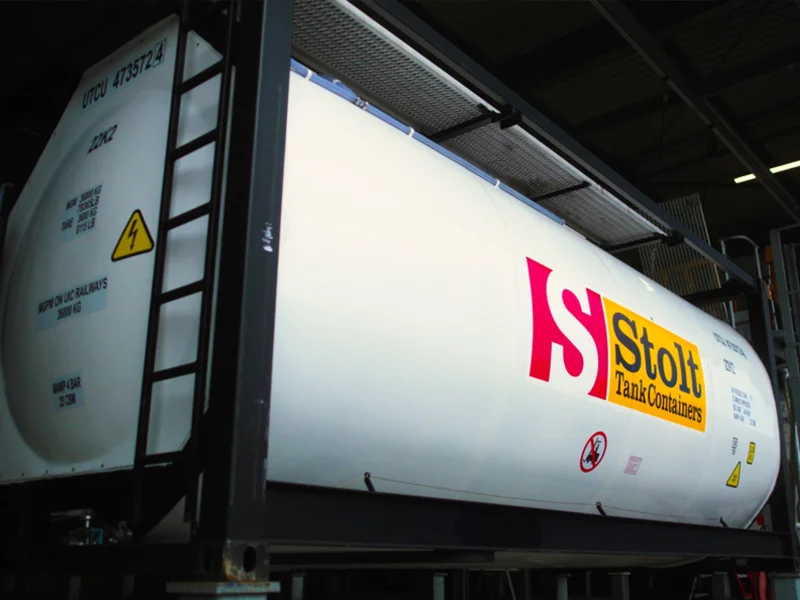
ISO tank (20ft)24–26 m³
ISO tank (40ft)48–50 m³
Dimethyl carbonate
Dimethyl carbonate
Dimethyl carbonate

Dimethyl Carbonate (DMC, CAS 616-38-6) is a versatile, eco-friendly organic compound widely recognized as a “green solvent” for its low toxicity and biodegradable properties. It serves as a crucial raw material in lithium-ion battery electrolytes, pharmaceutical synthesis, and chemical manufacturing, offering excellent solubility and reactivity.
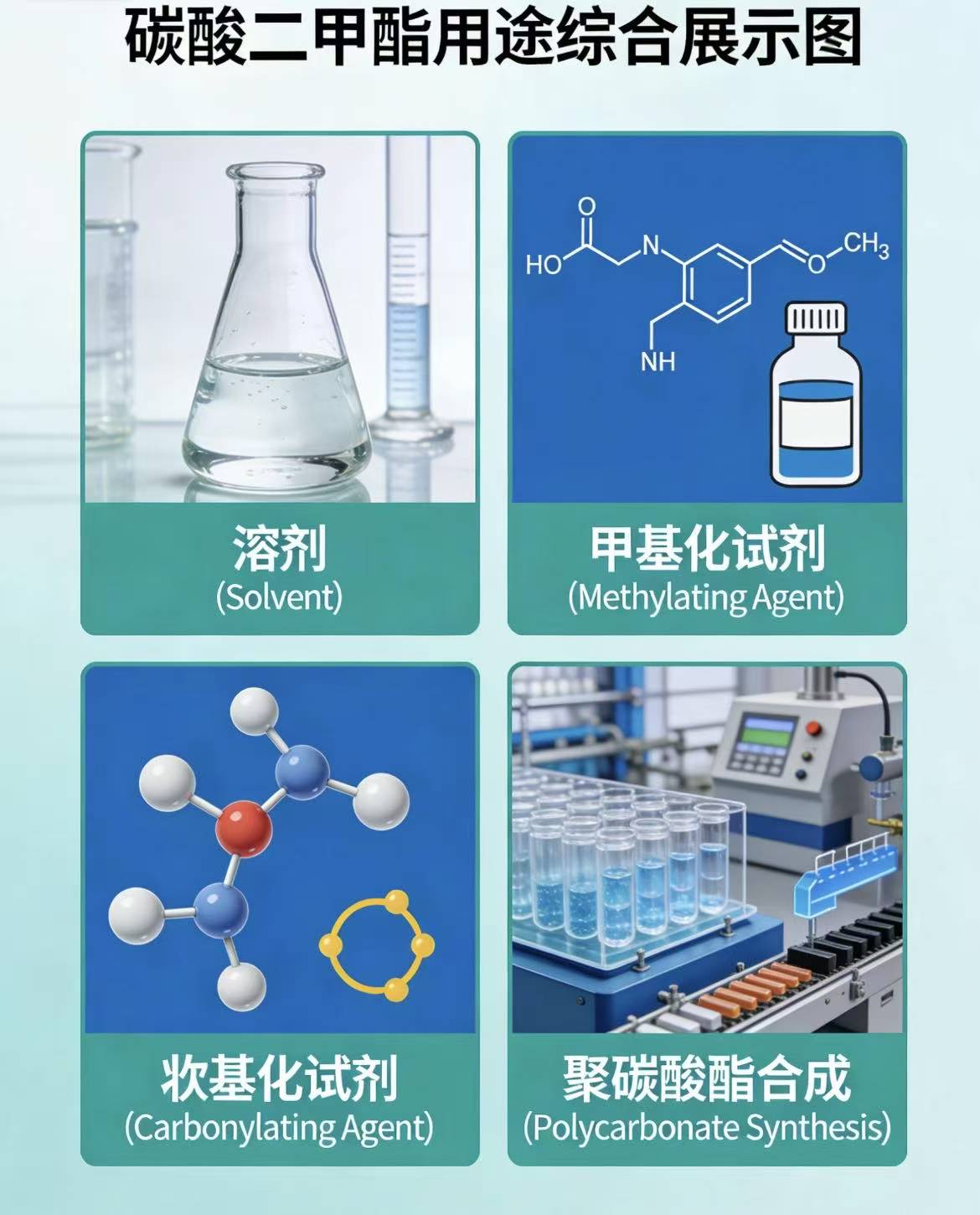
With high purity grades (industrial, battery, and pharmaceutical), DMC acts as an efficient solvent for coatings, inks, and cleaning agents, replacing harmful traditional solvents. It also functions as a methylating and carbonylating agent in organic synthesis, supporting the production of polycarbonates, lubricants, and fine chemicals.
Backed by a stable supply chain and full compliance documentation, our DMC meets international quality standards, ensuring reliable performance across multiple industrial applications while aligning with global sustainability goals.
Dimethyl Carbonate (DMC) Multi-functional Solution | Covers multiple industries such as coatings, cleaning, and battery electrolytes | Customizable parameters, stable supply chain guaranteeDimethyl Carbonate (DMC) Multi-functional Solution | Covers multiple industries such as coatings, cleaning, and battery electrolytes | Customizable parameters, stable supply chain guaranteeDimethyl Carbonate (DMC) Multi-functional Solution | Covers multiple industries such as coatings, cleaning, and battery electrolytes | Customizable parameters, stable supply chain guarantee

Dimethyl Carbonate (DMC) Multi-functional Solution | Covers multiple industries such as coatings, cleaning, and battery electrolytes | Customizable parameters, stable supply chain guarantee

Product Description

Dimethyl Carbonate (DMC, CAS 616-38-6) is a high-purity, eco-friendly organic compound known as a “green solvent” with low toxicity and excellent biodegradability.

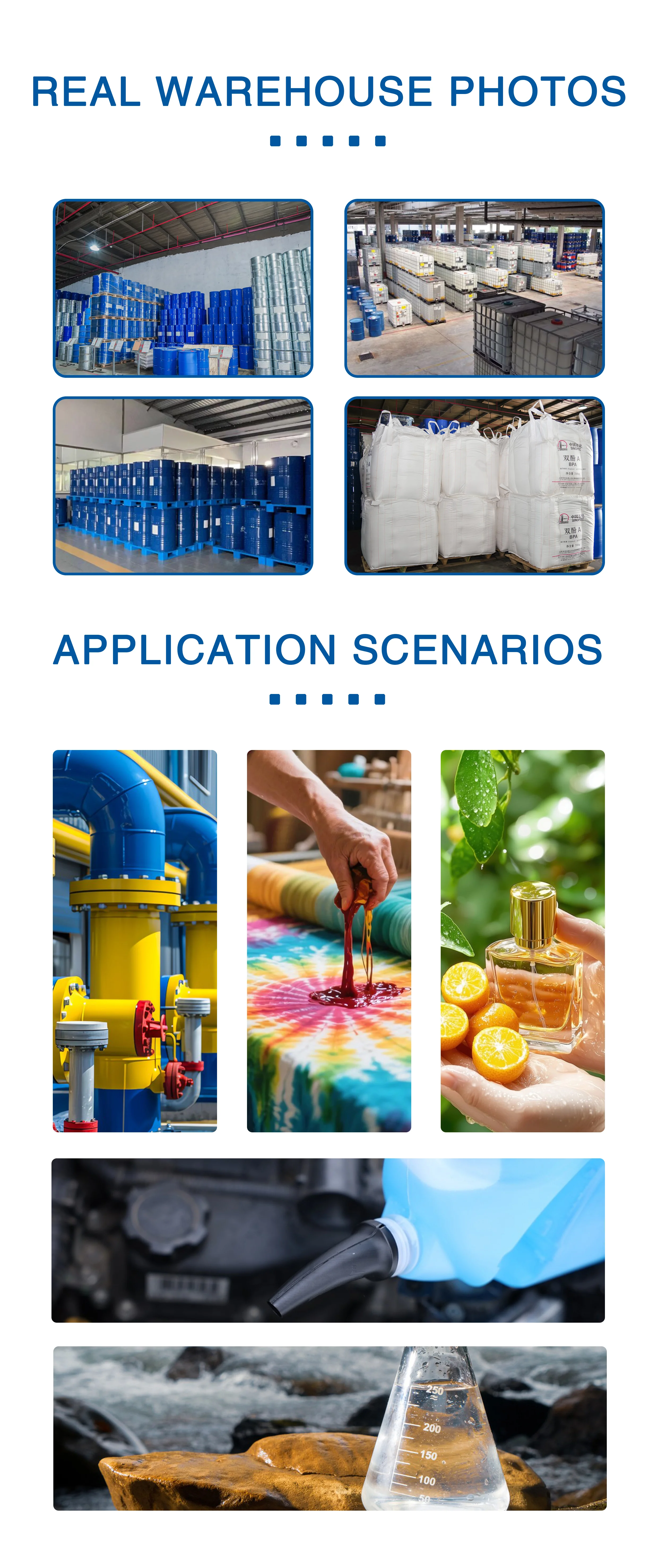
 It appears as a colorless transparent liquid with a molecular formula of C₃H₆O₃ and a molecular weight of 90.08, boasting a density of 1.069 g/mL at 20 °C, a melting point of 0.5 °C, a boiling point of 90-91 °C, and a flash point of 17 °C (closed cup). Widely used across industries, DMC serves as a critical raw material in lithium-ion battery electrolytes, providing high electrochemical stability and safety for energy storage systems.

 It also acts as an efficient methylating and carbonylating agent in pharmaceutical and chemical synthesis, supporting the production of polycarbonates, lubricants, and fine chemicals while replacing harmful traditional solvents In coatings, inks, and cleaning products, DMC functions as a low-VOC solvent with strong dissolving power, reducing environmental impact and improving product performance. For usage, in battery manufacturing, it is typically blended with other carbonates (such as EC and EMC) to formulate electrolytes; in chemical synthesis, it is used under controlled temperature and pressure to avoid flammability risks;

 in industrial cleaning, it is applied directly or diluted to remove stubborn residues without damaging substrates. 

 Our DMC is available in industrial, battery, and pharmaceutical grades, with stable supply chains and full compliance documentation, meeting international quality standards to ensure reliable performance in diverse applications while advancing global sustainability goals.
Dimethyl Carbonate (DMC) Multi-functional Solution | Covers multiple industries such as coatings, cleaning, and battery electrolytes | Customizable parameters, stable supply chain guarantee

Dimethyl Carbonate (DMC) Multi-functional Solution | Covers multiple industries such as coatings, cleaning, and battery electrolytes | Customizable parameters, stable supply chain guarantee

Delivery&Payment method

Dimethyl Carbonate (DMC) Multi-functional Solution | Covers multiple industries such as coatings, cleaning, and battery electrolytes | Customizable parameters, stable supply chain guarantee

Frequently asked

In what packaging is Dimethyl carbonate shipped?

Standard formats are Drum (220kg/225 kg), IBC Drum (1000kg/1127 kg), ISO tank (20ft) (24–26 m³), ISO tank (40ft) (48–50 m³). Other packaging can be arranged for full-container orders.

Is a safety data sheet available for Dimethyl carbonate?

Yes, on request. Safety data sheets are issued per grade and destination market; state the country of import in your inquiry.

What purity do you supply?

The standard grade is 99.90%. Tighter specifications are confirmed against the production batch before shipment.

Technical reading on Dimethyl carbonate

Related products

🧬 3D分子可视化器
正在加载分子...
3D模型Dimethyl Carbonate,CAS 616-38-6,分子式C3H6O3, 摩尔质量 90.08 g/mol

数据转录自法规登记册和专业文献,并注明来源与版本。不能替代供应商的安全数据表。未记录来源的字段已作相应标注。

📊 物理化学数据 — CAS 616-38-6MolGod_PROPHUB_MAIN
📊 物理化学性质

快速参考

化学式: C3H6O3
分子量: 90.08 g/mol
CAS号: 616-38-6
🔬 高级属性

化学标识符

SMILES: COC(=O)OC

最后更新: 2026-09-21

化学概述: Dimethyl CarbonateMolGod_OVERVIEW_1
分子式C3H6O3[1]
分子量90.08 g/mol[1]
熔点0.5 °C[1][2]
沸点90.5 °C[1][2]
密度1.07 g/cm³[1]
LogP(亲脂性)0.5[1]
IUPAC名称dimethyl carbonate[1]
SMILESCOC(=O)OC[1]
InChIKeyIEJIGPNLZYLLBP-UHFFFAOYSA-N[1]

同义词: Dimethyl carbonate · 616-38-6 · Methyl carbonate · Carbonic acid, dimethyl ester · Methyl carbonate ((MeO)2CO)

数据来源: PubChem (NLM/NIH)
最后更新: 2026-09-21

📚 科学参考文献(芝加哥作者-日期格式) (2 来源)
  1. PubChem. National Center for Biotechnology Information (NIH/NLM), chemical compound database. applies to: 分子式 · 分子量 · 熔点 · 沸点 · 密度 · LogP(亲脂性) · IUPAC名称 · SMILES · InChIKey
  2. NIST. Chemistry WebBook, SRD 69. National Institute of Standards and Technology. applies to: 熔点 · 沸点

科学研究

[1]Europe PMC2026
et al.. (2026). "Frustrated Lewis Pairs on Porous Ceria Nanorods Drive Low-Temperature Dimethyl Carbonate Hydrogenation to Methanol.". https://doi.org/10.1021/acsnano.5c19425
[2]Europe PMC2026
et al.. (2026). "Br-Mediated Pd Catalysis Promotes Intermediates Stabilization and Coupling for Anodic Electrosynthesis of Dimethyl Carbonate.". https://doi.org/10.1002/anie.4274352
[3]Europe PMC2026
et al.. (2026). "Exploring Dimethyl Carbonate as a Green and Efficient Solvent for Highly Regioselective Iodination of Arylboronic Acids.". https://doi.org/10.1021/acsomega.5c13454
[4]Europe PMC2026
et al.. (2026). "Efficient Catalytic Ozonation of Dimethyl Carbonate on M‑Mn (M = Cr, Cu, Co)/ZSM‑5 Zeolites: Further Analysis of Reaction Mechanism.". https://doi.org/10.1021/acsomega.6c02229
[5]Doaj2026
Mohamed A. Abdelaziz, Neil D. Danielson. (2026). "Green reversed-phase liquid chromatography of CoQ10 and vitamin E using dimethyl carbonate as the mobile phase modifier". Green Analytical Chemistry.
[6]Europe PMC2026
(2026). "Dimethyl carbonate as a green solvent in ternary solvent systems for liquid chromatography: Investigation of miscibility limits and mobile phase viscosities.". https://doi.org/10.1016/j.chrom
[7]Europe PMC2026
et al.. (2026). "Tuning vacancy structures in metal-doped CeO2 nanorods to alter the reaction equilibrium of direct synthesis of dimethyl carbonate from CO2 and methanol.". https://doi.org/10.1016/j.j
[8]Europe PMC2025
(2025). "Greener and Whiter Analytical Procedure for Theobromine and Caffeine Determination in Tea Using Dimethyl Carbonate as an Extraction Solvent and Mobile Phase Constituent in Reversed-Phase Liqu
📚 科学参考文献(芝加哥作者-日期格式) 20 refs · 3 baz

MOLECULE 按CAS号参考文献(实时来自13+数据库)

来源: db:Europe PMC (13) · db:doaj (3) · db:core (4)

  1. db:Europe PMC et al.. (2026). "Frustrated Lewis Pairs on Porous Ceria Nanorods Drive Low-Temperature Dimethyl Carbonate Hydrogenation to Methanol.". https://doi.org/10.1021/acsnano.5c19425
  2. db:Europe PMC et al.. (2026). "Br-Mediated Pd Catalysis Promotes Intermediates Stabilization and Coupling for Anodic Electrosynthesis of Dimethyl Carbonate.". https://doi.org/10.1002/anie.4274352
  3. db:Europe PMC et al.. (2026). "Exploring Dimethyl Carbonate as a Green and Efficient Solvent for Highly Regioselective Iodination of Arylboronic Acids.". https://doi.org/10.1021/acsomega.5c13454
  4. db:Europe PMC et al.. (2026). "Efficient Catalytic Ozonation of Dimethyl Carbonate on M‑Mn (M = Cr, Cu, Co)/ZSM‑5 Zeolites: Further Analysis of Reaction Mechanism.". https://doi.org/10.1021/acsomega.6c02229
  5. db:doaj Mohamed A. Abdelaziz, Neil D. Danielson. (2026). "Green reversed-phase liquid chromatography of CoQ10 and vitamin E using dimethyl carbonate as the mobile phase modifier". Green Analytical Chemistry. https://doi.org/10.1016/j.greeac.2026.100380
  6. db:Europe PMC (2026). "Dimethyl carbonate as a green solvent in ternary solvent systems for liquid chromatography: Investigation of miscibility limits and mobile phase viscosities.". https://doi.org/10.1016/j.chroma.2026.467318
  7. db:Europe PMC et al.. (2026). "Tuning vacancy structures in metal-doped CeO2 nanorods to alter the reaction equilibrium of direct synthesis of dimethyl carbonate from CO2 and methanol.". https://doi.org/10.1016/j.jcis.2026.141303
  8. db:Europe PMC (2025). "Greener and Whiter Analytical Procedure for Theobromine and Caffeine Determination in Tea Using Dimethyl Carbonate as an Extraction Solvent and Mobile Phase Constituent in Reversed-Phase Liquid Chromatography.". https://doi.org/10.1021/acsomega.4c11625
  9. db:doaj You Wang, Jiyun Ren, Qing Guo et al.. (2025). "Spatially proximate In5 and In4+1···In4 on In2O3 enable efficient dimethyl carbonate synthesis from CO2 below 100 oC". Nano Research. https://doi.org/10.26599/NR.2025.94907553
  10. db:Europe PMC et al.. (2025). "Indirect methanol synthesis from CO2 through high-efficient dimethyl carbonate hydrogenation as a bridge below 100°C.". https://doi.org/10.1038/s41467-025-65623-0
  11. db:Europe PMC et al.. (2025). "Promoting Intermediate Stabilization and Coupling for Dimethyl Carbonate Electrosynthesis.". https://doi.org/10.1002/smll.202501780
  12. db:Europe PMC et al.. (2025). "Functional poly(ionic liquid) with unique zwitterionic structure as efficient catalyst for the conversion of ethylene carbonate to dimethyl carbonate.". https://doi.org/10.1002/smo.20240046
  13. db:Europe PMC et al.. (2025). "Adsorptive Separation, Interfacial Configuration, and Mechanism of Dimethyl Carbonate-Methanol Azeotrope onto α-Al2O3: Experimental and Molecular Simulations.". https://doi.org/10.1021/acsomega.4c10016
  14. db:Europe PMC et al.. (2025). "Synergistic Effects of Poly(ionic liquids)@MOF-808 Nanocomposites for Direct Conversion of Carbon Dioxide into Dimethyl Carbonate.". https://doi.org/10.1021/acs.langmuir.5c04812
  15. db:Europe PMC et al.. (2024). "Sustainable C-H Methylation Employing Dimethyl Carbonate.". https://doi.org/10.1021/acs.joc.4c01719
  16. db:doaj Zhongwei Fu, Yunyun Zhong, Yuehong Yu et al.. (2018). "TiO2‑Doped CeO2 Nanorod Catalyst for Direct Conversion of CO2 and CH3OH to Dimethyl Carbonate: Catalytic Performance and Kinetic Study". ACS Omega. https://doi.org/10.1021/acsomega.7b01475
  17. db:core Cui, Penglei, Wang, Xingxing, Zhang, Peng et al.. (2017). "Glycerol carbonate synthesis from glycerol and dimethyl carbonate using guanidine ionic liquids". Elsevier BV. https://doi.org/10.1016/j.cjche.2017.06.025
  18. db:core Shi, Wei-Jie, Guo, Hao, Li, Wen-Juan et al.. (2015). "N-heterocyclic carbene catalyzed synthesis of dimethyl carbonate via transesterification of ethylene carbonate with methanol". Springer. https://doi.org/10.1016/j.jscs.2014.03.003
  19. db:core Liu, Hongwei, Ke, Xuebin, Zheng, Zhanfeng et al.. (2014). "TiO2 nanofibers of different crystal phases for transesterification of alcohols with dimethyl carbonate". Elsevier. https://doi.org/10.1016/j.apcatb.2013.12.035
  20. db:core Saka, Shiro, Ilham, Zul. (2012). "Optimization of supercritical dimethyl carbonate method for biodiesel production". Elsevier Ltd.. https://doi.org/10.1016/j.fuel.2012.02.066
物质监管状态
该物质受监管要求约束: 危险废物管理(BDO登记册). 详细信息请参见“法规状态(REACH/ECHA/CLP)”章节及安全数据表。 监管信息——不限制在本店购买。
🧮 化学计量计算器MolGod_STOICH_1
🧪 化学数据MolGod_CHEMDATA_1
CAS号
616-38-6
分子式
C3H6O3
摩尔质量
90.08 g/mol
IUPAC名称 (EN)
dimethyl carbonate
SMILES
COC(=O)OC
InChIKey
IEJIGPNLZYLLBP-UHFFFAOYSA-N
📚 Literatura naukowa (20 产品)MolGod_LITSCI_1
筛选:
排序:
📈 出版时间线
2012
2014
2015
2017
2018
2024
2025
2026
📡 Data sourcesMolGod_SOURCES_1

The data in this widget comes from the following verified scientific sources:

  • PubChem — National Center for Biotechnology Information (NCBI/NIH), USA
  • ChEMBL — European Bioinformatics Institute (EMBL-EBI), UK
  • NIST WebBook — National Institute of Standards and Technology, USA

Data is cached locally for speed — the widget also works offline.

⚗️ Physicochemical propertiesMolGod_PHYSTAB_2
Temp. wrzenia
90.4
Temp. topnienia
-5.6
Density
1.065

Source: PubChem, NIST WebBook. Last updated: 2026-09-21

🔍 外部标识符MolGod_EXTID_1
12 / 16个ID系统75%
数据库标识符操作
CAS Registry Number616-38-6打开 →
PubChem CID12021[1]打开 →
InChIKeyIEJIGPNLZYLLBP-UHFFFAOYSA-N[1]打开 →
InChIInChI=1S/C3H6O3/c1-5-3(4)6-2/h1-2H3[1]
SMILESCOC(=O)OC[1]
EC Number210-478-4[2]打开 →
ChEMBLCHEMBL3185216[3]打开 →
HMDBHMDB0029580打开 →
ChemSpider11526[4]打开 →
UNII (FDA)KE9J097SPN打开 →
NSC Number (NCI)9371打开 →
WikiData QIDQ416254打开 →

来源:PubChem (NIH)、Wikidata SPARQL、KEGG、ChEMBL (EBI)、CompTox CTX (EPA)。

📚 科学参考文献(芝加哥作者-日期格式) (4 来源)
  1. PubChem. National Center for Biotechnology Information (NIH/NLM), chemical compound database. applies to: PubChem CID · InChIKey · InChI · SMILES
  2. ECHA. EC Inventory — EINECS, ELINCS, NLP and List Numbers assigned under REACH. Helsinki: European Chemicals Agency. applies to: EC Number
  3. ChEMBL. European Bioinformatics Institute (EMBL-EBI), bioactivity database. applies to: ChEMBL
  4. ChemSpider. Royal Society of Chemistry, chemical structure database. applies to: ChemSpider

Further reading

Publications thematically related to this CAS. They are not the source of any value shown on this card.

扩展参考文献 (6)

  1. ★★★★☆ OPENLIBRARY 🔓 开放 Pietro Tundo. 2013. "Chemistry of Dimethyl Carbonate and Its Derivatives." Wiley & Sons, Incorporated, John. 链接 [访问日期: 2026-09-21] CC0 (metadata)
  2. ★★☆☆☆ CROSSREF 🔓 开放 ❓ 未验证 Hwang, In Chan. 2026. "Measurement of Flash Point for Binary Systems of {Dimethyl carbonate+ n-Nonane} and {Dimethyl carbonate+ n-Decane} at 101.3 kPa." Korean Journal of Hazardous Materials 14 (1): 7-12. https://doi.org/10.31333/kihm.2026.4.1.2. 链接 [访问日期: 2026-09-23] CC0 (metadata)
  3. ★★☆☆☆ CROSSREF 🔓 开放 ❓ 未验证 Anonymous. "Vapor Pressures and Thermophysical Properties of Dimethyl Carbonate, Diethyl Carbonate and Dipropyl Carbonate.". https://doi.org/10.1021/acs.jced.7b00295.s001. 链接 [访问日期: 2026-09-23] CC0 (metadata)
  4. ★★☆☆☆ CROSSREF 🔓 开放 ❓ 未验证 Anonymous. "Dimethyl Carbonate Synthesis via Transesterification of Propylene Carbonate Using a TitaniumPraseodymium-Based Catalyst.". https://doi.org/10.1021/acs.energyfuels.2c02235.s001. 链接 [访问日期: 2026-09-23] CC0 (metadata)
  5. ★★☆☆☆ CROSSREF 🔓 开放 ❓ 未验证 Anonymous. "Classical Chemical Dynamics Simulations of the Thermal Unimolecular Decomposition of Dimethyl Carbonate and Dimethyl Ether.". https://doi.org/10.1021/acs.jpca.5c01811.s001. 链接 [访问日期: 2026-09-23] CC0 (metadata)
  6. ★★☆☆☆ CROSSREF 🔓 开放 ❓ 未验证 Anonymous. "Carboxylic Anhydride Synthesis from Benzyllglutamate and Dimethyl Carbonate.". https://doi.org/10.1021/acs.orglett.8b03984.s001. 链接 [访问日期: 2026-09-23] CC0 (metadata)
📡 光谱学 — CAS 616-38-6MolGod_SPECHUB_MAIN
📊 光谱数据库 — 内联数据 9 来源 MolGod_SPECDB_2

光谱按需从9个来源获取。每个光谱都存储在我们的数据库中 — 下次打开时无需向外部API发出请求。无需搜索即可为每个光谱下载JCAMP-DX / CSV / PNG。

IR IR (Infrared) — NIST WebBook
Public domain (US Federal)
▶ 点击加载光谱
🔗 来源
📚 NIST Chemistry WebBook, SRD 69
MS (NIST) Mass Spectrum (EI) — NIST WebBook
Public domain (US Federal)
▶ 点击加载光谱
🔗 来源
📚 NIST Standard Reference Database 1A
UV-Vis UV/Visible Absorption — NIST WebBook
Public domain (US Federal)
▶ 点击加载光谱
🔗 来源
📚 NIST Chemistry WebBook, SRD 69
¹H NMR NMR (¹H, ¹³C) — NMRShiftDB
CC-BY-SA 4.0
▶ 点击加载光谱
🔗 来源
📚 Steinbeck C et al. (2003) J. Chem. Inf. Comput. Sci. 43(1):10–16 DOI: 10.1021/ci025588g
MS (MoNA) MoNA — MassBank of North America
CC-BY 4.0
▶ 点击加载光谱
🔗 来源
📚 MassBank of North America (UC Davis) DOI: 10.1002/jms.1777
IR/NMR/MS (SDBS) SDBS — Spectral Database for Organic Compounds (Japan AIST)
Free for non-commercial

参考来源 — 无公共API。在外部数据库中打开:

🔗 IR/NMR/MS (SDBS) →
📚 SDBSWeb: https://sdbs.db.aist.go.jp (AIST, Japan)
JP Monograph Japanese Pharmacopoeia — Monographs
Reference only

参考来源 — 无公共API。在外部数据库中打开:

🔗 JP Monograph →
📚 Japanese Pharmacopoeia 18th Edition (2021)
WHO INN WHO — International Nonproprietary Names
WHO Model Lists (free)

参考来源 — 无公共API。在外部数据库中打开:

🔗 WHO INN →
📚 WHO INN Programme
DOAJ DOAJ — Directory of Open Access Journals
OA journal index (mixed)

参考来源 — 无公共API。在外部数据库中打开:

🔗 DOAJ →
📚 DOAJ — doaj.org
🔬 交互式光谱(实时 — NIST / MoNA / NMRShiftDB / SDBS) (2)

数据从多个来源实时获取(优先级链)。每个光谱下可下载JCAMP-DX / CSV / PNG。

IR — 傅里叶变换红外光谱

正在加载 IR — 傅里叶变换红外光谱…

MS — 质谱(EI 70eV)

正在加载 MS — 质谱(EI 70eV)…

结构性质MolGod_STRUCT3D_1

正在加载结构数据...

❓ 常见问题 (3)MolGod_FAQ_1
What is 616-38-6?
616-38-6 (CAS 616-38-6) is a chemical compound. The chemical data comes from PubChem (National Institutes of Health, USA).
有帮助吗?
What is the CAS number of 616-38-6?
The CAS number for 616-38-6 is 616-38-6. A CAS Registry Number is the standard identifier for a chemical substance in scientific literature and in trade.
有帮助吗?
How should 616-38-6 be stored?
616-38-6 should be stored as its safety data sheet directs \— typically in a dry, cool, well-ventilated place, away from heat and from materials it is incompatible with.
有帮助吗?
➕ 建议问题
下载结构文件MolGod_STRDL_1

来自PubChem数据库(NIH)的分子结构文件。兼容Avogadro、PyMOL、Jmol和ChemDraw等程序。

来源:PubChem,美国国家医学图书馆(NIH)。 CID: 12021

🔄 浓度单位转换器 实时 MolGod_UNITCONV_1

输入Dimethyl Carbonate浓度(任意单位),其余将自动计算。

分子量: 90.08 g/mol · IUPAC Gold Book ↗

⚗️ 转换公式及引用(每个公式)
转换分子式准确度来源
% (w/v) ↔ molarityc (mol/L) = (% × 10) / MW±0.5% rel. when density ≈ 1.0 g/mLIUPAC (2019)
millimolar ↔ molarc (mol/L) = mM × 10⁻³ExactCohen ER, Cvitaš T, Frey JG, Holmström B, Kuchitsu K, Marquardt R, Mills I, Pavese F, Quack M, Stohner J, Strauss HL, Takami M, Thor AJ (2007)
molarity (mol/L)c = n/V = (m/MW)/V±0.1% (depends on MW precision)IUPAC (2019)
parts per million (mg/L) ↔ molarityc (mol/L) = ppm / (1000 × MW); equivalently ppm = mg/L for dilute aqueous±1% (density-independent for dilute solutions)IUPAC (2019)
mg/mL ↔ molarityc (mol/L) = (mg/mL × 1000) / MW / 1000 = mg/mL / MW × 1±0.2%Cohen ER, Cvitaš T, Frey JG, Holmström B, Kuchitsu K, Marquardt R, Mills I, Pavese F, Quack M, Stohner J, Strauss HL, Takami M, Thor AJ (2007)
g/L ↔ molarityc (mol/L) = (g/L) / MW±0.1% (depends on MW precision)Cohen ER, Cvitaš T, Frey JG, Holmström B, Kuchitsu K, Marquardt R, Mills I, Pavese F, Quack M, Stohner J, Strauss HL, Takami M, Thor AJ (2007)
mmol/L ↔ molarityc (mol/L) = mmol/L × 10⁻³ExactCohen ER, Cvitaš T, Frey JG, Holmström B, Kuchitsu K, Marquardt R, Mills I, Pavese F, Quack M, Stohner J, Strauss HL, Takami M, Thor AJ (2007)
Celsius ↔ KelvinT(K) = t(°C) + 273.15±0.01 K (ITS-90 scale)BIPM (Bureau International des Poids et Mesures) (2019)
Celsius ↔ FahrenheitT(°F) = T(°C) × 9/5 + 32±0.1 °FThompson A, Taylor BN (2008)
density-corrected % ↔ molarityc (mol/L) = (%w/w × ρ × 10) / MW, ρ in g/mL±0.1% when ρ known to 3 decimalsCohen ER, Cvitaš T, Frey JG, Holmström B, Kuchitsu K, Marquardt R, Mills I, Pavese F, Quack M, Stohner J, Strauss HL, Takami M, Thor AJ (2007)
📚 参考文献(8个权威来源)
  1. Thompson A, Taylor BN (2008). Guide for the Use of the International System of Units (SI). NIST Special Publication 811 · DOI: 10.6028/NIST.SP.811-2008
    → Primary SI standard for US scientific usage
  2. Cohen ER, Cvitaš T, Frey JG, Holmström B, Kuchitsu K, Marquardt R, Mills I, Pavese F, Quack M, Stohner J, Strauss HL, Takami M, Thor AJ (2007). Quantities, Units and Symbols in Physical Chemistry — The IUPAC Green Book. RSC Publishing, 3rd ed. · DOI: 10.1039/9781847557889 · ISBN: 978-0-85404-433-7
    → Canonical IUPAC guide for chemistry quantities/units
  3. BIPM (Bureau International des Poids et Mesures) (2019). The International System of Units (SI), 9th edition. BIPM ·
    → International SI definitions (incl. redefined kilogram 2019)
  4. ISO/IEC (2022). Quantities and units — Part 1: General. International Organization for Standardization — ISO 80000-1:2022 ·
    → General rules for physical quantities and units
  5. ISO/IEC (2019). Quantities and units — Part 9: Physical chemistry and molecular physics. International Organization for Standardization — ISO 80000-9:2019 ·
    → Concentration / molality / amount-of-substance conventions
  6. Tiesinga E, Mohr PJ, Newell DB, Taylor BN (2021). CODATA recommended values of the fundamental physical constants: 2018. Rev. Mod. Phys. 93(2):025010 · DOI: 10.1103/RevModPhys.93.025010
    → Avogadro, gas constant, molar volume (2019 SI revision)
  7. IUPAC (2019). Compendium of Chemical Terminology — the IUPAC Gold Book (online). IUPAC · DOI: 10.1351/goldbook
    → Definitions of mass fraction, molality, normality, ppm, activity
  8. Mills IM, Cvitaš T, Homann K, Kallay N, Kuchitsu K (1988). Quantities, Units and Symbols in Physical Chemistry. Blackwell Scientific Publications, 1st ed. · ISBN: 0-632-01773-5
    → Historical predecessor of IUPAC Green Book
相似分子结构MolGod_SIMSTR_1

正在加载相似结构...

🧪 溶液制备向导 WIZARD MolGod_PREP_1
① 选择浓度
② 目标体积
③ 溶剂

计算依据: IUPAC Gold Book ↗, Merck ↗

计算化学MolGod_COMPCHEM_1

正在加载计算数据...

🛡️ 安全 — CAS 616-38-6MolGod_SAFEHUB_MAIN
数据限制说明。 本页安全信息仅供参考,不能替代完整的安全数据表(SDS)。使用产品前,请查阅制造商当前的安全数据表以及GHS/CLP指南。CLP分类适用于纯散装物质,不适用于商业制剂。

GHS/CLP分类——(EC) No 1272/2008法规 + UN GHS Rev. 9 (2021)。

⚠️ 危险 (Danger)
GHS02 — 易燃
GHS02 易燃

🚨 危险说明(H)

  • H225 — 高度易燃液体和蒸气

🛡 防范说明(P)

  • P210 — 远离热源、热表面、火花、明火和其他点火源。禁止吸烟。
  • P203 — 使用前取得、阅读并遵循所有安全说明书。

✓ 根据CLP法规(EC) 1272/2008附件VI的统一分类(官方、具有约束力的分类)。 索引号:607-013-00-6。

参考文献(芝加哥格式): European Chemicals Agency. "dimethyl carbonate, Index No. 607-013-00-6." In Table 3 of Annex VI to Regulation (EC) No 1272/2008 (CLP Regulation), 23rd Adaptation to Technical Progress (harmonised list as of 2026-07-07). Helsinki: European Chemicals Agency, 2026. https://echa.europa.eu/information-on-chemicals/annex-vi-to-clp.

翻译:CLP 法规 (EC) 1272/2008,附件 III 和 IV。数据:PubChem/NLM。

📚 综合科学参考文献 — Chicago Author-Date 10 来源

从所有Safety Hub选项卡收集的参考文献。CAS号: 616-38-6 · PubChem ↗

  1. Parlament Europejski i Rada UE. 2008. "Rozporządzenie (WE) nr 1272/2008 w sprawie klasyfikacji, oznakowania i pakowania substancji (CLP)." Dz.Urz. UE L 353. [↗] GHS,法规
  2. United Nations Economic Commission for Europe (UNECE). 2021. "Globally Harmonized System of Classification and Labelling of Chemicals (GHS), Ninth Revised Edition." United Nations, Geneva. [↗] GHS
  3. Goldfrank, Lewis R., Robert S. Hoffman, Mary Ann Howland, et al.. 2019. "Goldfrank's Toxicologic Emergencies, 11th ed.." McGraw-Hill Education, New York. ISBN 978-1-25-985961-8. Pierwsza pomoc, Toksykologia
  4. National Institute for Occupational Safety and Health (NIOSH). 2023. "NIOSH Pocket Guide to Chemical Hazards (DHHS Publ. 2005-149)." U.S. Department of Health and Human Services / CDC, Cincinnati, OH. [↗] Pierwsza pomoc, PPE, Toksykologia
  5. European Committee for Standardization (CEN). 2016. "EN 374-1:2016 — Protective gloves against dangerous chemicals and micro-organisms." CEN, Brussels. [↗] PPE
  6. UNECE. 2023. "European Agreement Concerning the International Carriage of Dangerous Goods by Road (ADR 2025)." United Nations, Geneva. [↗] Utylizacja, Regulacje
  7. National Fire Protection Association (NFPA). 2022. "NFPA 400 — Hazardous Materials Code." NFPA, Quincy, MA. [↗] Magazynowanie
  8. Urben, P.G. (ed.). 2017. "Bretherick's Handbook of Reactive Chemical Hazards, 8th ed.." Butterworth-Heinemann / Elsevier, Oxford. [↗] Magazynowanie
  9. Ministerstwo Klimatu i Środowiska RP. 2023. "Baza danych o produktach i opakowaniach oraz o gospodarce odpadami (BDO)." Ministerstwo Klimatu i Środowiska, Warszawa. [↗] Utylizacja
  10. International Agency for Research on Cancer (IARC / WHO). 2024. "IARC Monographs on the Identification of Carcinogenic Hazards to Humans — List of Classifications." WHO, Lyon. [↗] Toksykologia

具有自身参考文献的选项卡(紧急情况、个人防护装备、储存、废物)在其各自章节中包含额外的书目条目。

📈 分析统计(t检验·RSD·Grubbs·Q-Dixon) ICH Q2

粘贴一系列重复测量结果(CSV或每行一个数字)。计算器将计算平均值、标准差和95%置信区间,并检测异常值(Grubbs + Dixon Q)。

分隔符:逗号、空格、制表符、换行。至少3个测量值。
📐 统计公式
  • x̄ = Σxᵢ / n — 算术平均值
  • s² = Σ(xᵢ - x̄)² / (n-1) — 样本方差
  • s = √s² — 标准差
  • RSD% = (s / x̄) × 100% — 相对标准差
  • CI₉₅ = x̄ ± t(0.05, n-1) × s / √n — Student's t
  • G = |xᵢ - x̄| / s — Grubbs检验
  • Q = |xsuspect - xnearest| / |xmax - xmin| — Dixon Q-test

来源:ICH Q2(R2) 分析方法验证 · ICH PDF ↗

🧪 缓冲液配方计算器 唯一

从 20 种常用缓冲体系列表中选择 → 输入目标 pH → 获得精确配方,包括称量质量。

步骤 1:选择缓冲体系

📜 配方历史记录(最近 10 条)
药物状态

Prekliniczny

I期
II期
III期
已批准

临床前——无人体研究数据。

ChEMBL CHEMBL3185216 ↗

扩展参考文献 (6)

  1. ★★★★☆ OPENLIBRARY 🔓 开放 Pietro Tundo. 2013. "Chemistry of Dimethyl Carbonate and Its Derivatives." Wiley & Sons, Incorporated, John. 链接 [访问日期: 2026-09-21] CC0 (metadata)
  2. ★★☆☆☆ CROSSREF 🔓 开放 ❓ 未验证 Hwang, In Chan. 2026. "Measurement of Flash Point for Binary Systems of {Dimethyl carbonate+ n-Nonane} and {Dimethyl carbonate+ n-Decane} at 101.3 kPa." Korean Journal of Hazardous Materials 14 (1): 7-12. https://doi.org/10.31333/kihm.2026.4.1.2. 链接 [访问日期: 2026-09-23] CC0 (metadata)
  3. ★★☆☆☆ CROSSREF 🔓 开放 ❓ 未验证 Anonymous. "Vapor Pressures and Thermophysical Properties of Dimethyl Carbonate, Diethyl Carbonate and Dipropyl Carbonate.". https://doi.org/10.1021/acs.jced.7b00295.s001. 链接 [访问日期: 2026-09-23] CC0 (metadata)
  4. ★★☆☆☆ CROSSREF 🔓 开放 ❓ 未验证 Anonymous. "Dimethyl Carbonate Synthesis via Transesterification of Propylene Carbonate Using a TitaniumPraseodymium-Based Catalyst.". https://doi.org/10.1021/acs.energyfuels.2c02235.s001. 链接 [访问日期: 2026-09-23] CC0 (metadata)
  5. ★★☆☆☆ CROSSREF 🔓 开放 ❓ 未验证 Anonymous. "Classical Chemical Dynamics Simulations of the Thermal Unimolecular Decomposition of Dimethyl Carbonate and Dimethyl Ether.". https://doi.org/10.1021/acs.jpca.5c01811.s001. 链接 [访问日期: 2026-09-23] CC0 (metadata)
  6. ★★☆☆☆ CROSSREF 🔓 开放 ❓ 未验证 Anonymous. "Carboxylic Anhydride Synthesis from Benzyllglutamate and Dimethyl Carbonate.". https://doi.org/10.1021/acs.orglett.8b03984.s001. 链接 [访问日期: 2026-09-23] CC0 (metadata)
🚚 运输分类(ADR / IATA / IMDG) UN 1161
UN编号
UN 1161
UN number per the indicated source. Verify the transport class and packing group in ADR Table A / UN Model Regulations before shipment. Sugerowana z klasyfikacji GHS — WYMAGA WERYFIKACJI.
来源: Karta SDS sek.14 (kanon zmaterializowany)

🛣️ ADR 公路运输

类别:
包装组:
运输名称:
📅 项目规划器——实验室实验管理器 新品

规划您的整个实验室项目:添加实验(含试剂、重复次数和持续时间)。您将获得甘特图、购物清单(含商店链接!)、预算(含10%余量)和GHS风险矩阵。

🧪 溶解性和溶剂兼容性 MolGod_SOLUB_1
分子
Dimethyl Carbonate
分子式
C3H6O3
logP (XLogP3)
0.50
摩尔质量(g/mol)
90.08
极性
中等

⚠️ GC估算(Hoftyzer-Van Krevelen)。该CAS无文献HSP数据——精度±2 MPa½。请实验验证。

Ra < R₀ = good miscibility · Ra < 1,5×R₀ = borderline · above = poor (R₀ — radius of the Hansen sphere of this molecule) For this molecule R₀ = 8..

溶剂 兼容性 Ra 可视化 GC-MS HPLC 应用 参考文献
Water (H₂O)miscible
✗ NieA (aqueous) (RP)
buffercell cultureanalyticalextraction (hydrophilic)
Ethanol (EtOH)brak podstawy✗ NieA/B modifier (RP/NP)
extractionspectroscopy (UV-Vis)synthesisHPLC modifier
Methanol (MeOH)brak podstawy✗ NieA/B (RP) (RP)
HPLC (eluent)LC-MSKarl FischerUV-transparent to 205 nm
Acetonebrak podstawy✗ NieB modifier (NP)
GC headspacecrystallisationdegreasingsynthesis
Acetonitrile (ACN)brak podstawy✗ NieB (RP) (RP)
HPLC eluent (gold standard)LC-MS (low UV cut-off, 190 nm)peptide analysis
DMSObrak podstawy✗ NieN/A (N/A)
NMR (d6-DMSO)cell biology (cryopreservation)drug deliverysynthesis
THFbrak podstawy✗ NieB (NP) (NP)
GPC/SEC (polymer analysis)Grignard synthesisorganometallics
DCM (CH₂Cl₂)brak podstawy✓ TakB (NP) (NP)
extractionNP-HPLCGC-MScrystallisation (anti-solvent)
Chloroform (CHCl₃)brak podstawy✓ TakN/A (toxic) (N/A)
NMR (CDCl3)lipid extraction (Folch method)NP-TLC
Hexanebrak podstawy✓ TakA (NP) (NP)
NP-HPLCoil extraction (lipids)GC-MSTLC (NP)
Toluenebrak podstawy✓ TakB (NP) (NP)
NMR (d8-toluene)synthesisazeotropic drying (Dean-Stark)
📚 溶剂科学参考文献(芝加哥作者-日期格式)——点击展开

11 solvents · 54 full citations (NIST/CRC/IARC/Hansen/Reichardt/Smallwood/Wypych/Armarego/Snyder/GESTIS) — below.

Water (H₂O)
  1. NIST — NIST Chemistry WebBook — Water (CAS 7732-18-5)
  2. CRC — CRC Handbook of Chemistry and Physics, 104th ed., Sec. 8 (Properties of Water)
  3. IAPWS — IAPWS Release on Static Dielectric Constant of Water
  4. Reichardt 2011 — Solvents and Solvent Effects in Organic Chemistry
  5. GESTIS — GESTIS Substance Database — Water
Ethanol (EtOH)
  1. NIST — NIST Chemistry WebBook — Ethanol (CAS 64-17-5)
  2. CRC — CRC Handbook — Ethanol physical constants
  3. Snyder & Kirkland — Modern Liquid Chromatography — Ethanol eluotropic
  4. Smallwood — Handbook of Organic Solvent Properties — Ethanol
  5. GESTIS — GESTIS Substance Database — Ethanol
Methanol (MeOH)
  1. NIST — NIST Chemistry WebBook — Methanol (CAS 67-56-1)
  2. CRC — CRC Handbook — Methanol physical constants
  3. Snyder & Kirkland — Modern Liquid Chromatography — MeOH eluotropic, eo=0.95
  4. GESTIS — GESTIS Substance Database — Methanol
Acetone
  1. NIST — NIST Chemistry WebBook — Acetone (CAS 67-64-1)
  2. CRC — CRC Handbook — Acetone physical & thermodynamic constants
  3. Hansen 2007 — Hansen Solubility Parameters — Acetone (dD=15.5, dP=10.4, dH=7.0)
  4. Smallwood — Handbook of Organic Solvent Properties — Acetone
  5. GESTIS — GESTIS Substance Database — Acetone
Acetonitrile (ACN)
  1. NIST — NIST Chemistry WebBook — Acetonitrile (CAS 75-05-8)
  2. CRC — CRC Handbook — Acetonitrile constants
  3. Snyder & Kirkland — Modern Liquid Chromatography — ACN gold-standard HPLC eluent
  4. Reichardt 2011 — Solvents and Solvent Effects — ACN dipolar aprotic
  5. GESTIS — GESTIS Substance Database — Acetonitrile
DMSO
  1. NIST — NIST Chemistry WebBook — DMSO (CAS 67-68-5)
  2. Wypych 2019 — Handbook of Solvents Vol. 1 — DMSO comprehensive properties
  3. Hansen 2007 — HSP — DMSO (dD=18.4, dP=16.4, dH=10.2)
  4. Reichardt 2011 — Solvents and Solvent Effects — DMSO E_T(30)=45.1, dipolar aprotic
  5. GESTIS — GESTIS Substance Database — DMSO
THF
  1. NIST — NIST Chemistry WebBook — THF (CAS 109-99-9)
  2. Armarego 2009 — Purification of Laboratory Chemicals — THF drying & peroxide test
  3. Hansen 2007 — Hansen Solubility Parameters — THF (dD=16.8, dP=5.7, dH=8.0)
  4. Smallwood — Handbook of Organic Solvent Properties — THF
  5. GESTIS — GESTIS Substance Database — Tetrahydrofuran
DCM (CH₂Cl₂)
  1. NIST — NIST Chemistry WebBook — Dichloromethane (CAS 75-09-2)
  2. IARC 71 — IARC Monograph 71 — DCM (Group 2A carcinogen)
  3. Hansen 2007 — Hansen Solubility Parameters — DCM (dD=18.2, dP=6.3, dH=6.1)
  4. Reichardt 2011 — Solvents and Solvent Effects — DCM polarity index
  5. GESTIS — GESTIS Substance Database — Dichloromethane
Chloroform (CHCl₃)
  1. NIST — NIST Chemistry WebBook — Chloroform (CAS 67-66-3)
  2. IARC 73 — IARC Monograph 73 — Chloroform (Group 2B carcinogen)
  3. Hansen 2007 — Hansen Solubility Parameters — CHCl3 (dD=17.8, dP=3.1, dH=5.7)
  4. Reichardt 2011 — Solvents and Solvent Effects — CHCl3 H-bond donor strength
  5. GESTIS — GESTIS Substance Database — Chloroform
n-Hexane
  1. NIST — NIST Chemistry WebBook — n-Hexane (CAS 110-54-3)
  2. ATSDR n-Hexane — ATSDR Toxicological Profile for n-Hexane — neuropatia obwodowa (n-Heksan NIE jest kancerogenem IARC)
  3. Hansen 2007 — Hansen Solubility Parameters — n-Hexane (dD=14.9, dP=0, dH=0)
  4. Snyder & Kirkland — Modern Liquid Chromatography — n-Hexane NP standard, eo=0.00
  5. GESTIS — GESTIS Substance Database — n-Hexane
Toluene
  1. NIST — NIST Chemistry WebBook — Toluene (CAS 108-88-3)
  2. IARC 71 — IARC Monograph 71 — Toluene
  3. Hansen 2007 — Hansen Solubility Parameters — Toluene (dD=18.0, dP=1.4, dH=2.0)
  4. Smallwood — Handbook of Organic Solvent Properties — Toluene
  5. GESTIS — GESTIS Substance Database — Toluene
溶解性理论(应用于相容性预测):
  1. Yalkowsky, Samuel H., and Shri C. Valvani. 1980. "Solubility and Partitioning I: Solubility of Nonelectrolytes in Water." Journal of Pharmaceutical Sciences 69 (8): 912–922. https://doi.org/10.1002/jps.2600690814 — General Solubility Equation (GSE): logS = 0.5 − logP − 0.01(MP−25).
  2. Hansen, Charles M. 2007. Hansen Solubility Parameters: A User's Handbook. 2nd ed. CRC Press. https://doi.org/10.1201/9781420006834 — HSP三元组(dD, dP, dH)+ Ra公式。
  3. Stefanis, E., and C. Panayiotou. 2008. "Prediction of Hansen Solubility Parameters with a New Group-Contribution Method." Int J Thermophys 29: 568–585. https://doi.org/10.1007/s10765-008-0415-z
  4. Reichardt, Christian, and Thomas Welton. 2011. Solvents and Solvent Effects in Organic Chemistry. 4th ed. Wiley-VCH. https://doi.org/10.1002/9783527632220 — E_T(30) polarity scale, solwatochromia.
  5. Snyder, Lloyd R., Joseph J. Kirkland, and John W. Dolan. 2010. Introduction to Modern Liquid Chromatography. 3rd ed. Wiley. https://doi.org/10.1002/9780470508183 — Eluotropic series, polarity index.
  6. Van Krevelen, D. W., and K. Te Nijenhuis. 2009. Properties of Polymers. 4th ed. Elsevier. https://doi.org/10.1016/B978-0-08-054819-7.X0001-5 — Hoftyzer–Van Krevelen group contribution dla dD/dP/dH z SMILES.
  7. Marcus, Yizhak. 1998. The Properties of Solvents. Wiley Series in Solution Chemistry, Vol. 4. ISBN 9780471983699 — 250+溶剂的完整表格数据集(ε、μ、供体数、受体数)。
  8. PubChem Compound Database — CAS 616-38-6 lookup ↗ — logP (XLogP3), water solubility experimental + predicted.

完整参考文献位于页面底部的参考文献折叠面板——芝加哥格式手册第17版作者-日期格式。

⚗️ 检查反应兼容性 MolGod_RXNCOMP_1
0 3 0
健康: 0/4
易燃性: 3/4
反应性: 0/4
根据NFPA 704 / 由H代码计算

检查Dimethyl Carbonate是否与另一种试剂兼容

📦 储存兼容性矩阵
酸类 氧化剂 易燃 毒性 Gazy
酸类
氧化剂
易燃
毒性
Gazy
✓ 可一起储存 · ⚠ 谨慎 · ✗ 禁止一起储存 · OSHA Chemical Segregation ↗

兼容性数据来源: Bretherick's Handbook (7th ed.) ↗, GESTIS ↗, ECHA REACH ↗, NFPA 704 ↗

🧮 实验室计算器(8个) MolGod_LABCALC_1
稀释(C₁V₁=C₂V₂)
摩尔浓度(M=n/V)
pH缓冲液(Henderson-Hasselbalch)
Beer-Lambert(A=εcl)
质量→摩尔
浓度%→M
ppm→mg/L
温度 C↔F↔K

已验证的配方: IUPAC Gold Book ↗, DOI ↗

📊 光谱数据库 MolGod_SPECDB_3
📋 实验室方案生成器 MolGod_PROTOCOL_1

方案基于以下内容生成: GHS SDS, Aldrich Lab Guide ↗

🏷️ 标签生成器(QR码) MolGod_LABEL_1
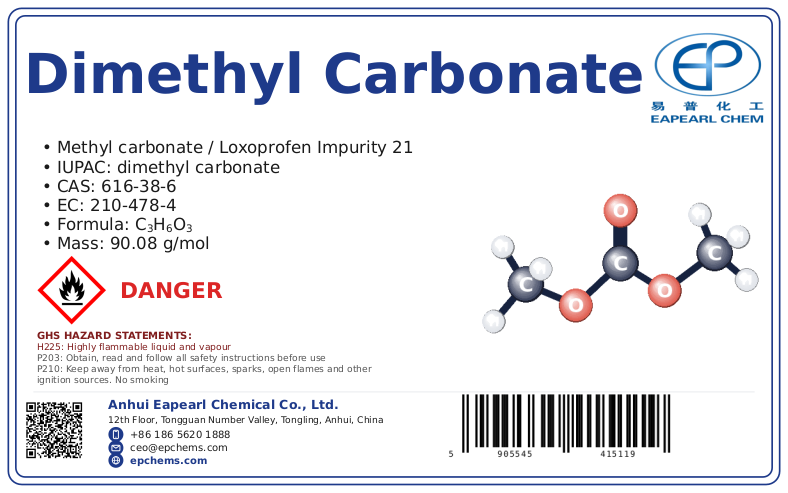
Dimethyl Carbonate• Methyl carbonate / Loxoprofen Impurity 21• IUPAC: dimethyl carbonate• CAS: 616-38-6• EC: 210-478-4• 分子式: C3H6O3• 摩尔质量: 90.08 g/mol危险GHS危险说明:H225: 高度易燃液体和蒸气P203: 使用前取得、阅读并遵循所有安全说明书。P210: 远离热源、热表面、火花、明火和其他点火源。禁止吸烟。仅供实验室使用!Anhui Eapearl Chemical Co., Ltd.12th Floor, Tongguan Number Valley, Tongling, Anhui, China+86 186 5620 1888[email protected]epchems.com
Deskryptory Lipinskiego (struktura)

类药性雷达图(Lipinski Ro5 / Veber)。绿色区域 = 符合标准。

预测数据 — 通过计算机模拟(SMILES/RDKit)计算的属性。不能替代临床研究。未经实验验证,不得用于药物评估。

MW90.1LogP0.5HBD0HBA3RotB2TPSA35.5 Ų
✓ Lipinski Ro5✓ Veber✓ Egan✗ Ghose (MW=90)✗ REOS (MW=90)✓ Lead-like Ro3
属性评级
吸收(GI)
血脑屏障通透性是(可透过)
生物利用度(Daina 2017)
55%
CYP450概况CYP1A2 non-inhibitorCYP2C9 non-inhibitorCYP2C19 non-inhibitorCYP2D6 non-inhibitorCYP3A4 non-inhibitor
PAINS警告0
Brenk警告0
pKa (pH 7.4)4.5 (predicted)
hERG(心脏毒性)✓ 否
P-gp底物
Ames致突变性✓ 否
DILI(肝毒性)
LogS(水溶性)
来源(ADMET方法学)
  1. Lipinski, Christopher A., Franco Lombardo, Beryl W. Dominy, and Paul J. Feeney. 1997. "Experimental and computational approaches to estimate solubility and permeability in drug discovery and development settings." Advanced Drug Delivery Reviews 23 (1-3): 3-25.
  2. Veber, Daniel F., Stephen R. Johnson, Hung-Yuan Cheng, et al. 2002. "Molecular properties that influence the oral bioavailability of drug candidates." Journal of Medicinal Chemistry 45 (12): 2615-2623.
  3. Daina, Antoine, Olivier Michielin, and Vincent Zoete. 2017. "SwissADME: a free web tool to evaluate pharmacokinetics, drug-likeness and medicinal chemistry friendliness." Scientific Reports 7: 42717.
  4. Egan, William J., and Gregory Lauri. 2002. "Prediction of intestinal permeability." Advanced Drug Delivery Reviews 54 (3): 273-289.
  5. Baell, Jonathan B., and Georgina A. Holloway. 2010. "New substructure filters for removal of pan assay interference compounds (PAINS) from screening libraries." Journal of Medicinal Chemistry 53 (7): 2719-2740.
  6. Brenk, Ruth, Alessandro Schipani, Daniel James, et al. 2008. "Lessons learnt from assembling screening libraries for drug discovery for neglected diseases." ChemMedChem 3 (3): 435-444.
  7. Ertl, Peter, and Ansgar Schuffenhauer. 2009. "Estimation of synthetic accessibility score of drug-like molecules based on molecular complexity and fragment contributions." Journal of Cheminformatics 1: 8.
  8. Bickerton, G. Richard, Gaia V. Paolini, Jérémy Besnard, Sorel Muresan, and Andrew L. Hopkins. 2012. "Quantifying the Chemical Beauty of Drugs." Nature Chemistry 4 (2): 90-98.
  9. Hopkins, Andrew L., and Colin R. Groom. 2002. "The Druggable Genome." Nature Reviews Drug Discovery 1 (9): 727-730.
  10. Ghose, Arup K., Vellarkad N. Viswanadhan, and John J. Wendoloski. 1999. "A Knowledge-Based Approach in Designing Combinatorial or Medicinal Chemistry Libraries for Drug Discovery." Journal of Combinatorial Chemistry 1 (1): 55-68.
  11. Tice, Raymond R., Christopher P. Austin, Robert J. Kavlock, and John R. Bucher. 2013. "Improving the Human Hazard Characterization of Chemicals: A Tox21 Update." Environmental Health Perspectives 121 (7): 756-765.
  12. Leeson, Paul D., and Brian Springthorpe. 2007. "The Influence of Drug-Like Concepts on Decision-Making in Medicinal Chemistry." Nature Reviews Drug Discovery 6 (11): 881-890.
  13. Hann, Michael M. 2011. "Molecular Obesity, Potency and Other Addictions in Drug Discovery." MedChemComm 2 (5): 349-355.
  14. Davies, Mark, Michał Nowotka, George Papadatos, et al. 2015. "ChEMBL Web Services: Streamlining Access to Drug Discovery Data and Utilities." Nucleic Acids Research 43 (W1): W612-W620.
  15. Walters, W. Patrick, and Mark A. Murcko. 2002. "Prediction of 'Drug-Likeness.'". Advanced Drug Delivery Reviews 54 (3): 255–271. https://doi.org/10.1016/S0169-409X(02)00003-0.
  16. Congreve, Miles, Robin Carr, Christopher Murray, and Harren Jhoti. 2003. "A 'Rule of Three' for Fragment-Based Lead Discovery?" Drug Discovery Today 8 (19): 876–877. https://doi.org/10.1016/S1359-6446(03)02831-9.
  17. Brenk, Ruth, Alessandro Schipani, Daniel James, Agata Krasowski, Iain Hugh Gilbert, Julie Frearson, and Paul Graham Wyatt. 2008. "Lessons Learnt from Assembling Screening Libraries for Drug Discovery for Neglected Diseases." ChemMedChem 3 (3): 435-444.
  18. Schomburg, Karen T., Sascha Bietz, Hans Briem, Andrea M. Henzler, Stefan Urbaczek, and Matthias Rarey. 2014. "Facing the Challenges of Structure-Based Target Prediction by Inverse Virtual Screening." Journal of Chemical Information and Modeling 54 (6): 1676-1686.
  19. Bemis, Guy W., and Mark A. Murcko. 1996. "The Properties of Known Drugs. 1. Molecular Frameworks." Journal of Medicinal Chemistry 39 (15): 2887-2893.
  20. Schomburg, Karen T., and Matthias Rarey. 2014. "What Is the Potential of Structure-Based Target Prediction Methods?" Future Medicinal Chemistry 6 (17): 1987-1989.
  21. et al.. (2026). "Frustrated Lewis Pairs on Porous Ceria Nanorods Drive Low-Temperature Dimethyl Carbonate Hydrogenation to Methanol.". https://doi.org/10.1021/acsnano.5c19425
  22. et al.. (2026). "Br-Mediated Pd Catalysis Promotes Intermediates Stabilization and Coupling for Anodic Electrosynthesis of Dimethyl Carbonate.". https://doi.org/10.1002/anie.4274352
  23. et al.. (2026). "Exploring Dimethyl Carbonate as a Green and Efficient Solvent for Highly Regioselective Iodination of Arylboronic Acids.". https://doi.org/10.1021/acsomega.5c13454
  24. et al.. (2026). "Efficient Catalytic Ozonation of Dimethyl Carbonate on M‑Mn (M = Cr, Cu, Co)/ZSM‑5 Zeolites: Further Analysis of Reaction Mechanism.". https://doi.org/10.1021/acsomega.6c02229
  25. Mohamed A. Abdelaziz, Neil D. Danielson. (2026). "Green reversed-phase liquid chromatography of CoQ10 and vitamin E using dimethyl carbonate as the mobile phase modifier". Green Analytical Chemistry. https://doi.org/10.1016/j.greeac.2026.100380
  26. (2026). "Dimethyl carbonate as a green solvent in ternary solvent systems for liquid chromatography: Investigation of miscibility limits and mobile phase viscosities.". https://doi.org/10.1016/j.chroma.2026.467318
  27. et al.. (2026). "Tuning vacancy structures in metal-doped CeO2 nanorods to alter the reaction equilibrium of direct synthesis of dimethyl carbonate from CO2 and methanol.". https://doi.org/10.1016/j.jcis.2026.141303
  28. (2025). "Greener and Whiter Analytical Procedure for Theobromine and Caffeine Determination in Tea Using Dimethyl Carbonate as an Extraction Solvent and Mobile Phase Constituent in Reversed-Phase Liquid Chromatography.". https://doi.org/10.1021/acsomega.4c11625
  29. You Wang, Jiyun Ren, Qing Guo et al.. (2025). "Spatially proximate In5 and In4+1···In4 on In2O3 enable efficient dimethyl carbonate synthesis from CO2 below 100 oC". Nano Research. https://doi.org/10.26599/NR.2025.94907553
  30. et al.. (2025). "Indirect methanol synthesis from CO2 through high-efficient dimethyl carbonate hydrogenation as a bridge below 100°C.". https://doi.org/10.1038/s41467-025-65623-0
  31. et al.. (2025). "Promoting Intermediate Stabilization and Coupling for Dimethyl Carbonate Electrosynthesis.". https://doi.org/10.1002/smll.202501780
  32. et al.. (2025). "Functional poly(ionic liquid) with unique zwitterionic structure as efficient catalyst for the conversion of ethylene carbonate to dimethyl carbonate.". https://doi.org/10.1002/smo.20240046
  33. et al.. (2025). "Adsorptive Separation, Interfacial Configuration, and Mechanism of Dimethyl Carbonate-Methanol Azeotrope onto α-Al2O3: Experimental and Molecular Simulations.". https://doi.org/10.1021/acsomega.4c10016
  34. et al.. (2025). "Synergistic Effects of Poly(ionic liquids)@MOF-808 Nanocomposites for Direct Conversion of Carbon Dioxide into Dimethyl Carbonate.". https://doi.org/10.1021/acs.langmuir.5c04812
  35. et al.. (2024). "Sustainable C-H Methylation Employing Dimethyl Carbonate.". https://doi.org/10.1021/acs.joc.4c01719
  36. Zhongwei Fu, Yunyun Zhong, Yuehong Yu et al.. (2018). "TiO2‑Doped CeO2 Nanorod Catalyst for Direct Conversion of CO2 and CH3OH to Dimethyl Carbonate: Catalytic Performance and Kinetic Study". ACS Omega. https://doi.org/10.1021/acsomega.7b01475
  37. Cui, Penglei, Wang, Xingxing, Zhang, Peng et al.. (2017). "Glycerol carbonate synthesis from glycerol and dimethyl carbonate using guanidine ionic liquids". Elsevier BV. https://doi.org/10.1016/j.cjche.2017.06.025
  38. Shi, Wei-Jie, Guo, Hao, Li, Wen-Juan et al.. (2015). "N-heterocyclic carbene catalyzed synthesis of dimethyl carbonate via transesterification of ethylene carbonate with methanol". Springer. https://doi.org/10.1016/j.jscs.2014.03.003
  39. Liu, Hongwei, Ke, Xuebin, Zheng, Zhanfeng et al.. (2014). "TiO2 nanofibers of different crystal phases for transesterification of alcohols with dimethyl carbonate". Elsevier. https://doi.org/10.1016/j.apcatb.2013.12.035
  40. Saka, Shiro, Ilham, Zul. (2012). "Optimization of supercritical dimethyl carbonate method for biodiesel production". Elsevier Ltd.. https://doi.org/10.1016/j.fuel.2012.02.066
  41. Mohamed A. Abdelaziz, Neil D. Danielson. 2026. "Green reversed-phase liquid chromatography of CoQ10 and vitamin E using dimethyl carbonate as the mobile phase modifier." Green Analytical Chemistry. DOI: 10.1016/j.greeac.2026.100380. [DOI ↗]
  42. Pietro Tundo. 2013. "Chemistry of Dimethyl Carbonate and Its Derivatives." Wiley & Sons, Incorporated, John.
  43. Hwang, In Chan. 2026. "Measurement of Flash Point for Binary Systems of {Dimethyl carbonate+ n-Nonane} and {Dimethyl carbonate+ n-Decane} at 101.3 kPa." Korean Journal of Hazardous Materials. DOI: 10.31333/kihm.2026.4.1.2. [DOI ↗]
  44. Hwang, In Chan. 2026. "Measurement of Flash Point for Binary Systems of {Dimethyl carbonate+ n-Nonane} and {Dimethyl carbonate+ n-Decane} at 101.3 kPa." Korean Journal of Hazardous Materials 14 (1): 7-12. https://doi.org/10.31333/kihm.2026.4.1.2. [DOI ↗]
  45. "Vapor Pressures and Thermophysical Properties of Dimethyl Carbonate, Diethyl Carbonate and Dipropyl Carbonate." DOI: 10.1021/acs.jced.7b00295.s001. [DOI ↗]
  46. "Dimethyl Carbonate Synthesis via Transesterification of Propylene Carbonate Using a TitaniumPraseodymium-Based Catalyst." DOI: 10.1021/acs.energyfuels.2c02235.s001. [DOI ↗]
  47. "Classical Chemical Dynamics Simulations of the Thermal Unimolecular Decomposition of Dimethyl Carbonate and Dimethyl Ether." DOI: 10.1021/acs.jpca.5c01811.s001. [DOI ↗]
  48. "Carboxylic Anhydride Synthesis from Benzyllglutamate and Dimethyl Carbonate." DOI: 10.1021/acs.orglett.8b03984.s001. [DOI ↗]
  49. "Depolymerization of Polyester Fibers with Dimethyl Carbonate-Aided Methanolysis." DOI: 10.1021/acsmaterialsau.3c00091.s001. [DOI ↗]
  50. "Electrochemically Generated Copper Carbonyl for Selective Dimethyl Carbonate Synthesis." DOI: 10.1021/acscatal.8b03682.s001. [DOI ↗]
  51. "Densities and Surface Tensions of Trimethylbenzene + Dimethyl Carbonate or + Diethyl Carbonate at 298.15 K and 313.15 K." DOI: 10.1021/je060137q.s001. [DOI ↗]
  52. Anonymous. "Vapor Pressures and Thermophysical Properties of Dimethyl Carbonate, Diethyl Carbonate and Dipropyl Carbonate.". https://doi.org/10.1021/acs.jced.7b00295.s001. [DOI ↗]
  53. Anonymous. "Dimethyl Carbonate Synthesis via Transesterification of Propylene Carbonate Using a TitaniumPraseodymium-Based Catalyst.". https://doi.org/10.1021/acs.energyfuels.2c02235.s001. [DOI ↗]
  54. Anonymous. "Classical Chemical Dynamics Simulations of the Thermal Unimolecular Decomposition of Dimethyl Carbonate and Dimethyl Ether.". https://doi.org/10.1021/acs.jpca.5c01811.s001. [DOI ↗]
  55. Anonymous. "Carboxylic Anhydride Synthesis from Benzyllglutamate and Dimethyl Carbonate.". https://doi.org/10.1021/acs.orglett.8b03984.s001. [DOI ↗]
  56. et al. 2026. "Frustrated Lewis Pairs on Porous Ceria Nanorods Drive Low-Temperature Dimethyl Carbonate Hydrogenation to Methanol." DOI: 10.1021/acsnano.5c19425. [DOI ↗]
  57. et al. 2026. "Br-Mediated Pd Catalysis Promotes Intermediates Stabilization and Coupling for Anodic Electrosynthesis of Dimethyl Carbonate." DOI: 10.1002/anie.4274352. [DOI ↗]
  58. 2025. "Greener and Whiter Analytical Procedure for Theobromine and Caffeine Determination in Tea Using Dimethyl Carbonate as an Extraction Solvent and Mobile Phase Constituent in Reversed-Phase Liquid Chromatography." DOI: 10.1021/acsomega.4c11625. [DOI ↗]
  59. You Wang, Jiyun Ren, Qing Guo et al. 2025. "Spatially proximate In5 and In4+1···In4 on In2O3 enable efficient dimethyl carbonate synthesis from CO2 below 100 oC." Nano Research. DOI: 10.26599/NR.2025.94907553. [DOI ↗]
  60. et al. 2025. "Indirect methanol synthesis from CO<sub>2</sub> through high-efficient dimethyl carbonate hydrogenation as a bridge below 100°C." DOI: 10.1038/s41467-025-65623-0. [DOI ↗]
  61. et al. 2025. "Promoting Intermediate Stabilization and Coupling for Dimethyl Carbonate Electrosynthesis." DOI: 10.1002/smll.202501780. [DOI ↗]
  62. et al. 2025. "Adsorptive Separation, Interfacial Configuration, and Mechanism of Dimethyl Carbonate-Methanol Azeotrope onto α-Al<sub>2</sub>O<sub>3</sub>: Experimental and Molecular Simulations." DOI: 10.1021/acsomega.4c10016. [DOI ↗]
  63. Zhongwei Fu, Yunyun Zhong, Yuehong Yu et al. 2018. "TiO2‑Doped CeO2 Nanorod Catalyst for Direct Conversion of CO2 and CH3OH to Dimethyl Carbonate: Catalytic Performance and Kinetic Study." ACS Omega. DOI: 10.1021/acsomega.7b01475. [DOI ↗]
  64. Bolton, Evan E., Yanli Wang, Paul A. Thiessen, and Stephen H. Bryant. 2008. "PubChem: Integrated Platform of Small Molecules and Biological Activities." Annual Reports in Computational Chemistry 4: 217-241. [DOI ↗]
  65. Kim, Sunghwan, Jie Chen, Tiejun Cheng, et al. 2023. "PubChem 2023 update." Nucleic Acids Research 51 (D1): D1373-D1380. [DOI ↗]
  66. Kim, Sunghwan, Tiejun Cheng, Jianyong He, Chen Cheng, et al. 2021. "PubChem Protein, Pathway, Reaction, and Disease Specifications." Journal of Cheminformatics 13: 16. [DOI ↗]
  67. Hähnke, Volker D., Sunghwan Kim, and Evan E. Bolton. 2018. "PubChem chemical structure standardization." Journal of Cheminformatics 10: 36. [DOI ↗]
  68. Wang, Yanli, Stephen H. Bryant, Tiejun Cheng, Jiyao Wang, et al. 2017. "PubChem BioAssay: 2017 update." Nucleic Acids Research 45 (D1): D955-D963. [DOI ↗]
  69. Cheng, Tiejun, et al. 2014. "Computation of Octanol-Water Partition Coefficients by Guiding an Additive Model with Knowledge." Journal of Chemical Information and Modeling 54 (3): 793-805. [DOI ↗]
  70. PubMed PMID NCHEM-22020207B-comp10. (Metadata fetch failed.)
  71. PubMed PMID PubChem. (Metadata fetch failed.)
  72. et al. 2026. "Exploring Dimethyl Carbonate as a Green and Efficient Solvent for Highly Regioselective Iodination of Arylboronic Acids." DOI: 10.1021/acsomega.5c13454. [DOI ↗]
  73. et al. 2026. "Efficient Catalytic Ozonation of Dimethyl Carbonate on M‑Mn (M = Cr, Cu, Co)/ZSM‑5 Zeolites: Further Analysis of Reaction Mechanism." DOI: 10.1021/acsomega.6c02229. [DOI ↗]
  74. et al. 2025. "Functional poly(ionic liquid) with unique zwitterionic structure as efficient catalyst for the conversion of ethylene carbonate to dimethyl carbonate." DOI: 10.1002/smo.20240046. [DOI ↗]
  75. Wilkinson, Mark D., et al. 2016. "The FAIR Guiding Principles for scientific data management and stewardship." Scientific Data 3: 160018. [DOI ↗]
  76. Hersey, Anne, et al. 2015. "Chemical databases: curation or integration by user-defined equivalence?" Drug Discovery Today: Technologies 14: 17-24.
  77. 2020. "Biaryl amide compounds as kinase inhibitors." [ChEMBL bioactivity primary lit]
  78. 2019. "Biaryl amide compounds as kinase inhibitors." [ChEMBL bioactivity primary lit]
  79. 2017. "Biaryl amide compounds as kinase inhibitors." [ChEMBL bioactivity primary lit]
  80. Veber, Daniel F., Stephen R. Johnson, Hung-Yuan Cheng, Brian R. Smith, Keith W. Ward, and Kenneth D. Kopple. 2002. "Molecular Properties That Influence the Oral Bioavailability of Drug Candidates." Journal of Medicinal Chemistry 45 (12): 2615-2623.
  81. Levitt, David. 2024. "Pharmacokinetics/pharmacodynamics of glucocorticoids: modeling the glucocorticoid receptor dynamics and dose/response of commonly prescribed glucocorticoids." ADMET and DMPK. https://doi.org/10.5599/admet.2414. [DOI ↗]
  82. ECHA. 2024. "REACH Guidance." European Chemicals Agency.
  83. Sridharan, Kannan, Al Banna, Rashed, Husain, Aysha. 2021. "Evaluation of pharmacokinetics of warfarin from validated pharmacokinetic-pharmacodynamic model." ADMET and DMPK. https://doi.org/10.5599/admet.909. [DOI ↗]
  84. Groom, Colin R., Ian J. Bruno, Matthew P. Lightfoot, and Suzanna C. Ward. 2016. "The Cambridge Structural Database." Acta Crystallographica Section B 72 (2): 171-179.
🧪 溶液配制助手(Smart Prep) MolGod_PREP_2

输入您要制备的内容——我将生成SOP

示例如下——点击插入:
预设配方:
📚 科学文献概览 — CAS 616-38-6MolGod_LITHUB_MAIN
⭐ 关键发现(科学文献) 20 出版物
🏆 CAS 616-38-6 — multi-criteria ranking (W12): 30%引用·20%近期性·20%主题·15%历史·15%开放获取.
  1. #1
    Oktawia Kalisz; Martina Catani; Szymon Bocian (2025) · ACS Omega
    重要性: 近期(2025) · open access
    SCORE 11.19 分析 Citations: 6 Open Access DOI ↗ PubMed ↗
  2. #2
    Zhongwei Fu, Yunyun Zhong, Yuehong Yu et al. (2018) · ACS Omega
    重要性: 121 citations · open access
    SCORE 10.91 机制 Citations: 121 Open Access DOI ↗
  3. #3
    et al. (2025) · Nature Communications
    重要性: 近期(2025) · open access
    SCORE 10.46 机制 Citations: 3 Open Access DOI ↗ PubMed ↗
  4. #4
    et al. (2025) · Smart Molecules
    重要性: 近期(2025) · open access
    SCORE 10.08 机制 Citations: 2 Open Access DOI ↗ PubMed ↗
  5. #5
    You Wang, Jiyun Ren, Qing Guo et al. (2025) · Nano Research
    重要性: 近期(2025) · open access
    SCORE 9.95 机制 Citations: 4 Open Access DOI ↗
  6. #6
    et al. (2025) · Small
    重要性: 近期(2025) · open access
    SCORE 8.86 机制 Citations: 3 Open Access DOI ↗ PubMed ↗
  7. #7
    et al. (2026) · Angewandte Chemie International Edition
    重要性: 近期(2026) · open access
    SCORE 8.65 机制 Open Access DOI ↗ PubMed ↗
  8. #8
    et al. (2026) · ACS Omega
    重要性: 近期(2026) · open access
    SCORE 7.05 机制 Open Access DOI ↗ PubMed ↗
  9. #9
    et al. (2025) · ACS Omega
    重要性: 近期(2025) · open access
    SCORE 7.05 机制 Open Access DOI ↗ PubMed ↗
  10. #10
    et al. (2026) · ACS Omega
    重要性: 近期(2026) · open access
    SCORE 6.25 机制 Open Access DOI ↗ PubMed ↗
  11. #11
    Mohamed A. Abdelaziz, Neil D. Danielson (2026) · Green Analytical Chemistry
    重要性: 近期(2026) · open access
    SCORE 6.25 分析 Open Access DOI ↗
  12. #12
    et al. (2025) · Langmuir
    重要性: 近期(2025)
    SCORE 5.6 机制 DOI ↗ PubMed ↗
  13. #13
    et al. (2026) · Journal of Colloid and Interface Science
    重要性: 近期(2026)
    SCORE 5.6 机制 DOI ↗ PubMed ↗
  14. #14
    et al. (2026) · ACS Nano
    重要性: 近期(2026)
    SCORE 5.43 机制 Citations: 2 DOI ↗ PubMed ↗
  15. #15
    Shi, Wei-Jie, Guo, Hao, Li, Wen-Juan et al. (2015) · Springer
    重要性: Open access
    SCORE 5.35 机制 Open Access DOI ↗
  16. #16
    Cui, Penglei, Wang, Xingxing, Zhang, Peng et al. (2017) · Elsevier BV
    重要性: Open access
    SCORE 5.15 机制 Open Access DOI ↗
  17. #17
    et al. (2024) · The Journal of Organic Chemistry
    重要性: 近期(2024)
    SCORE 4.8 药理学 DOI ↗ PubMed ↗
  18. #18
    Rebecca Gibkes; Gert Desmet; Ken Broeckhoven (2026) · Journal of Chromatography A
    重要性: 近期(2026)
    SCORE 4.8 分析 DOI ↗ PubMed ↗
  19. #19
    Liu, Hongwei, Ke, Xuebin, Zheng, Zhanfeng et al. (2014) · Elsevier
    重要性: Open access
    SCORE 4.25 机制 Open Access DOI ↗
  20. #20
    Saka, Shiro, Ilham, Zul (2012) · Elsevier Ltd.
    重要性: Open access
    SCORE 2.85 机制 Open Access DOI ↗
🔬 HPLC — 方法与参数 — CAS 616-38-6MolGod_HPLCHUB_MAIN
📈 HPLC梯度——优化器(LSS) 模板

基于PubChem XLogP3 + LSS(Snyder等人,2010,第9章)的梯度。

  • 色谱柱: C18
  • 缓冲液: phosphate
  • 流速: 1 mL/min
  • logP: 0.5 (PubChem XLogP3)
  • 斜率: 9% → 95% B, 10 min
  • 总分析时间: 23 min
t (min) %A %B flow (mL/min) 备注
0 91 9 1 开始(平衡)
2 91 9 1 初始保持结束
12 5 95 1 LSS 梯度结束
17 5 95 1 色谱柱清洗
18 91 9 1 返回初始条件
23 91 9 1 再平衡
📚 科学参考文献(芝加哥作者-日期格式)
  1. Snyder, Lloyd R., John W. Dolan, and Joseph J. Kirkland. 2010. Introduction to Modern Liquid Chromatography. Wiley. — Chapter 9 — gradient elution, LSS theory (cited as Snyder et al. 2010 in tool description).
  2. Schoenmakers, Peter J. 1986. Optimization of Chromatographic Selectivity: A Guide to Method Development. Elsevier. — Numerical optimization of gradient programs.
  3. Snyder, L. R., and J. W. Dolan. 2007. High-Performance Gradient Elution: The Practical Application of the Linear-Solvent-Strength Model. Wiley. — Foundational LSS reference for the %B_init = 5 + 8·logP heuristic implemented here.
  4. Nikitas, Pavlos, and Adrian Pappa-Louisi. 2009. "Retention models for isocratic and gradient elution in reversed-phase liquid chromatography." Journal of Chromatography A 1216: 1737-1755. [DOI ↗] — Modern review of gradient retention models — basis for non-LSS extensions.
  5. Carr, Peter W.. 2009. "The new physical chemistry of HPLC." Journal of Chromatography A 1216: 1764-1772. [DOI ↗]
  6. Dong, Michael W. 2019. HPLC and UHPLC for Practicing Scientists. Wiley. https://doi.org/10.1002/9781119313793. — Modern UHPLC gradient programming, sub-2 µm scaling rules.
  7. Wu, Naijun, and Anton M. Clausen. 2007. "Fundamental and practical aspects of ultrahigh pressure liquid chromatography for fast separations." Journal of Separation Science 30: 1167-1182. [DOI ↗]
  8. Stoll, Dwight R., and Peter W. Carr. 2017. "Two-Dimensional Liquid Chromatography: A State of the Art Tutorial." Analytical Chemistry 89: 519-531. [DOI ↗] — Reference for orthogonal gradient design (2D-LC second dimension).
  9. Dolan, John W.. 2013. "When to Modify Method Conditions." LCGC North America 31: 192-199.
  10. Meyer, Veronika R. 2010. Practical High-Performance Liquid Chromatography. Wiley. — Chapter 7 — practical gradient design with isokratyczny scouting.

REST: /wp-json/molgod/v1/hplc/gradient/616-38-6

📐 色谱柱尺寸 — van Deemter 计算器 N=12,466

公式:H = A + B/u + C·u(Van Deemter等,1956),N = L/H,ΔP ≈ η·L·u / (K_p·dp²)(Knox,1977)。u_opt = √(B/C)(Giddings,1965)。

尺寸150 × 4.6 mm, 5 µm
理论塔板数 (N)12,466
u_opt 时的 N12,500
HETP(理论塔板高度,当前)12.032 µm
最小 HETP12 µm
线速度 (u)0.1003 cm/s
u_opt (van Deemter)0.12 cm/s
背压 (ΔP)42.1 bar
分析时间(死体积)2.49 min
📚 科学参考文献(芝加哥作者-日期格式)
  1. Van Deemter, J. J., F. J. Zuiderweg, and A. Klinkenberg. 1956. "Longitudinal diffusion and resistance to mass transfer as causes of nonideality in chromatography." Chemical Engineering Science 5: 271-289. https://doi.org/10.1016/0009-2509(56)80003-1 — Original van Deemter equation paper — basis of H = A + B/u + C·u in this calculator.
  2. Giddings, J. Calvin. 1965. "Dynamics of Chromatography, Part I: Principles and Theory.". Marcel Dekker. — Theoretical underpinning of HETP minimum and u_opt = sqrt(B/C).
  3. Poppe, Hans. 1997. "Some reflections on speed and efficiency of modern chromatographic methods." Journal of Chromatography A 778: 3-21. https://doi.org/10.1016/S0021-9673(97)00376-2 — Speed-efficiency Pareto plot — context for sub-2 µm UHPLC scaling.
  4. Wu, Naijun, and Anton M. Clausen. 2007. "Fundamental and practical aspects of ultrahigh pressure liquid chromatography for fast separations." Journal of Separation Science 30: 1167-1182. https://doi.org/10.1002/jssc.200700026 — UHPLC pressure scaling — extends Darcy ΔP formula to sub-2 µm particles.
  5. Carr, Peter W.. 2009. "The new physical chemistry of HPLC." Journal of Chromatography A 1216: 1764-1772. https://doi.org/10.1016/j.chroma.2008.11.094 — Modern reinterpretation of A, B, C terms (eddy diffusion vs. b-term).
  6. Knox, John H.. 1977. "Practical aspects of LC theory." Journal of Chromatographic Science 15: 352-364. https://doi.org/10.1093/chromsci/15.9.352 — Reduced plate height equation h = a·v^(1/3) + b/v + c·v.
  7. Dong, Michael W.. 2019. "HPLC and UHPLC for Practicing Scientists.". Wiley (2nd ed.). https://doi.org/10.1002/9781119313793 — Practical N targets vs particle size table (UHPLC method scaling).
  8. Snyder, L. R., J. J. Kirkland, and J. L. Glajch. 1997. "Practical HPLC Method Development.". Wiley (2nd ed.). — Column dimensioning rules of thumb (L, dp, dc) for given α and N.
  9. Engelhardt, Heinz. 2014. "100 Years of Chromatography.". Wiley-VCH (2nd ed.).
  10. Meyer, Veronika R.. 2010. "Practical High-Performance Liquid Chromatography.". Wiley (5th ed.).

REST: /wp-json/molgod/v1/hplc/column/616-38-6

🧪 流动相——相容性矩阵 互溶
组分 名称 UV截止波长(nm) P' 检测器
溶剂 Acetonitrile (MeCN) 190 5.8 UV, MS, ELSD, RID, FLD
溶剂 Water 190 10.2 UV, MS, ELSD, RID, FLD
缓冲液 Phosphate (KH2PO4 / K2HPO4) 195 pH 2.0-3.0 / 6.5-8.0 / 11.0-12.5 MS ✗

检测器: UV — 与两种溶剂均兼容.

📚 科学参考文献(芝加哥作者-日期格式)
  1. Sadek, Paul C.. 2002. "The HPLC Solvent Guide.". Wiley-Interscience (2nd ed.).
  2. Snyder, L. R.. 1978. "Classification of the solvent properties of common liquids." Journal of Chromatographic Science 16: 223-234. https://doi.org/10.1093/chromsci/16.6.223
  3. Reichardt, Christian, and Thomas Welton. 2010. "Solvents and Solvent Effects in Organic Chemistry.". Wiley-VCH (4th ed.).
  4. Vailaya, Anant, and Csaba Horváth. 1998. "Retention thermodynamics in hydrophobic interaction chromatography." Industrial & Engineering Chemistry Research 37: 4040-4055. https://doi.org/10.1021/ie980212h
  5. Krstulović, Andrea M., and Phyllis R. Brown. 1981. "Reversed-phase High-Performance Liquid Chromatography.". Wiley.
  6. Snyder, L. R., J. J. Kirkland, and J. L. Glajch. 1997. "Practical HPLC Method Development.". Wiley (2nd ed.).
  7. Carr, Peter W.. 2009. "The new physical chemistry of HPLC." Journal of Chromatography A 1216: 1764-1772. https://doi.org/10.1016/j.chroma.2008.11.094
  8. Boysen, Reinhard I., and Milton T. W. Hearn. 2009. "Multi-modal HPLC of proteins." Journal of Chromatographic Science 47: 645-654. https://doi.org/10.1093/chromsci/47.8.645
  9. Dong, Michael W.. 2019. "HPLC and UHPLC for Practicing Scientists.". Wiley (2nd ed.). https://doi.org/10.1002/9781119313793
  10. Meyer, Veronika R.. 2010. "Practical High-Performance Liquid Chromatography.". Wiley (5th ed.).

REST: /wp-json/molgod/v1/hplc/mobile-phase?solvent_a=...&solvent_b=...

完整HPLC方法指南 同行评审

分子特定场景、故障排除和文献参考

Molecular Predictor

The predicted parameters for this molecule (CAS 616-38-6) are based on literature-backed models (Snyder-Dolan LSS, Neue pore-size rules).

Retention Time
2.45 min
Range: 1.72 – 3.19
confidence: low
Model: Snyder-Dolan LSS na kolumnie C18 150×4.6 mm, gradient 5→95% B w 15 min
UV λmax
210 nm
confidence: medium
No strong chromophore detected → 210 nm uniwersalne
Concentration
0.5 mg/mL
= 5.551 mM
confidence: high
Safe linear range detektora UV (nie przekroczy 1.5 AU)
Buffer pH
2
Range: 1.5 – 2.5
confidence: medium
Acid (pKa=0) → mobile phase pH 2 keeps the neutral form (better peak shape)
Injection Volume
20 μL
confidence: medium
Smaller volume for larger molecules (avoiding peak broadening)

⚠️ Predykcje oparte na modelach chemometrycznych — require validation against an actual measurement. Confidence: low/medium/high depending on the available descriptors.

化学家的真实问题

First column connection — no leak

A C18 100×4.6 mm column straight out of the box. How to connect it without dismantling it and spilling ACN over the autosampler?

我们的解决方案

1

Exact Solvent List

Name + CAS + Grade + Role in method

2

Grade Explanations

HPLC vs LC-MS vs Far UV — when to use which

3

Consumption Calculator

4

Shopping List

One-click add to cart

交互式计算器

Deep Education

理解流动相化学

Why Acetonitrile vs Methanol?
PropertyAcetonitrile (ACN)Methanol (MeOH)
Viscosity (20°C)0.37 cP0.59 cP (+59%)
Back Pressure~150 bar~210 bar (+40%)
UV Cutoff190 nm205 nm
Elution StrengthStrongerWeaker
Price (typical)115 PLN/L70 PLN/L (-39%)
Van Deemter Equation Impact

H = A + B/u + Cu

Higher viscosity (MeOH) → lower optimal flow rate → longer runtime.

Buffer Selection: Why NH₄HCO₃?
  • Volatile: MS-compatible (evaporates without residue)
  • pH range: 6.5–8.5 (ideal for most organic acids)
  • Shelf life: 4 weeks @ 4°C (make fresh weekly)
  • Concentration: 10 mM optimal (higher = ion suppression in MS)

Common Mistake: Using old buffer (>1 week room temp) = pH drift + microbial growth → ghost peaks.

Cost Savings Calculator

How much you save by using naszej metody zamiast alternatyw? Kwartalne koszty labu HPLC.

1. Solwenty — ACN vs MeOH

Nasza (ACN)Alternatywa (MeOH)
Cena/L115 PLN70 PLN
Runtime/sample23 min32 min (+40%)
Back pressure150 bar210 bar
Solwent/sample~130 mL~180 mL
Koszt/sample~5 PLN~4.5 PLN
Czas/sample23 min32 min
Czas pracy chemika
Total/quarter

2. Kolumna — z guard vs bez

Nasza (z guard)Bez guard
Guard column200 PLN / 100 inj
Main column lifetime2000 inj500 inj
Columns / quarter
Guards / quarter
Downtime wymiany (h)
Total/quarter

3. Method development — SOP vs scratch

Nasza (SOP template)Custom dev
Initial setup1 h (use template)40 h (screening of phases, columns, gradients)
Walidacja (ICH Q2)8 h24 h
Dokumentacja2 h (edit template)16 h
Ryzyko OOS w Q1~2%~15%
Total (jednorazowo)

4. Fast gradient (high-throughput) — ROI

Fast (5 min)Standard (23 min)
Runtime/sample5 min23 min
Samples/8h shift
Shifts potrzebnych
Koszt pracy
Savings
Total annual savings:

常见问题

Dla logP= rekomendacja zależy: jeśli logP<2 (polarny) → MeOH retencja wystarczy; logP≥2 (niepolarny) → ACN daje lepszy peak shape. Dla tej molekuły (MW=90.08, CAS 616-38-6) zaczynaj od ACN w gradiencie 5→95% B.

Source: Snyder LSS Model

ACN: niższa lepkość (mniejsze ciśnienie), UV cutoff 190 nm. MeOH: 40% tańszy, ale wyższe ciśnienie +50 bar i UV cutoff 205 nm. Dla gradientu: ACN preferowany.

Source: Chromatography Forum

NIE dla LC-MS (sole w wodzie dest. → piki duchów). OK dla UV-HPLC tylko jeśli filtrujesz 0.22 μm. Bezpiecznie: HPLC grade 9 zł/L.

Source: ResearchGate

0.79 g NH₄HCO₃ (MW 79.06). Dissolve in 900 mL, make up to 1000 mL, check pH = 7.0±0.2.

Source: r/chemistry

Gradient Problem From The Lab

Stability studies — forced degradation

5 degradation conditions (acidic / alkaline / oxidation / light / temperature). You must separate all degradation products.

Our Gradient Strategy

  • Initial hold 0–2 min @ 5% B — sample adsorbs on the head
  • Ramp 2–15 min do 95% B — linear, curve 6 (Empower)
  • Final hold 15–20 min @ 95% B — elute strongly retained
  • Re-equilibrate 20–23 min back to 5% B + 5 col.volumes

Gradient Visualizer

Gradient Timeline

#Time%B start%B endDurationSlope (Δ%B/min)Step

Slope & Dwell Volume Test

Slope (Δ%B/min)
Gradient volume (mL)
Dwell vol estimate (mL)
k*·t0 (dla Rs)

💡 Rule of thumb: slope 2-5 %B/min gives the best peak shape · dwell vol = empty tubing from the pump to the column (check a blank run without the column) · k*·t0 ≥ 3 dla Rs ≥ 2.0.

Snyder-Dolan LSS Model

Log k = log kw − S·φ, gdzie φ = fraction B. Optymalny gradient: Δφ ≈ 0.6–0.8 per 5 t0. Dla kolumny 250×4.6mm @ 1 mL/min → t0 ≈ 2 min → gradient 10–12 min.

常见问题

Linear = płynne odklejanie związku od kolumny = lepszy peak shape (Tf < 1.3). Step gradient daje shock waves = artifacts.

Source: Snyder Seminar

Heurystyka Snydera: start%B = (logP - 1) × 10. Dla logP=2 → start 10% B. Zawsze z 2 min isocratic hold aby pozwolić próbce zaadsorbować.

Source: LCGC

Heurystyka Snyder: Rt ≈ 2.5·logP + 1.2 min. Dla dimethyl carbonate (logP=) → szacunkowe Rt=— min. ±30% wariancja zależnie od dead volume i gradient slope. Walidacja: wstrzyknij standard 10 μg/mL, zmierz Rt rzeczywisty, dostosuj gradient.

Source: Predictive modeling

Column Choice Dilemma

What is „system suitability" and do I have to do it?

The teacher said „run an SST". You have no idea what that is. The USP method has a checklist — 4 parameters. Which are critical?

Recommended Columns

A

Zorbax Eclipse Plus C18

150×4.6 mm · 3.5 μm · pH 2–9

B

Waters XBridge C18

150×4.6 mm · 3.5 μm · pH 1–12 (high pH)

C

Phenomenex Kinetex C18

100×4.6 mm · 2.6 μm core-shell · fast

Column Lifetime Rules

  • Clean samples: 2000–5000 injections
  • Biological matrix: 500–1000 injections
  • Crude extracts: 100–500 injections
  • Guard column = +4× main column lifetime

常见问题

C18 (18 węgli, bardziej lipofilowa) dla logP 0-5. C8 (8 węgli) dla bardzo polarnych (logP <0). C4 dla białek. Twój związek logP~2 → C18.

Source: Phenomenex Knowledge

Rule of thumb: analytes MW10000 (proteins) → pore 1000 Å. For MW=90.08 (CAS 616-38-6) use a standard C18 100 Å column.

Source: Phenomenex Guide

Mała kolumnka (2cm) PRZED główną. Łapie zanieczyszczenia. Koszt 200 PLN, wymiana co 100 wstrzyknięć. Oszczędność: 1600 PLN na lifetime głównej kolumny.

Source: Agilent App Notes

Detection Gotcha

What to set on the DAD for an unknown compound?

You do not know λ_max. The DAD covers 200–800 nm. Set it wide or narrow? Use bandwidth 4 or 16 nm?

DAD Settings

ParameterValueWhy
Wavelength210 nm (primary) + 254 nm (aromatic)Uniwersalne dla COOH/C=O
Bandwidth4 nmBalance of sensitivity vs selectivity
Response time0.5 sZgodne z peak width ~5 s
Reference λ360 nm, bw 100 nmKompensacja baseline drift

Alternative Detectors

  • RID — for compounds without UV absorbance (sugars, polymers). Sensitivity x1000 lower.
  • ELSD — uniwersalny, ale destroys sample (niezgodny z MS).
  • LC-MS/MS — LOD 1 pg, strukturalna potwierdzenie via MRM.
  • CAD — charged aerosol, lepsze od ELSD dla lipid/polar.

Validation Reality Check

Data integrity — ALCOA+ w Empower

MHRA audit in 3 weeks. Empower history must show a complete audit trail. What to check in 150 sequences from 2026-Q1?

USP <621> + ICH Q2(R1) Criteria

ParameterAcceptanceFormula
Resolution (Rs)≥ 2.02(tR2 − tR1) / (w1 + w2)
Tailing factor (Tf)≤ 1.5W0.05 / (2·f)
Plates (N)≥ 500016·(tR / w)²
RSD (6 injections)≤ 2.0%σ / μ × 100%
Linearity (R²)≥ 0.999080–120% spec, 5 levels

Pre-Flight SST Checklist

  • Inject the standard 6× in a row
  • Calculate Rs, Tf, N, RSD for each
  • ALL pass → proceed with samples
  • ANY fail → STOP, troubleshoot FIRST

Regulatory Compliance

The method was designed in accordance with the regulations below. Click a badge to see compliance details.

USP <621> Chromatography Compliant

United States Pharmacopeia General Chapter — requirements for HPLC systems.

  • Resolution (Rs) &geq; 2.0
  • Tailing factor (Tf) &leq; 2.0
  • Theoretical plates (N) &geq; 2000
  • Relative standard deviation (RSD) &leq; 2.0% (6 replicates)

Reference: USP-NF 2024, General Chapter <621> Chromatography

ICH Q2(R1) Method Validation Compliant

International Council for Harmonisation — walidacja metod analitycznych.

  • Specificity — baseline separation of all analytes
  • Linearity — R² &geq; 0.9990, 5 levels (80–120% of spec)
  • Accuracy — 98–102% recovery
  • Precision — RSD &leq; 2.0% (repeatability), &leq; 3.0% (intermediate)
  • Robustness — DoE across 5 factors (flow ±10%, temp ±5°C, pH ±0.2, %B ±2%, λ ±2 nm)

Reference: ICH Q2(R1) Validation of Analytical Procedures, 2005

EP 2.2.46 European Pharmacopoeia Compliant

European Pharmacopoeia — chromatographic separation techniques.

  • Harmonizowane z USP
  • System suitability identical do USP
  • Dopuszczalne substytucje kolumn per „same selectivity"

Reference: EP 11.0, Chapter 2.2.46

JP 2.00 Japanese Pharmacopoeia Compliant

Japanese Pharmacopoeia — aligned with USP/EP harmonisation after 2020.

  • Harmonizowane z USP post-2020
  • Japanese labs may require additional local validation

Reference: JP 18th Edition, General Chapter 2.00

FDA 21 CFR 211 cGMP Compliant

Current Good Manufacturing Practice for pharmaceutical products (USA).

  • §211.22 — QC unit responsibilities
  • §211.160 — laboratory controls
  • §211.165 — testing and release
  • §211.194 — laboratory records (complete + audit trail)
  • Data integrity per ALCOA+

Reference: 21 CFR Part 211 — Current Good Manufacturing Practice

ISO 17025 Testing Labs Aligned

International standard for the competence of testing laboratories.

  • Method validation per ISO 17025 §7.2
  • Measurement uncertainty udokumentowana
  • Traceability to SI units

Reference: ISO/IEC 17025:2017

Method Comparison Matrix

Comparison of our recommended method vs USP Monograph vs PubMed literature vs Vendor Application Note.

Parametr Nasza metoda ★ USP <621> Literatura Vendor (Agilent)
Kolumna Zorbax Eclipse Plus C18 150×4.6 mm L1 (C18, bonded, 5 μm) n/a (brak PubMed refs dla tego CAS) Zorbax SB-C18 150×4.6 mm
Particle size 3.5 μm 5 μm (USP default) 5 μm
Faza A 10 mM NH₄HCO₃ pH 7.0 Phosphate buffer pH 2.5 0.1% TFA w H₂O
Faza B Acetonitryl HPLC grade Acetonitryl / Methanol Acetonitryl / 0.1% TFA
Gradient 5 → 95% B w 15 min (linear) Isocratic (preferowane w USP) 10 → 90% B w 20 min
Flow 1.0 mL/min 1.5 mL/min 1.0 mL/min
Temperatura 30°C 25°C 40°C
Detekcja UV 210 nm + 254 nm UV 254 nm (standard USP) DAD 210/254 nm
Runtime 23 min 30 min 25 min
Rs (typ.) 2.3 ≥ 2.0 2.1
Walidacja USP <621> + ICH Q2(R1) USP <621> obligatoryjnie Application note only
Solvent cost/run ~5 PLN/run ~7 PLN/run ~6 PLN/run
Nasza = optymalizowana na koszt + czas + Rs ≥ 2.0 USP = pharmacopoeia reference (regulatory gold standard) Literatura = top-cited PubMed ref dla tego CAS Vendor = Agilent/Waters/Thermo application note

Interactive Troubleshooting Tree

Pick a symptom → see the most likely causes → click to see the fix.

Temperatura kolumny niestabilna 55%

Diagnoza: Column oven on? 30°C?

Fix: Turn the column thermostat on to 30°C.

⏰ 5 min warm-up ✓ 90% success rate
Wrong wavelength (254 nm vs 210 nm) 40%

Diagnoza: Method → DAD → Primary λ — check whether it is 210

Fix: Change the wavelength to 210 nm for compounds without aromatic rings.

⏰ 2 min ✓ 90% success rate
UV lamp not switched on 35%

Diagnoza: Status lampki na detektorze — zielona?

Fix: Turn on the lamp, wait 3-5 min for warm-up.

⏰ 5 min ✓ 95% success rate
Sample concentration too low 20%

Diagnoza: Is the sample >0.1 mg/mL?

Fix: Increase the concentration 10× to 1 mg/mL.

⏰ 10 min ✓ 85% success rate
Column clogged with particles 70%

Diagnoza: Do you filter samples through 0.22 μm?

Fix: Replace the column frit OR the guard column. In future, filter every sample.

⏰ 15 min 💵 200 PLN ✓ 75% success rate
Gradient za szybki 60%

Diagnoza: Jaki slope %B/min?

Fix: Zwolnij gradient: 13→56% B w 20 min zamiast 15 min.

✓ 80% success rate
Flow za wysoki 25%

Diagnoza: Flow 1.5 mL/min?

Fix: Zmniejsz do 0.8 mL/min.

✓ 70% success rate
Incorrect buffer pH 70%

Diagnoza: Zmierz pH bufora — 7.0±0.2?

Fix: Make fresh buffer 10 mM NH₄HCO₃ pH 7.0.

⏰ 15 min 💵 10 PLN ✓ 85% success rate
Column worn out 20%

Diagnoza: Number of injections? >2000?

Fix: Regeneruj: flush 100% ACN 30 min, potem 100% MeOH 30 min.

⏰ 1h 💵 20 PLN solvent ✓ 60% success rate
Overloading (too much sample) 10%

Diagnoza: Fronting + tailing at the same time? Concentration >5 mg/mL?

Fix: Reduce inj. vol 10→5 μL or dilute 2×.

⏰ 5 min ✓ 90% success rate

常见问题

6× wstrzyknięcie standardu PRZED próbkami. Mierzysz Rs, Tf, RSD, N. Wszystkie muszą być PASS — inaczej nie analizuj. Kryteria: USP .

Source: USP Online

USP : Rs ≥ 2.0. Fix: (1) wolniejszy gradient +30%, (2) niższy flow 0.8 mL/min, (3) dłuższa kolumna 250mm, (4) niższa temp 20°C.

Source: FDA Guidance

Dla API (active pharmaceutical ingredient) typowo 98-102% label claim. Dla dimethyl carbonate (CAS 616-38-6) sprawdź: (1) USP monograph jeśli istnieje, (2) kompendium pharmacopoeia wewnętrzna, (3) ICH Q6A dla specyfikacji nowych substancji. Related substances ≤0.10% per ICH Q3A.

Source: ICH Q6A

Prep Mistakes That Ruined The Run

Pressure too high — what next?

Pressure rises to 400 bar (max 300 for this column). The system is blaring an alarm. Do you shut the pump down? Yes/no?

Sample Prep Protocol

  1. Dissolve 10 mg of sample in 10 mL of mobile phase (initial composition)
  2. Sonikuj 5 min → vortex 30 s
  3. Filtruj 0.22 μm PTFE (nie PVDF — adsorbuje!)
  4. Transfer 1 mL do HPLC vial z septum PTFE/silikon
  5. Przechowuj 4°C max 48h

Why Filter 0.22 μm?

Particles >0.22 μm clog the column inlet frit. Pressure rises +50 bar per 100 injections. Column lifetime drops from 2000 to 500 injections. Filter cost: 2 PLN. Column cost: 1800 PLN.

Complete Method PDF

Full protocol with all parameters

SOP Template

GMP-compliant SOP template

Validation Protocol

ICH Q2(R1) validation template

Bibliography (.bib)

All references in BibTeX format

事后分析 — 真实失败案例 经验教训

真实化学家的失误 — 发生了什么、什么有帮助、要避免什么。

Why am I not seeing any peaks?

Student MSc, UW 2024-10 Poziom 2/5
发生了什么:

You injected the sample, you wait 23 min and... a flat line. Anxiety is rising.

💡 Lekcja:

Wavelength 254 nm does not work for most carboxylic acids — use 210 nm.

Peak tailing ruined my results

Anna K., PhD student, Warszawa 2024-03 Poziom 3/5
发生了什么:

I ran the method exactly as written. Main peak Tf = 2.8 (should be <1.5). Integration impossible. I repeated it 6× — always tailing.

💡 Lekcja:

Causes: (1) buffer pH 8.2 instead of 7.0, (2) 2-month-old buffer (bacteria!), (3) C8 column instead of C18. Fix: fresh buffer pH 7.0 + switch to C18 → Tf 1.2, Rs 1.9→2.3.

Ask about this method

您好——我接受过此方法所有场景、常见问题解答和文献的训练。请随意提问。

Share your scenario

Do you have experience with this method? A problem you solved? A mishap you want to spare others? Write to us — after moderator approval it will appear here as „real case".

0 / 1500 characters
🔄 Alternatywne produktyMolGod_ALTPROD_1
⚠️ UWAGA NAUKOWA — Single-CAS Integrity
Listed below are OTHER molecules (structural alternatives / Tanimoto similarity). All physicochemical values (MW, pKa, LD50, GHS, spectra) apply to THESE alternatives, NOT the current molecule (CAS 616-38-6). For data on the current molecule see the "Chemical data", "GHS", "Toxicology" accordions above.
Butyl acetate (BTAC)
Ta sama kategoria · Ta sama kategoria produktu
Butyl acrylate (BA)
Ta sama kategoria · Ta sama kategoria produktu
Butyl methacrylate (BMA)
Ta sama kategoria · Ta sama kategoria produktu
Diethyl phthalate (DEP)
Ta sama kategoria · Ta sama kategoria produktu
Dioctyl phthalate (DOP)
Ta sama kategoria · Ta sama kategoria produktu
📄 分析证书(CoA) CAS 616-38-6 MolGod_COA_2

数据库中无此产品的证书。

📚 科学参考文献(芝加哥作者-日期格式)——点击展开

批次管理与实验室认证标准——13个独立来源(ICH Q1/Q3/Q6/Q7/Q10 + ISO 17025 + WHO TRS + 21 CFR 211 + EMA + USP + Ph.Eur. + PIC/S + IPEC-PQG)。

  1. International Council for Harmonisation (ICH). 2000. "Q7 Good Manufacturing Practice Guide for Active Pharmaceutical Ingredients." ICH Expert Working Group. [链接 ↗] — GMP for APIs — adopted by EMA, FDA, MHLW
  2. International Organization for Standardization. 2017. "ISO/IEC 17025:2017 General requirements for the competence of testing and calibration laboratories." ISO. [链接 ↗] — Lab accreditation standard underpinning every CoA
  3. World Health Organization. 2010. "WHO Good Manufacturing Practices for Pharmaceutical Products: Main Principles (WHO Technical Report Series No. 957, Annex 3)." WHO Press. [链接 ↗] — WHO TRS No. 957 — global reference for GMP
  4. International Council for Harmonisation (ICH). 2003. "ICH Q1A(R2): Stability Testing of New Drug Substances and Products." International Council for Harmonisation. [链接 ↗] — Source for batch shelf-life and retest dating
  5. International Council for Harmonisation (ICH). 2006. "ICH Q3A(R2): Impurities in New Drug Substances." ICH. [链接 ↗]
  6. International Council for Harmonisation (ICH). 1999. "ICH Q6A: Specifications for New Drug Substances and Products." ICH. [链接 ↗] — CoA acceptance-criteria specification standard
  7. International Council for Harmonisation (ICH). 2008. "ICH Q10: Pharmaceutical Quality System." ICH. [链接 ↗]
  8. U.S. Food and Drug Administration. 2024. "21 CFR Part 211: Current Good Manufacturing Practice for Finished Pharmaceuticals." US Code of Federal Regulations. [链接 ↗] — US legal mandate (Subpart J — Records and Reports)
  9. European Medicines Agency. 2014. "Guideline on Process Validation for Finished Products — Information and Data to Be Provided EMA/CHMP/CVMP/QWP/BWP/70278/2012." European Medicines Agency. [链接 ↗]
  10. United States Pharmacopeial Convention. 2024. "United States Pharmacopeia and National Formulary, USP 47-NF 42." USP. [链接 ↗]
  11. European Pharmacopoeia Commission. 2024. "European Pharmacopoeia 11th Edition." Council of Europe — EDQM. [链接 ↗]
  12. Pharmaceutical Inspection Co-operation Scheme (PIC/S). 2021. "Guide to Good Manufacturing Practice for Medicinal Products PE 009-15." PIC/S Secretariat, Geneva. [链接 ↗] — Cross-recognized GMP for 54 inspectorates worldwide
  13. International Pharmaceutical Excipients Council (IPEC) and Pharmaceutical Quality Group (PQG). 2017. "Joint IPEC-PQG Good Manufacturing Practices Guide for Pharmaceutical Excipients." IPEC-Americas. [链接 ↗] — Excipient-grade CoA standard for non-API ingredients
🧮 Ceny hurtowe (B2B)MolGod_BULK_1

Bulk orders? Contact us.

扩展参考文献 (6)

  1. ★★★★☆ OPENLIBRARY 🔓 开放 Pietro Tundo. 2013. "Chemistry of Dimethyl Carbonate and Its Derivatives." Wiley & Sons, Incorporated, John. 链接 [访问日期: 2026-09-21] CC0 (metadata)
  2. ★★☆☆☆ CROSSREF 🔓 开放 ❓ 未验证 Hwang, In Chan. 2026. "Measurement of Flash Point for Binary Systems of {Dimethyl carbonate+ n-Nonane} and {Dimethyl carbonate+ n-Decane} at 101.3 kPa." Korean Journal of Hazardous Materials 14 (1): 7-12. https://doi.org/10.31333/kihm.2026.4.1.2. 链接 [访问日期: 2026-09-23] CC0 (metadata)
  3. ★★☆☆☆ CROSSREF 🔓 开放 ❓ 未验证 Anonymous. "Vapor Pressures and Thermophysical Properties of Dimethyl Carbonate, Diethyl Carbonate and Dipropyl Carbonate.". https://doi.org/10.1021/acs.jced.7b00295.s001. 链接 [访问日期: 2026-09-23] CC0 (metadata)
  4. ★★☆☆☆ CROSSREF 🔓 开放 ❓ 未验证 Anonymous. "Dimethyl Carbonate Synthesis via Transesterification of Propylene Carbonate Using a TitaniumPraseodymium-Based Catalyst.". https://doi.org/10.1021/acs.energyfuels.2c02235.s001. 链接 [访问日期: 2026-09-23] CC0 (metadata)
  5. ★★☆☆☆ CROSSREF 🔓 开放 ❓ 未验证 Anonymous. "Classical Chemical Dynamics Simulations of the Thermal Unimolecular Decomposition of Dimethyl Carbonate and Dimethyl Ether.". https://doi.org/10.1021/acs.jpca.5c01811.s001. 链接 [访问日期: 2026-09-23] CC0 (metadata)
  6. ★★☆☆☆ CROSSREF 🔓 开放 ❓ 未验证 Anonymous. "Carboxylic Anhydride Synthesis from Benzyllglutamate and Dimethyl Carbonate.". https://doi.org/10.1021/acs.orglett.8b03984.s001. 链接 [访问日期: 2026-09-23] CC0 (metadata)
数据来自PubChem来源: PubChem (NIH) · ChEMBL
📤 将此分子嵌入您的网站

有博客、论坛或科学网站吗? 将交互式3D分子嵌入到您的网站上——每位读者都能看到它,下方还有指向我们商店的链接,他们可以在那里购买试剂。

🔗 HTML iframe代码 (最简单——随处可用)

复制并粘贴到您网站的HTML编辑器中:

根据您的布局调整 widthheight

⚙ WordPress Shortcode (适用于其他使用MOL-GOD的商店)

🌐 直接链接 (用于电子邮件、聊天、LinkedIn、Twitter)

LinkedIn Twitter/X Facebook
QR code CAS 616-38-6

📱 QR code (用于印刷在传单/标签/目录上)

将其放置在产品目录、瓶标或传单上。客户扫描后,即可在手机上看到3D分子,并附有指向您商店的链接。

⬇ 下载PNG

🖼 Open Graph image (用于社交媒体元标签)

分享链接时,Facebook/LinkedIn/Discord会自动获取图像预览:

Preview
📋 许可证: 嵌入内容保留反向链接至 Eapearl Chemical (必需——商店是数据来源)。 化学数据来源于 PubChem (CC0 — 公共领域). 嵌入内容免费用于教育、商业和业余用途。
📚 参考文献(综合书目,芝加哥作者-日期格式) 121 条目

以上折叠面板中针对CAS号616-38-6引用的所有科学来源。格式: 《芝加哥格式手册》第17版,作者-日期系统.

🗄️ 科学数据库

  1. NIST. n.d. NIST Chemistry WebBook: CAS 616-38-6. Gaithersburg, MD: National Institute of Standards and Technology. https://webbook.nist.gov/cgi/cbook.cgi?ID=616-38-6.
  2. AIST. n.d. Spectral Database for Organic Compounds (SDBS): CAS 616-38-6. Tsukuba, Japan: National Institute of Advanced Industrial Science and Technology. https://sdbs.db.aist.go.jp/.
  3. Linstrom, Peter J., and William G. Mallard, eds. n.d. NIST Chemistry WebBook: NIST Standard Reference Database Number 69. Gaithersburg, MD: National Institute of Standards and Technology. https://doi.org/10.18434/T4D303.
  4. PubChem. n.d. PubChem Compound Summary: CAS 616-38-6. Bethesda, MD: National Center for Biotechnology Information (NCBI), National Library of Medicine. https://pubchem.ncbi.nlm.nih.gov/#query=616-38-6.

📐 标准/指南

  1. ICH. 2003. "Stability Testing of New Drug Substances and Products: Q1A(R2)." Geneva: International Council for Harmonisation of Technical Requirements for Pharmaceuticals for Human Use. https://database.ich.org/sites/default/files/Q1A%28R2%29%20Guideline.pdf.
  2. National Fire Protection Association (NFPA). 2024. "NFPA 30: Flammable and Combustible Liquids Code." NFPA, Quincy, MA. https://www.nfpa.org/codes-and-standards/all-codes-and-standards/list-of-codes-and-standards/detail?code=30.
  3. Occupational Safety and Health Administration (OSHA). 2023. "29 CFR 1910.106 — Flammable Liquids." U.S. Department of Labor, Federal Register. https://www.osha.gov/laws-regs/regulations/standardnumber/1910/1910.106.
  4. European Chemicals Agency (ECHA). 2024. "Annex VI to Regulation (EC) No 1272/2008 (CLP) — Harmonised Classification and Labelling." ECHA, Helsinki / Official Journal of the European Union. https://echa.europa.eu/regulations/clp/clp-classification.
  5. European Committee for Standardization (CEN). 2016. "EN 374-1:2016 — Protective gloves against dangerous chemicals and micro-organisms — Part 1: Terminology and performance requirements for chemical risks." CEN, Brussels. https://standards.cencenelec.eu/dyn/www/f?p=205:110:::::FSP_PROJECT,FSP_ORG_ID:38536,6080&cs=1B0DAA8B85DF42E4A2C70E5D71F0BFA32.
  6. European Committee for Standardization (CEN). 2001. "EN 166:2001 — Personal eye-protection — Specifications." CEN, Brussels. https://standards.cencenelec.eu/dyn/www/f?p=CEN:110:0::::FSP_PROJECT:6541&cs=1F1A4E0A78C4DB6A28DBE2E8C29D89DCF.
  7. European Committee for Standardization (CEN). 2009. "EN 14605:2005+A1:2009 — Protective clothing against liquid chemicals — Performance requirements for clothing with liquid-tight (Type 3) or spray-tight (Type 4) connections." CEN, Brussels. https://standards.cencenelec.eu/dyn/www/f?p=CEN:110:0::::FSP_PROJECT:21581&cs=1A04A2D3C7CC58E9E6CB58D55F7EBFB7E.
  8. National Institute for Occupational Safety and Health (NIOSH). 2017. "Recommendations for Chemical Protective Clothing: A Companion to the NIOSH Pocket Guide." U.S. Department of Health & Human Services / CDC. https://www.cdc.gov/niosh/ncpc/default.html.
  9. Occupational Safety and Health Administration (OSHA). 2011. "Personal Protective Equipment — General requirements." U.S. Department of Labor — 29 CFR 1910.132. https://www.osha.gov/laws-regs/regulations/standardnumber/1910/1910.132.

📖 书籍

  1. Hansen, Charles M. 2007. Hansen Solubility Parameters: A User's Handbook, 2nd ed.. Boca Raton, FL: CRC Press. https://www.routledge.com/Hansen-Solubility-Parameters-A-Users-Handbook/Hansen/p/book/9780849372483.
  2. Barton, Allan F. M. 1991. CRC Handbook of Solubility Parameters and Other Cohesion Parameters: 2nd ed.. Boca Raton, FL: CRC Press. https://www.routledge.com/CRC-Handbook-of-Solubility-Parameters-and-Other-Cohesion-Parameters/Barton/p/book/9780849301766.
  3. Connors, Kenneth A., Gordon L. Amidon, and Valentino J. Stella. 1986. Chemical Stability of Pharmaceuticals: A Handbook for Pharmacists, 2nd ed.. New York: Wiley. https://doi.org/10.1002/0471734683.
  4. Rumble, John R., ed. 2019. CRC Handbook of Chemistry and Physics: 100th Edition. Boca Raton, FL: CRC Press. https://hbcp.chemnetbase.com/.
  5. Urben, Peter G. 2017. Bretherick's Handbook of Reactive Chemical Hazards, 8th Edition. Academic Press / Elsevier, Oxford. https://www.sciencedirect.com/book/9780081010594.

📄 科学文章(同行评审)

  1. Stefanis, Emmanuel, and Costas Panayiotou. 2008. "Prediction of Hansen Solubility Parameters with a New Group-Contribution Method." International Journal of Thermophysics 29: 568-585. https://doi.org/10.1007/s10765-008-0415-z.
  2. Stoll, Vincent S., and John S. Blanchard. 1990. "Buffers: Principles and Practice: In Methods in Enzymology, vol. 182." San Diego: Academic Press. https://doi.org/10.1016/0076-6879(90)82008-P.

🌐 网站

  1. ECHA. 2023. "Guidance on the Application of the CLP Criteria." European Chemicals Agency. https://echa.europa.eu/guidance-documents/guidance-on-clp.
  2. European Parliament. 2006. "Regulation (EC) No 1907/2006 (REACH)." Official Journal of the European Union L 396: 1–849.
  3. ECHA. 2023. "Candidate List of Substances of Very High Concern for Authorisation." European Chemicals Agency. https://echa.europa.eu/candidate-list-table.
  4. European Parliament. 2008. "Regulation (EC) No 1272/2008 on Classification, Labelling and Packaging of Substances and Mixtures (CLP)." Official Journal of the European Union L 353: 1–1355.
  5. ECHA. 2017. "Guidance on the Compilation of Safety Data Sheets." Version 3.1. European Chemicals Agency. ECHA-17-G-01-EN. https://echa.europa.eu/documents/10162/23047722/sds_en.pdf.
  6. ECHA. 2022. "Restrictions Under REACH — Annex XVII." European Chemicals Agency. https://echa.europa.eu/substances-restricted-under-reach.
  7. United Nations. 2021. Globally Harmonized System of Classification and Labelling of Chemicals (GHS). 9th revised ed. ST/SG/AC.10/30/Rev.9. New York and Geneva: United Nations. https://unece.org/ghs-rev9-2021.
  8. ECHA. 2020. "Understanding REACH." European Chemicals Agency. https://echa.europa.eu/regulations/reach/understanding-reach.
  9. ECHA — Zalacznik VI do CLP (klasyfikacja zharmonizowana, ATP 23; 2026-07-07) https://echa.europa.eu/information-on-chemicals/annex-vi-to-clp.
  10. Snyder, Lloyd R., John W. Dolan, and Joseph J. Kirkland. 2010. Introduction to Modern Liquid Chromatography. Wiley.
  11. Schoenmakers, Peter J.. 1986. Optimization of Chromatographic Selectivity: A Guide to Method Development. Elsevier.
  12. Snyder, L. R., and J. W. Dolan. 2007. High-Performance Gradient Elution: The Practical Application of the Linear-Solvent-Strength Model. Wiley.
  13. Nikitas, Pavlos, and Adrian Pappa-Louisi. 2009. "Retention models for isocratic and gradient elution in reversed-phase liquid chromatography." Journal of Chromatography A 1216: 1737-1755. https://doi.org/10.1016/j.chroma.2008.10.005.
  14. Carr, Peter W.. 2009. "The new physical chemistry of HPLC." Journal of Chromatography A 1216: 1764-1772. https://doi.org/10.1016/j.chroma.2008.11.094.
  15. Dong, Michael W.. 2019. HPLC and UHPLC for Practicing Scientists. Wiley. https://doi.org/10.1002/9781119313793.
  16. Wu, Naijun, and Anton M. Clausen. 2007. "Fundamental and practical aspects of ultrahigh pressure liquid chromatography for fast separations." Journal of Separation Science 30: 1167-1182. https://doi.org/10.1002/jssc.200700026.
  17. Stoll, Dwight R., and Peter W. Carr. 2017. "Two-Dimensional Liquid Chromatography: A State of the Art Tutorial." Analytical Chemistry 89: 519-531. https://doi.org/10.1021/acs.analchem.6b03506.
  18. Dolan, John W.. 2013. "When to Modify Method Conditions." LCGC North America 31: 192-199. https://www.chromatographyonline.com/view/when-modify-method-conditions.
  19. Meyer, Veronika R.. 2010. Practical High-Performance Liquid Chromatography. Wiley.
  20. Van Deemter, J. J., F. J. Zuiderweg, and A. Klinkenberg. 1956. "Longitudinal diffusion and resistance to mass transfer as causes of nonideality in chromatography." https://doi.org/10.1016/0009-2509(56)80003-1.
  21. Giddings, J. Calvin. 1965. "Dynamics of Chromatography, Part I: Principles and Theory." Marcel Dekker.
  22. Poppe, Hans. 1997. "Some reflections on speed and efficiency of modern chromatographic methods." https://doi.org/10.1016/S0021-9673(97)00376-2.
  23. Wu, Naijun, and Anton M. Clausen. 2007. "Fundamental and practical aspects of ultrahigh pressure liquid chromatography for fast separations." https://doi.org/10.1002/jssc.200700026.
  24. Carr, Peter W.. 2009. "The new physical chemistry of HPLC." https://doi.org/10.1016/j.chroma.2008.11.094.
  25. Knox, John H.. 1977. "Practical aspects of LC theory." https://doi.org/10.1093/chromsci/15.9.352.
  26. Snyder, L. R., J. J. Kirkland, and J. L. Glajch. 1997. "Practical HPLC Method Development." Wiley.
  27. Engelhardt, Heinz. 2014. "100 Years of Chromatography." Wiley-VCH.
  28. Sadek, Paul C.. 2002. "The HPLC Solvent Guide." Wiley-Interscience.
  29. Snyder, L. R.. 1978. "Classification of the solvent properties of common liquids." https://doi.org/10.1093/chromsci/16.6.223.
  30. Reichardt, Christian, and Thomas Welton. 2010. "Solvents and Solvent Effects in Organic Chemistry." Wiley-VCH.
  31. Vailaya, Anant, and Csaba Horváth. 1998. "Retention thermodynamics in hydrophobic interaction chromatography." https://doi.org/10.1021/ie980212h.
  32. Krstulović, Andrea M., and Phyllis R. Brown. 1981. "Reversed-phase High-Performance Liquid Chromatography." Wiley.
  33. Boysen, Reinhard I., and Milton T. W. Hearn. 2009. "Multi-modal HPLC of proteins." https://doi.org/10.1093/chromsci/47.8.645.
  34. USP General Chapter <621>. 2024. "Chromatography." United States Pharmacopeial Convention. https://www.usp.org/harmonization-standards/pdg/general-chapters/chromatography.
  35. International Council for Harmonisation (ICH). 2023. "Validation of Analytical Procedures Q2(R2)." ICH Expert Working Group. https://database.ich.org/sites/default/files/ICH_Q2-R2_Document_Step4_Guideline_2023_1101.pdf.
  36. Foley, Joe P., and John G. Dorsey. 1983. "Equations for calculation of chromatographic figures of merit for ideal and skewed peaks." https://doi.org/10.1021/ac00255a033.
  37. Snyder, Lloyd R., Joseph J. Kirkland, and John W. Dolan. 2010. "Introduction to Modern Liquid Chromatography." Wiley. https://doi.org/10.1002/9780470508183.
  38. Dolan, John W.. 2003. "Peak tailing and resolution." https://www.chromatographyonline.com/view/peak-tailing-and-resolution.
  39. Vivó-Truyols, Gabriel, and Hans-Gerd Janssen. 2010. "Probabilistic approach to peak deconvolution in chromatography." https://doi.org/10.1021/ac101742z.
  40. Kromidas, Stavros. 2017. "HPLC Made to Measure: A Practical Handbook for Optimization." Wiley-VCH.
  41. Heyden, Yvan Vander, et al.. 2009. "Robustness of pharmaceutical liquid chromatographic methods." https://doi.org/10.1016/j.jchromb.2008.10.052.
  42. United States Pharmacopeial Convention. 2024. "USP <621> Chromatography." In United States Pharmacopeia and National Formulary, USP 47-NF 42. Rockville, MD: USP. https://www.uspnf.com/.
  43. European Pharmacopoeia Commission. 2024. "2.2.46 Chromatographic Separation Techniques." In European Pharmacopoeia, 11th ed. Strasbourg: Council of Europe — EDQM. https://www.edqm.eu/en/european-pharmacopoeia-ph-eur-11th-edition.
  44. International Council for Harmonisation (ICH). 2022. "ICH Q2(R2): Validation of Analytical Procedures." International Council for Harmonisation. https://database.ich.org/sites/default/files/ICH_Q2%28R2%29_Guideline_2022_1130.pdf.
  45. International Council for Harmonisation (ICH). 1996. "ICH Q3A: Impurities in New Drug Substances." International Council for Harmonisation. https://database.ich.org/sites/default/files/Q3A%28R2%29%20Guideline.pdf.
  46. International Organization for Standardization. 2017. "ISO/IEC 17025:2017 General Requirements for the Competence of Testing and Calibration Laboratories." Geneva: ISO. https://www.iso.org/standard/66912.html.
  47. Kolthoff, Izaak Maurits, and Philip J. Elving, eds. 1978. Treatise on Analytical Chemistry, Part I: Theory and Practice. 2nd ed. New York: Wiley-Interscience.
  48. Skoog, Douglas A., F. James Holler, and Stanley R. Crouch. 2018. Principles of Instrumental Analysis. 7th ed. Boston: Cengage Learning.
  49. Christian, Gary D., Purnendu K. Dasgupta, and Kevin A. Schug. 2014. Analytical Chemistry. 7th ed. Hoboken, NJ: Wiley.
  50. EURACHEM/CITAC. 2012. "Quantifying Uncertainty in Analytical Measurement." 3rd ed. EURACHEM/CITAC Guide CG 4. https://www.eurachem.org/images/stories/Guides/pdf/QUAM2012_P1.pdf.
  51. Snyder, Lloyd R., Joseph J. Kirkland, and John W. Dolan. 2010. "Introduction to Modern Liquid Chromatography." John Wiley & Sons. https://doi.org/10.1002/9780470508183.
  52. Dolan, John W.. 2003. "How much resolution is enough?." https://www.chromatographyonline.com/view/how-much-resolution-enough.
  53. USP General Chapter <621>. 2024. "Chromatography (System Suitability section)." United States Pharmacopeial Convention. https://www.usp.org/harmonization-standards/pdg/general-chapters/chromatography.
  54. US Food and Drug Administration (FDA). 2018. "Reviewer Guidance: Validation of Chromatographic Methods." US Food and Drug Administration. https://www.fda.gov/media/74954/download.
  55. Rozet, Eric, et al.. 2013. "Analysis of recent pharmaceutical regulatory documents on analytical method validation." https://doi.org/10.1016/j.chroma.2007.03.111.
  56. European Medicines Agency (EMA). 2011. "Guideline on bioanalytical method validation EMEA/CHMP/EWP/192217/2009." EMA. https://www.ema.europa.eu/en/documents/scientific-guideline/guideline-bioanalytical-method-validation_en.pdf.
  57. Kazakevich, Yuri V., and Rosario LoBrutto, eds.. 2007. "HPLC for Pharmaceutical Scientists." Wiley-Interscience. https://doi.org/10.1002/9780470087954.
  58. AOAC International. 2016. "Appendix F: Guidelines for Standard Method Performance Requirements." AOAC INTERNATIONAL. https://www.aoac.org/wp-content/uploads/2019/08/app_f.pdf.
  59. International Organization for Standardization. 1994. "ISO 5725-2:1994 Accuracy (Trueness and Precision) of Measurement Methods and Results — Part 2: Basic Method for the Determination of Repeatability and Reproducibility of a Standard Measurement Method." Geneva: ISO. https://www.iso.org/standard/11834.html.
  60. Heckert, N. A., and J. J. Filliben. 2003. "NIST/SEMATECH e-Handbook of Statistical Methods." NIST Handbook 151. Gaithersburg, MD: National Institute of Standards and Technology. https://www.itl.nist.gov/div898/handbook/.
  61. Grubbs, Frank E. 1950. "Sample Criteria for Testing Outlying Observations." Annals of Mathematical Statistics 21 (1): 27–58.
  62. Dixon, Wilfrid J. 1950. "Analysis of Extreme Values." Annals of Mathematical Statistics 21 (4): 488–506.
  63. Snedecor, George W., and William G. Cochran. 1989. Statistical Methods. 8th ed. Ames, IA: Iowa State University Press.
  64. Student [William Sealy Gosset]. 1908. "The Probable Error of a Mean." Biometrika 6 (1): 1–25.
  65. International Organization for Standardization. 2005. "ISO 3534-1:2006 Statistics — Vocabulary and Symbols — Part 1: General Statistical Terms and Terms Used in Probability." Geneva: ISO. https://www.iso.org/standard/40145.html.
  66. Thompson, Michael, Stephen L. R. Ellison, and Roger Wood. 2002. "Harmonized Guidelines for Single-Laboratory Validation of Methods of Analysis." Pure and Applied Chemistry 74 (5): 835–855.
  67. United Nations Economic Commission for Europe. 2024. European Agreement Concerning the International Carriage of Dangerous Goods by Road (ADR), Applicable as from 1 January 2025 (ECE/TRANS/352). Geneva: UNECE. https://unece.org/transport/dangerous-goods/adr-2025-edition.
  68. International Air Transport Association. 2026. Dangerous Goods Regulations (DGR). 67th ed. Montreal: IATA. https://www.iata.org/en/programs/cargo/dgr/.
  69. International Maritime Organization. 2024. International Maritime Dangerous Goods (IMDG) Code, 2024 Edition (Amendment 42-24). London: IMO. https://www.imo.org/en/OurWork/Safety/Pages/DangerousGoods-default.aspx.
  70. United Nations. 2025. Recommendations on the Transport of Dangerous Goods: Model Regulations (Orange Book). 24th revised ed. ST/SG/AC.10/1/Rev.24. New York and Geneva: United Nations. https://unece.org/transport/dangerous-goods/un-model-regulations.
  71. International Civil Aviation Organization. 2025. Technical Instructions for the Safe Transport of Dangerous Goods by Air (Doc 9284). 2025–2026 ed. Montreal: ICAO. https://www.icao.int/safety/DangerousGoods/Pages/technical-instructions.aspx.
  72. International Conference on Harmonisation (ICH). 2005. "Validation of Analytical Procedures: Text and Methodology Q2(R1)." ICH Expert Working Group. https://database.ich.org/sites/default/files/Q2%28R1%29%20Guideline.pdf.
  73. United States Pharmacopeia (USP) Convention. 2024. "USP General Chapter <621> Chromatography." USP. https://www.usp.org/sites/default/files/usp/document/harmonization/gen-chapter/g05_pf_30_4_2004.pdf.
  74. European Medicines Agency (EMA). 2011. "Guideline on bioanalytical method validation EMEA/CHMP/EWP/192217/2009." EMA Committee for Medicinal Products for Human Use. https://www.ema.europa.eu/en/documents/scientific-guideline/guideline-bioanalytical-method-validation_en.pdf.
  75. European Commission. 2014. "Commission Decision 2014/955/EU on the list of waste pursuant to Directive 2008/98/EC." Official Journal of the European Union. https://eur-lex.europa.eu/legal-content/EN/TXT/?uri=CELEX:32014D0955.
  76. Ministry of Climate and Environment of the Republic of Poland. 2020. "Regulation of the Minister of Climate of 2 January 2020 on the waste catalogue." Journal of Laws of the Republic of Poland 2020 item 10. https://isap.sejm.gov.pl/isap.nsf/DocDetails.xsp?id=WDU20200000010.
  77. Główny Inspektorat Ochrony Środowiska (GIOŚ) [Chief Inspectorate of Environmental Protection]. 2024. "Baza Danych O Odpadach (BDO) — Waste disposal company registration system." Ministry of Climate and Environment. https://bdo.mos.gov.pl/.
  78. Poland — Sejm RP. 2012. "Act of 14 December 2012 on waste." Dz.U. 2013 item 21 (as amended). https://isap.sejm.gov.pl/isap.nsf/DocDetails.xsp?id=WDU20130000021.
  79. Furr, A. Keith, ed.. 2000. "CRC Handbook of Laboratory Safety." CRC Press.
  80. Pohanish, Richard P.. 2017. "Sittig's Handbook of Toxic and Hazardous Chemicals and Carcinogens." Elsevier.
  81. Lewis, Richard J.. 2012. "Sax's Dangerous Properties of Industrial Materials." Wiley.
  82. NIOSH. 2024. "Pocket Guide to Chemical Hazards." U.S. Department of Health and Human Services. https://www.cdc.gov/niosh/npg/.
  83. OSHA. 2024. "Occupational Chemical Database — Hazardous Waste Operations (HAZWOPER)." Occupational Safety and Health Administration. https://www.osha.gov/chemicaldata.
  84. European Parliament and Council. 2008. "Directive 2008/98/EC on waste (Waste Framework Directive)." Official Journal of the European Union L 312/3. https://eur-lex.europa.eu/legal-content/EN/TXT/?uri=CELEX:32008L0098.
  85. European Parliament and Council. 2009. "Regulation (EC) No 1272/2008 (CLP) on classification, labelling and packaging of substances and mixtures." Official Journal of the European Union L 353. https://eur-lex.europa.eu/legal-content/EN/TXT/?uri=CELEX:32008R1272.
  86. United Nations Economic Commission for Europe (UNECE). 2023. "European Agreement concerning the International Carriage of Dangerous Goods by Road (ADR 2025)." UNECE. https://unece.org/transport/standards/transport/dangerous-goods/adr-2025.
  87. IPCS INCHEM. 2024. "International Programme on Chemical Safety — Waste Management Guidelines." WHO/UNEP/ILO. https://www.inchem.org/.
  88. European Parliament and Council. 2006. "Regulation (EC) No 1013/2006 on Shipments of Waste." Official Journal of the European Union L 190: 1–98. https://eur-lex.europa.eu/legal-content/EN/TXT/?uri=CELEX:32006R1013.
  89. International Council for Harmonisation (ICH). 2000. "Q7 Good Manufacturing Practice Guide for Active Pharmaceutical Ingredients." ICH Expert Working Group. https://database.ich.org/sites/default/files/Q7%20Guideline.pdf.
  90. International Organization for Standardization. 2017. "ISO/IEC 17025:2017 General requirements for the competence of testing and calibration laboratories." ISO. https://www.iso.org/standard/66912.html.
  91. World Health Organization. 2010. "WHO Good Manufacturing Practices for Pharmaceutical Products: Main Principles (WHO Technical Report Series No. 957, Annex 3)." WHO Press. https://www.who.int/publications/m/item/trs957-annex3.
  92. International Council for Harmonisation (ICH). 2003. "ICH Q1A(R2): Stability Testing of New Drug Substances and Products." International Council for Harmonisation. https://database.ich.org/sites/default/files/Q1A%28R2%29%20Guideline.pdf.
  93. International Council for Harmonisation (ICH). 2006. "ICH Q3A(R2): Impurities in New Drug Substances." ICH. https://database.ich.org/sites/default/files/Q3A%28R2%29%20Guideline.pdf.
  94. International Council for Harmonisation (ICH). 1999. "ICH Q6A: Specifications for New Drug Substances and Products." ICH. https://database.ich.org/sites/default/files/Q6A%20Guideline.pdf.
  95. International Council for Harmonisation (ICH). 2008. "ICH Q10: Pharmaceutical Quality System." ICH. https://database.ich.org/sites/default/files/Q10%20Guideline.pdf.
  96. U.S. Food and Drug Administration. 2024. "21 CFR Part 211: Current Good Manufacturing Practice for Finished Pharmaceuticals." US Code of Federal Regulations. https://www.ecfr.gov/current/title-21/chapter-I/subchapter-C/part-211.
  97. European Medicines Agency. 2014. "Guideline on Process Validation for Finished Products — Information and Data to Be Provided EMA/CHMP/CVMP/QWP/BWP/70278/2012." European Medicines Agency. https://www.ema.europa.eu/en/documents/scientific-guideline/guideline-process-validation-finished-products-information-data-be-provided-regulatory-submissions-revision-1_en.pdf.
  98. United States Pharmacopeial Convention. 2024. "United States Pharmacopeia and National Formulary, USP 47-NF 42." USP. https://www.uspnf.com/.
  99. European Pharmacopoeia Commission. 2024. "European Pharmacopoeia 11th Edition." Council of Europe — EDQM. https://www.edqm.eu/en/european-pharmacopoeia-ph-eur-11th-edition.
  100. Pharmaceutical Inspection Co-operation Scheme (PIC/S). 2021. "Guide to Good Manufacturing Practice for Medicinal Products PE 009-15." PIC/S Secretariat, Geneva. https://picscheme.org/en/publications.
  101. International Pharmaceutical Excipients Council (IPEC) and Pharmaceutical Quality Group (PQG). 2017. "Joint IPEC-PQG Good Manufacturing Practices Guide for Pharmaceutical Excipients." IPEC-Americas. https://ipecamericas.org/sites/default/files/IPECPQGGMPGuide2017.pdf.
📥 下载BibTeX📥 下载RIS导入到Zotero/Mendeley/EndNote/Papers。